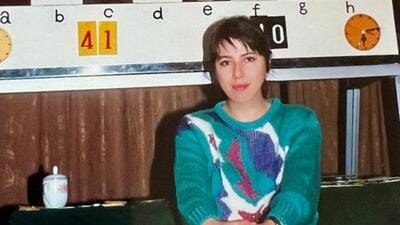
Bengaluru: “It’s not too late to back out” – Laszlo Polgar warned his daughter Susan as she set off for the airport, bound for Beijing. It was October 1992 and Susan had decided to play the Women’s Candidates tournament, much against her father’s will.
For Susan, then in her early twenties, it was her first women’s event (other than the Olympiad). In 1991, Susan had become the first female chess player to earn a Grandmaster title through the required number of tournament norms. Laszlo had trained his three daughters – Susan, Sofia and Judit, in the game, wanting them to focus on playing male players and staying out of women’s events for good.
Susan ended up scoring a historic 9.5 points out of 10 in the Women’s Candidates.
It was the kind of crushing dominance that Javokhir has had over the Candidates field this time around, winning six of his first 10 games – the most games any player has won in the current format. Sindarov currently has 9 points from 12 points.
Susan was accompanied to China for the tournament by her grandmaster boyfriend as well as Danish grandmaster Bent Larson and his wife, Laura Benedini. They arrived a couple of days early keeping jet lag and sightseeing in mind, visited the Great Wall of China and then flew from Beijing to Shanghai, where the tournament was to take place.
The playing conditions in Shanghai came as a pleasant surprise to Susan. It was around the time China began taking women’s chess seriously with Xie Jun being the reigning women’s world champion.
“The tournament was held at a beautiful resort, which was normally reserved for Communist party leaders and their guests,” Susan the eldest of the Polgar sisters, told HT in a chat. “The food was amazing and the resort had lovely manicured gardens where I loved taking walks.”
“Unfortunately for me, this serene atmosphere was in contrast to my emotional state leading up to the tournament,” she said, referring to tensions with her boyfriend at the time.
Thankfully, she had a team member to fall back on.
“Grandmaster Larson was a wonderful guy and a great chess player in his peak. When this tournament took place though, he was somewhat older and not very knowledgeable in current openings,” Susan said. “His wife, a professional psychologist, though was of great help. Dealing with all the drama with my boyfriend at the time was tough. She helped me calm down and put things in perspective.”
Susan was the highest-rated player in the nine-player field which included two former women’s world champions – Nona Gaprindashvili and Maia Chiburdanidze.
She had packed a couple of endgame books and hand-written notes on each opponent, which she went through before the games. “The notes had details of my plans – what each of them played six months or two years ago, how those games went, where would I improve upon, if that particular position or variation happened in our game… After things calmed down with my boyfriend, he too helped with preparation,”
Susan won nine out of her ten games. The only exception was a draw against Serbian player Alisa Maric in round six. She finished the tournament undefeated, with six rounds to spare and three points ahead of the second-placed Nana Ioseliani.
“It turned out to be a dream tournament for me. Although I don’t think I played too well. The relationship drama might have taken a toll on me because I struggled to close out games which should have been easy wins,” said Susan, “But the secret was really in the mindset – being ready to put up a fight in every game. I see this fighting spirit in too.”
Despite her outright win by a historic score, FIDE rules dictated Susan play Ioseliani in a match to determine who would face Xie Jun in the Women’s World Championship match.
In the match held in Monaco in February 1993, Susan, who was rated 100 points above her opponent, raced to a two-point lead after five games. Ioseliani though caught up and the match ended in a 4-4 tie. The playoffs that followed to determine the winner also ended in tied scores.
With no more chess left to play, it came down to an absurd game of chance. The winner would be decided by a drawing of lots, according to FIDE rules. Two identical boxes – one containing a gold medal, the other silver – were presented. Whoever won a coin flip would have the option of either picking a box or letting their opponent choose one. Ioseliani won the coin flip and asked Susan to pick a box. Susan opened the box and her heart dropped. She had picked silver. “It was one of the worst moments of my life.” And just like that her Women’s World Championship shot was over.
Ioseliani went on to suffer a crushing defeat against Xie Jun in their match.
In 1996, Susan returned to win her first women’s world title.