
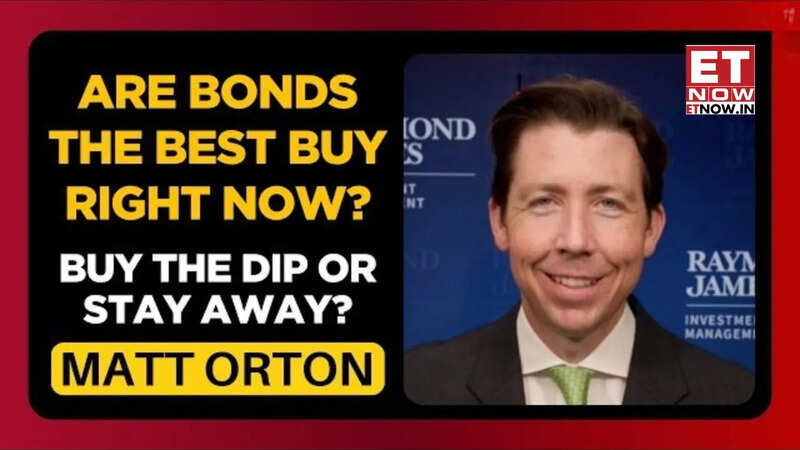
The US bond market may be presenting opportunities at the shorter end of the yield curve as investors overestimate the likelihood of further Federal Reserve tightening, according to Matt Orton, Chief Market Strategist at Raymond James Investment Management.
Speaking exclusively to ET Now, Orton said resilient economic growth and persistent inflation pressures have reduced the chances of interest-rate cuts this year, while market expectations for further tightening may have gone too far.
“With respect to bonds, I think shorter-end bonds look a little bit more attractive because I think rate hike expectations have gone a little bit too far,” he said.
Geopolitical tensions revive focus on safe-haven bonds
His comments come at a time when investors are grappling with heightened geopolitical uncertainty, including escalating tensions involving the United States, Iran and Israel, alongside concerns over energy prices and inflation. Such periods of uncertainty often drive investors toward government bonds, particularly US Treasuries, which are widely regarded as safe-haven assets.
Bonds are debt securities issued by governments or corporations to raise capital. Investors who buy bonds receive periodic interest payments and the return of principal at maturity. During times of market stress, geopolitical conflicts or economic uncertainty, investors often shift money from riskier assets such as equities into high-quality government bonds, seeking stability and capital preservation.
Strong economy clouds rate-cut outlook
Orton said the resilience of the US economy has complicated the outlook for monetary policy, even as investors continue to look for signs of policy easing.
“We should celebrate the resilience that the US economy and frankly a lot of the global economy has had with respect to everything that’s been thrown at it from higher oil prices and uncertainty,” Orton said.
Oil prices add to inflation concerns
The expert noted that inflation concerns remain elevated as oil reserves are drawn down and energy prices feed through into broader inflation measures monitored by the Fed. The risk of supply disruptions in the Middle East, particularly if tensions involving Iran intensify, has kept investors focused on the potential for higher crude oil prices, which could add to inflationary pressures globally.
“I don’t think that we’re going to see rate hikes from the Fed,” Orton said. “But I do think it greatly limits Fed Chair Kevin Warsh’s ability to institute or advocate for rate cuts this year.”
In the past six months, both major crude benchmarks have rallied sharply. Brent crude futures have gained about 55.7 per cent, while US West Texas Intermediate (WTI) crude futures have surged more than 60 per cent, underscoring investor concerns over supply risks and the potential inflationary impact of higher energy prices.
Higher oil prices can fuel inflation, increasing the likelihood that central banks maintain restrictive monetary policy for longer to contain price pressures.
Markets may be overpricing future rate hikes
As a result, Orton’s base-case scenario has shifted toward policy rates remaining unchanged.
“I think my base case has really moved to nothing happens as long as the data doesn’t get out of control,” he said.
Investors have recently increased bets on tighter monetary policy amid signs of economic resilience and sticky inflation. However, Orton believes those expectations may have become excessive, creating value in short-duration fixed-income assets.
Market expectations have also shifted toward a more hawkish outlook. According to CME’s FedWatch Tool, traders are pricing in the possibility of further policy tightening in 2026.
Short-duration bonds seen as attractive
“With respect to bonds, I think shorter-end bonds look a little bit more attractive because I think rate hike expectations have gone a little bit too far,” Orton said.
Short-term bonds are generally considered less sensitive to changes in interest rates than longer-dated bonds. If markets have indeed overestimated the likelihood of future rate hikes, shorter-duration bonds could benefit as yields stabilise or decline. They also offer investors a relatively defensive way to earn income while maintaining flexibility in uncertain market conditions.
Focus shifts to upcoming Fed meeting
The comments come ahead of the Federal Reserve’s policy meeting next week (June 16-17), where investors will closely monitor the central bank’s statement and economic projections for clues on the future path of interest rates.
While some Fed officials have recently adopted a more hawkish tone, Orton said markets will be watching whether consensus emerges around maintaining current policy settings or whether divisions among policymakers widen.
Treasuries retain safe-haven appeal
The bond market’s role as a safe haven has become increasingly relevant amid geopolitical tensions. Historically, investors have flocked to US Treasuries during conflicts and periods of heightened uncertainty because they are backed by the US government and are among the most liquid securities in the world.
Any escalation in tensions in the Middle East could reinforce demand for such assets, even as higher oil prices complicate the inflation outlook for central banks.
Despite his relatively constructive view on short-term bonds, Orton said he remains positive on equities over the longer term and would use market pullbacks as buying opportunities, particularly in sectors supported by strong fundamental growth trends.
(Disclaimer: The above article is meant for informational purposes only, and should not be considered as any investment advice. ET NOW DIGITAL suggests its readers/audience to consult their financial advisors before making any money-related decisions.)