
Prime Database data showed that Indian companies raised a record ₹1.76 lakh crore through 103 mainboard IPOs in 2025, eclipsing the previous high of ₹1.59 lakh crore in 2024 and marking the second straight year of record fundraising.
According to Pranav Haldea, Managing Director of Prime Database Group, the primary market generally follows the mood in the broader market. “IPO market always follows the secondary market, and the kind of volatility that you have seen the first six months of this year on account of various geopolitical issues, these are not ideal grounds for IPO activity to really pick up.”
Haldea stated that nearly 250 companies are waiting to tap the market and together they plan to raise around ₹4 lakh crore. However, many of them are choosing to stay on the sidelines until market conditions become more favourable.
For companies an IPO is a once-in-a-lifetime event for many companies and promoters would prefer launching their issues when investors are more confident.
That explains why activity has slowed sharply, with May witnessing no IPO launches and only a handful of issues coming to the market in June.
Despite slower activity, most IPOs have delivered gains
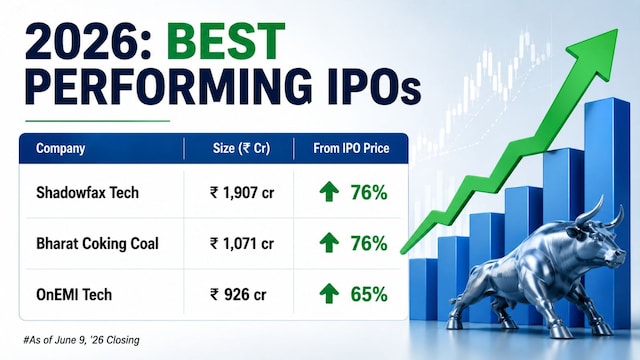
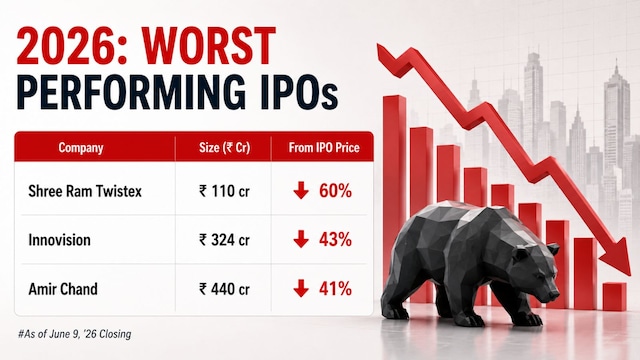
Despite the subdued pace of listings, IPO investors have largely been rewarded. Of the 21 IPOs launched in 2026 so far, 18 are trading above their issue price, while only three are below their offer price.
The underperformers have largely been smaller offerings in the ₹100-400 crore range, where subscription demand was relatively weak. Retail investors have also become more selective amid market volatility, with several IPOs seeing weak participation.
Big names remain in the wings
Even as listing activity has slowed, the pipeline remains healthy. Several large companies, including Zepto, NSE, Oyo and Hero FinCorp, are waiting in the wings. However, the timing of these issues will depend on how quickly market conditions and the broader geopolitical environment stabilise.
Why the first half is usually weak for IPOs
Haldea noted that the first half of the calendar year has consistently been a difficult period for the IPO market over the past several years. Events such as the COVID-19 pandemic in 2020 and 2021, the Russia-Ukraine conflict, US tariff-related uncertainties last year and geopolitical tensions in 2026 have weighed on sentiment and delayed listings.
He expects activity to improve in the second half of the year, as has been the case in previous years.
Foreign investors key to revival in large IPOs
According to Haldea, domestic institutional investors are now strong enough to support smaller issues of less than ₹1,000 crore. However, larger IPOs will require meaningful participation from foreign investors.
A sustained revival in big-ticket offerings will depend on easing geopolitical concerns and improved market stability.
 Pipeline spans technology, manufacturing and clean energy
Sector-wise, the pipeline remains well diversified. New-age technology firms, industrial manufacturing companies, clean energy businesses and multinational subsidiaries are all preparing to enter the market.
Unlike a decade ago, when financial services companies dominated IPO activity, the current pipeline reflects a much broader mix of industries.
Lock-in expiries need not be a major concern
Haldea also noted that concerns around shareholder lock-ins ending may be overstated. Historical data shows that IPOs launched over the past several years have continued to deliver positive returns on average even after lock-in periods expired.
According to him, IPOs from 2020, 2021 and 2022 have generated strong gains despite market volatility.
Zepto and Oyo move closer to market debut
Quick commerce major Zepto has filed its updated Draft Red Herring Prospectus (DRHP) and is planning a fresh issue worth ₹8,010 crore. The issue will also include an offer for sale by early institutional investors, taking the total IPO size to an estimated ₹11,000-12,000 crore.
Meanwhile, Oyo parent Prism has received approval from the Securities and Exchange Board of India (SEBI) for its proposed IPO. The company plans to raise ₹6,650 crore through a fresh issue and is expected to seek a valuation of around $7-8 billion, according to people familiar with the matter.
Watch accompanying video for more
