
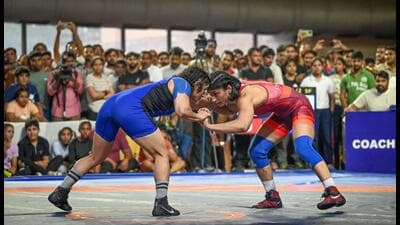
New Delhi: At daybreak, a smattering of children quietly emerge from their homes and make their way out of dusty bylanes. Their eyes groggy, their ears swollen and their bodies battered, they dutifully march on to the nearest akhada (mud pit). Mitti (soil), they say, is sacred; and so when mitti calls, they answer. The day has only just begun in Haryana’s hinterlands.
Last month’s wrestling trials for the Asian Games revealed a telling statistic. All 18 members of the Asiad-bound Indian wrestling contingent come from one state: Haryana. Tell that to a Haryanvi wrestler of any vintage, and they simply shrug their shoulders.
At the 2024 Paris Olympics, 24 out of India’s 117-member athlete contingent (20%) came from Haryana. Among the medallists (individual sports), Neeraj Chopra, Manu Bhaker, Sarabjot Singh, and Aman Sehrawat were from Haryana. For five consecutive Olympics starting Beijing 2008, Indian wrestlers have not returned empty-handed. Among the seven wrestling medals that India have won, five trace their origins to Haryana.
This success is not only a startling reminder of the state’s elite dominance but also a hat-tip to a primitive, spartan system that cocks a snook at structured, data-driven, analysis-heavy modern sporting models. It’s a seemingly disparate, disoriented system that somehow, miraculously comes together, year after year, Olympic cycle after Olympic cycle.
From Bhagana to Balali, Chhara to Rithal, this unintended symphony, this unerring, almost monastic submission forms the beating heart of Indian wrestling. For anyone who has been to these parts, the spiritual devotion to the brutal, violent art offers a peculiar paradox. Akhadas are where the quiet ones find their voice; some even find their purpose.
For Bajrang Punia, it was a way out of penury. For Aman Sehrawat, it healed the grief of losing his parents. And for countless women, it liberated them from the prisons of patriarchy.
“There’s something in our mitti that keeps producing wrestlers. There’s no real explanation,” says 17-year-old Asian Games-bound Dipanshi Phogat. It is perhaps a little too simplistic.
“Wrestling thrives in Haryana because it is a sport of dehat (villages). You don’t need an investment, you don’t need equipment, not even shoes. All you need is a loincloth and you’re good to go,” says Bajrang, one of India’s most decorated wrestlers.
“Then, of course, there have been role models like the Phogat sisters who have broken the glass ceiling for countless women.”
The Tokyo Olympics bronze medallist grew up in Chhara village in Jhajjar district, where “everyone wrestled.” Bajrang remembers his childhood cooped in a doorless single room. The family of seven — he had three elder sisters and an elder brother — shared space with their cattle. His father, a farmer who wrestled as a pastime, wanted one of his sons to take up wrestling. Bajrang obliged, also because wrestling offered him passage to a better life.
Back in 2014, after he won his first CWG medal — a silver in 61kg — he received prize money of around ₹70 lakh from various benefactors. The entire amount was used to pay off his father’s debts.
Four World Championships medals, three CWG podiums, two Asian Games medals, and one Olympic bronze later, he puts his success in perspective. “Wrestling gave me everything. Imagine, a vulnerable farmer living with a debt of ₹70 lakh…if not for wrestling, I would still be in that room, paying off debts. Why won’t I worship kushti?”
Former national coach Kuldeep Sehrawat offers another explanation. “Wrestling is a daily routine here; you don’t really think before getting into it. Most households have a cow or a buffalo, so children get a dairy-rich diet. Once they come to academies, we look for physique, speed, and endurance. That’s talent identification, if you will. Skills, technique and strength can be worked on later,” Kuldeep, who runs the sought-after Raipur Wrestling Academy in Sonepat, said.
He took over a derelict panchayat akhada in 2010, and has seen the number of trainees grow from less than 100 to over 250 now.
Sports Authority of India (SAI), having noticed the untapped talent in Haryana, started adopting akhadas under its National Sports Talent Contest (NSTC) Scheme from 2001–2002.
As of now, SAI operates five akhadas in Haryana — two in Rohtak and one each in Jhajjar, Nidani, Rohtak, and Hisar. These are provided with coaches, along with a mat and/or multi-gym equipment. As of now, 29 SAI coaches have been deployed across NCOE Sonepat, STCs Hisar and Kurukshetra, and SAI’s akhadas.
Another big push comes through cash rewards. An Olympic gold medalist is entitled to ₹6 crore, silver medalists get ₹4 crore, and bronze medalists ₹2.5 crore. All Olympic participants are awarded ₹15 lakh each. State’s padak lao pad pao job scheme guarantees a government job to eligible sportspersons across categories A, B, C, and D.
“Ultimately, it all boils down to raw talent. Given the talent we have at the district level, one might say that even a wrestler like Vinesh won’t easily make the Haryana team,” a wrestling coach said, referring to the fact that the India team is the Haryana team.
While Haryana’s grassroots system lacks sports science and innovation, it is still good enough because it has tradition and heart. For now. It allows them to keep churning out talent even as other traditional catchment areas continue to fade away.