
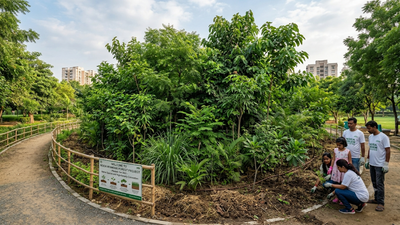
Across the world, cities are confronting a common challenge. As populations grow and development intensifies, urban areas are becoming hotter, noisier and increasingly disconnected from nature. Concrete surfaces absorb heat, biodiversity declines, and green spaces often struggle to keep pace with expansion. In response, an unconventional form of afforestation pioneered in Japan is gaining global attention. Known as the Miyawaki method, it transforms small plots of land into dense native forests capable of supporting wildlife, improving local environmental conditions and restoring fragments of lost ecosystems. From Tokyo, where the technique was first developed, to Delhi, where microforests are now appearing in crowded neighbourhoods and industrial zones, Miyawaki forests have become part of a wider international movement to bring nature back into cities.
How a Japanese botanist inspired a global fast growing urban rewilding movement
The story begins with Japanese botanist Akira Miyawaki, whose research focused on understanding what he called “Potential Natural Vegetation” (PNV). Rather than studying forests as isolated collections of trees, Miyawaki examined how native plant communities naturally organised themselves over time.His work revealed that many modern landscapes had lost the ecological complexity that once defined them. Native forests had been replaced by monoculture plantations, ornamental species and heavily managed green spaces. Miyawaki argued that ecological restoration should focus on recreating indigenous forest communities rather than simply increasing tree numbers.In a 2004 paper ‘Restoration of living environment based on vegetation ecology: Theory and practice,’ he described the restoration of native forests as one of the most important ecological challenges of the modern era. His approach involved identifying local native species, improving soil conditions and planting diverse vegetation at exceptionally high densities to accelerate natural forest development. The method would eventually spread far beyond Japan.Today, Miyawaki forests can be found in Europe, Southeast Asia, South America, North America and Africa. Municipal authorities, conservation groups, schools and businesses are adopting the technique as part of broader efforts to improve urban biodiversity and climate resilience.
What makes Miyawaki forests different from conventional tree plantations?
At first glance, a Miyawaki forest can appear unusually crowded. Unlike traditional plantations, where trees are often planted several metres apart, Miyawaki forests place saplings close together, frequently at densities of three to five plants per square metre. The objective is not aesthetic landscaping but ecological reconstruction.The process begins with identifying species native to a specific region. Depending on location, these may include canopy trees, smaller sub-canopy species, shrubs and ground vegetation. Once planted, the dense arrangement encourages competition for sunlight, driving rapid vertical growth while establishing a complex network of roots beneath the soil.The method seeks to replicate the layered structure found in natural forests. Because multiple species occupy different ecological niches, the resulting habitat is generally more diverse than conventional urban tree plantations.Supporters of the method argue that these dense plantings can create functioning ecosystems within a few decades, a process that may otherwise take much longer under natural conditions.
Why cities around the world are embracing urban microforests
The rapid spread of Miyawaki forests is closely tied to the environmental pressures facing modern cities.According to Theodore A Endreny of the Department of Environmental Resources Engineering, SUNY ESF, urban heat islands have become a growing concern across continents. Buildings, roads and paved surfaces absorb solar radiation during the day and release it slowly at night, causing cities to remain significantly warmer than surrounding rural areas.At the same time, biodiversity loss has become increasingly visible within urban environments. Pollinators, birds and small mammals often struggle to survive in fragmented habitats dominated by concrete infrastructure.For city planners, Miyawaki forests offer a practical advantage: they require relatively little space.Vacant plots, abandoned industrial sites, roadside corridors and former dumping grounds can all be converted into dense green spaces. In neighbourhoods where establishing large parks is impossible, microforests provide an opportunity to introduce native vegetation without major land acquisition.This flexibility explains why the technique has attracted attention from cities with vastly different climates and development patterns.
From Europe to Asia : Where Miyawaki forests are taking root
In the Netherlands, environmental organisations have established numerous tiny forests inspired by Miyawaki’s principles, often integrating them into schools and community spaces. Similar projects have emerged in France, Belgium and the United Kingdom, where urban biodiversity restoration has become an increasingly important policy objective.In Southeast Asia, rapidly urbanising cities have embraced the technique as a way of increasing green cover in densely populated districts. According to Technological University Singapore, Singapore, already recognised for its extensive urban greening programmes, has incorporated biodiversity-focused planting strategies that share several principles with Miyawaki’s ecological restoration philosophy.Across Latin America, local governments and community groups have begun experimenting with urban microforests as part of climate adaptation initiatives aimed at mitigating heat stress and improving environmental quality.The technique’s global appeal lies in its adaptability. While species composition varies from country to country, the underlying principle remains consistent: restore native ecosystems rather than simply planting trees.
How India became one of the world’s largest adopters of Miyawaki forests
Few countries have embraced the Miyawaki method as enthusiastically as India. Faced with rapid urbanisation, deteriorating air quality and shrinking green cover, cities across the country have increasingly turned to microforests as a practical restoration tool.Delhi has established multiple urban forests using the Miyawaki technique, including projects in densely populated settlements and industrial areas. Native species such as neem, jamun and mango have been planted to strengthen local biodiversity while expanding urban green cover.Mumbai, Pune, Bengaluru, Chennai, Hyderabad and Bhubaneswar have launched similar initiatives, often transforming degraded land into dense native forests.One of the most ambitious recent examples emerged in Prayagraj ahead of Mahakumbh 2025. According to the Ministry of Environment, Forest and Climate Change, approximately 56,000 square metres of Miyawaki forests were created across multiple locations. Former dumping grounds were rehabilitated and replanted with thousands of native, medicinal and fruit-bearing trees.A major project in the Naini industrial area alone involved around 120,000 trees representing 63 species. Government officials described the initiative as part of a broader effort to improve air quality, increase biodiversity and create greener urban environments for residents and visitors alike.These projects illustrate how Miyawaki forests have evolved from small-scale experimental plantations into components of mainstream urban environmental planning.
Do Miyawaki forests actually deliver environmental benefits?
As the technique has expanded globally, researchers have increasingly sought to evaluate its ecological performance.A 2025 study titled ‘Assessing carbon sequestration in urban Miyawaki forests of south India: Implications for climate mitigation planning and land suitability’ examined urban Miyawaki forests in southern India and found substantial increases in biomass and carbon storage as forests matured. Five-year-old sites stored approximately four times more carbon than two-year-old forests, indicating that carbon sequestration can accelerate rapidly during early growth stages.The researchers FROM Environmental Sciences and Sustainable Engineering Centre (ESSENCE), Indian Institute of Technology, Palakkad, concluded that Miyawaki forests could contribute to urban climate mitigation while also supporting ecological restoration efforts. Their analysis further suggested that large areas of marginal land across India may possess climatic conditions suitable for similar interventions.Beyond carbon storage, the biodiversity potential of Miyawaki forests is attracting growing interest. Dense native vegetation can provide habitat for insects, pollinators and birds that often struggle to find refuge within heavily developed urban environments.However, scientists also caution against exaggerated claims. Microforests cannot replace large natural forests, nor can they solve every urban environmental challenge. Their effectiveness depends heavily on species selection, maintenance quality and local ecological conditions.
The future of fast growing urban forests in a warming world
The popularity of Miyawaki forests reflects a broader shift in how cities think about nature. For much of the twentieth century, urban greening focused primarily on aesthetics. Trees were planted to beautify streets, parks were designed for recreation and landscaping often prioritised appearance over ecology.Today, cities increasingly view green spaces as essential infrastructure. Forests, wetlands and native vegetation are being recognised for their role in cooling neighbourhoods, supporting biodiversity, improving public health and strengthening resilience against climate change.Miyawaki forests have emerged as one response to this challenge. They are not a universal solution, nor are they a replacement for large-scale conservation. Yet their ability to convert neglected urban land into living ecosystems has made them one of the most influential rewilding experiments of the twenty-first century.From Tokyo, where the concept was born, to Delhi and beyond, these dense pockets of native vegetation are demonstrating that even in the world’s most crowded cities, nature can still reclaim a place.