
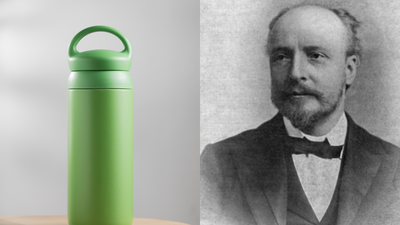
For most people, a thermos is a simple object used to keep tea hot or water cold. Yet its origins lie not in kitchens, camping trips or school lunches, but in one of the most demanding scientific pursuits of the nineteenth century: the study of extremely low temperatures. In 1892, Scottish chemist and physicist Sir James Dewar was searching for a way to store liquefied gases long enough to investigate their properties. The challenge was formidable because these substances rapidly absorbed heat from their surroundings and evaporated. Dewar’s solution was a double-walled vessel separated by a vacuum, dramatically reducing heat transfer. What began as a laboratory tool for cryogenic research would eventually become one of the world’s most recognisable household inventions. Remarkably, Dewar never patented the design, allowing others to transform his scientific apparatus into the commercial product now known globally as the thermos.
The scientific problem that led James Dewar to invent the vacuum flask
During the late nineteenth century, researchers were racing to understand matter at temperatures far below freezing. Dewar’s work focused on liquefied gases, particularly oxygen and hydrogen, which required specialised equipment to remain stable long enough for observation.According to the Department of Chemical Engineering, Ben-Gurion University of the Negev, Dewar developed a vessel consisting of one glass flask placed inside another, with a partial vacuum between them. The vacuum dramatically reduced heat transfer by conduction and convection, while later silvered surfaces minimised heat exchange through radiation. This design allowed precious liquefied gases to remain cold for far longer than previously possible.The Ben-Gurion University of the Negev notes:“The flask was designed especially to keep substances very cool.”The first version was publicly exhibited at the Royal Institution on Christmas Day 1892, marking a significant advance in experimental cryogenics.
Why the Dewar flask became the foundation of every modern thermos
The effectiveness of Dewar’s invention rested on a simple physical principle. Heat normally travels through conduction, convection and radiation. By removing most of the air between two walls and adding reflective silvered surfaces, the flask restricted all three pathways.The vacuum flask is a vessel whose evacuated space is “practically a nonconductor of heat”, allowing both hot and cold substances to retain their temperatures for extended periods.What made the invention extraordinary was its versatility. While intended for the purpose of storing cryogenic liquids, the invention was just as useful for retaining heat in hot liquids. As such, little modification would be necessary for the invention’s application in household products.By 1898, more robust variations of the Dewar flask were already being mass-produced for commercial use.
How the thermos became a global household essential
Despite inventing the vacuum flask, Dewar chose not to patent it. This decision had far-reaching consequences. In the early twentieth century, German glassblowers Reinhold Burger and Albert Aschenbrenner recognised that the device could serve ordinary consumers as effectively as scientists. They developed a commercial version protected by a metal casing and secured patents for domestic applications.The product was later marketed under the name “Thermos”, derived from the Greek word therme, meaning heat.The Royal Institution records that Dewar’s invention was patented and renamed for industrial use in 1904 after others recognised its broader potential.More than a century later, the core engineering remains fundamentally unchanged. Modern insulated bottles, food flasks, laboratory cryogenic containers and even specialised medical storage systems still rely on the same vacuum-insulation principles established by Dewar in the 1890s.