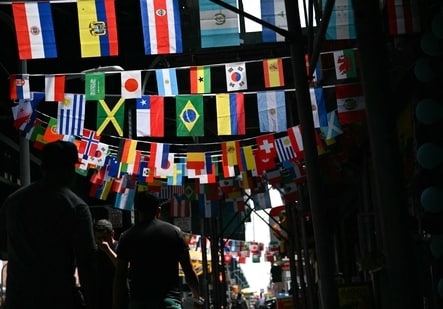
National anthems are among the world’s most recognisable and widely performed political texts. Many were written to rally troops, celebrate victory in war or unite new states. Today these battle cries are most often heard at sporting events. Before each match at the World Cup, teams will sing songs of the conflicts that once divided them.
Forty-eight countries will compete in the group stages this year, up from 32. Which ones will appear most often as enemies in the tournament’s national anthem (AFP)
Forty-eight countries will compete in the group stages this year, up from 32. Which ones will appear most often as enemies in the tournament’s national anthems? To find out, The Economist used AI tools to analyse the translated lyrics of every competing country’s song. To start, we ranked villains according to where there were explicit mentions of countries, specific battles, historical figures and symbols. Anthems with no official lyrics, such as Spain’s and Bosnia and Herzegovina’s, were excluded from the analysis.
Spain is the most hated country in our textual analysis, appearing in three national anthems. Perhaps this is because Spain’s former colonies and territories were more likely than Britain’s to gain independence through revolutionary wars. Ecuador’s anthem recalls how “the toppled lion could be heard, as it roared in impotence and despair.” The Dutch—hardly strangers to empires themselves—are less subtle: “The Spaniards rape thee, my Netherlands so sweet.” (We analysed the full official lyrics, including verses rarely sung at matches.)
The results rely on interpretation: anthems are often poetic and rarely specify exactly who they want dead. When factoring in historical context, our analysis suggests that at least nine additional national anthems allude to other countries, including a reference to Britain in America’s anthem. Spain once again takes first place.
National anthems are an unusually macabre genre. All but eight countries competing in the World Cup make some reference to violence, whether through soldiers, armour, threats, descriptions of historical battles or explicit calls to arms. Nineteenth-century writers were especially fond of bloodshed; our analysis found that anthems adopted more recently tend to be less fierce and battle-hungry.
Portugal’s anthem, originally written as a protest song against Britain, is unusually bellicose. It contains 11 references to violence per 100 words, compared with a tournament average of roughly two. It calls citizens “às armas!” (to arms) 12 times. By this measure, Portugal has the World Cup’s most combative anthem. Though others sound ready for a fight, too. The French warn dramatically that foreign soldiers are coming “to cut the throats of your sons and consorts”, while Uruguay’s and Tunisia’s tout the glory of martyrdom.
Not all anthems are so sanguinary. Some of history’s most notorious invaders sing remarkably peaceful songs. Britain’s anthem asks God to save its king (although Scotland’s unofficial anthem mocks King Edward II). Germany’s celebrates freedom, unity and happiness. Japan’s hopes the emperor will reign until little pebbles grow into moss-covered boulders.
Two of the World Cup’s hosts—America and Mexico—have similar themes of freedom, conflict and religion, although Mexico’s contains more than twice as many references to violence. Written during an era of territorial loss and invasion by America and other foreign powers, it imagines its national flag drenched in waves of blood. Canada’s, meanwhile, contains no references to conflict and is typically polite: “with glowing hearts we see thee rise.” (Its official lyrics were even updated in 2018 to be more gender-neutral.)
Football fans rarely pay much attention to the lyrics echoing around a stadium before a match. But these anthems are rousing epics of conquest, liberation, sacrifice and murder. Fortunately, this summer’s hard-fought football contests will be settled by goals, not guns.
For more on the latest books, films, TV shows, albums and controversies,sign up to Plot Twist, our weekly subscriber-only newsletter