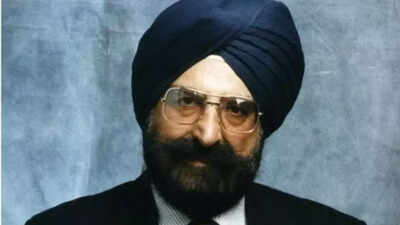
When people make a video call, stream a movie, send an email, or browse the internet, few stop to think about the technology carrying that information across continents in a fraction of a second. Even fewer know that one of the key pioneers behind this transformation was an Indian-born scientist whose work changed the course of modern communication.That scientist was Narinder Singh Kapany, often remembered as the “Father of Fiber Optics.” His groundbreaking research helped lay the foundation for the global communications network that powers today’s digital world.
From Punjab to a breakthrough that changed the world
Born on October 31, 1926, in Moga, Punjab, Kapany’s journey began far from the laboratories and technology hubs where he would later make history. Raised in a Sikh family, he completed his schooling in Dehradun before graduating from Agra University. His early interest in science eventually led him to pursue advanced studies in optics, a field that would define his life’s work.In the early 1950s, Kapany moved to London and joined the prestigious Imperial College London. There, while working with physicist Harold Hopkins, he began experimenting with the transmission of light through bundles of thin glass fibers.At the time, scientists had already explored the possibility of sending images through optical fibers. However, the results were poor and unreliable. Kapany and Hopkins succeeded in dramatically improving image transmission through large bundles of optical fibers, a breakthrough that opened the door to an entirely new field of research.The achievement may have appeared technical and limited at the time, but its impact would prove enormous. The technology eventually evolved into fiber-optic communication systems that now carry vast amounts of data across oceans and continents.Kapany did more than advance the science. He gave the field its identity. In 1960, he coined and popularised the term “fiber optics” through an article in Scientific American. He later wrote the first book dedicated to the subject and became one of its strongest advocates. Through his research, publications, and public engagement, he helped turn a promising scientific concept into a global technological movement.
Beyond fiber optics: Scientist, entrepreneur and cultural patron
His scientific interests extended well beyond fiber optics. Over the course of his career, Kapany worked on lasers, biomedical instruments, solar energy, and pollution monitoring technologies. His innovative thinking resulted in more than 120 patents, reflecting a lifetime devoted to solving practical problems through science.Kapany was not only a researcher but also a successful entrepreneur. In 1960, he founded Optics Technology Inc., a company focused on developing optical technologies. He later established several other ventures, helping bridge the gap between laboratory discoveries and commercial applications. Long before innovation and start-ups became popular buzzwords, Kapany was demonstrating how scientific ideas could be transformed into products and industries.His influence also reached academia. He taught and guided research at the University of California, Berkeley and the University of California, Santa Cruz. At Santa Cruz, he founded the Center for Innovation and Entrepreneurial Development, encouraging students and researchers to think beyond conventional academic boundaries.Yet Kapany’s legacy cannot be measured only through laboratories, patents, or businesses.Deeply connected to his cultural roots, he became a passionate supporter of Sikh history, art, and education. As the founding chairman of the Sikh Foundation, he spent decades supporting projects aimed at preserving Sikh culture. He donated generously to museums and universities, helping establish academic chairs and art collections that continue to educate future generations.His collection of Sikh art gained international recognition and played a major role in bringing Sikh heritage to global audiences through exhibitions in London, San Francisco, Toronto, and other cities.Despite the immense impact of his work, Kapany remained relatively unknown outside scientific circles for many years. Yet the world gradually recognised the scale of his contribution. In 1999, Fortune magazine named him among the seven “Unsung Heroes of the 20th Century” for helping shape modern life through innovation. The same year, Time magazine included him among the century’s leading scientists.India honoured him posthumously in 2021 with the Padma Vibhushan, the country’s second-highest civilian award. The recognition came months after his death on December 4, 2020, at the age of 94.Today, every high-speed internet connection, every international data transfer, and every digital communication network carries traces of the vision that Kapany helped create. His work transformed light into information and information into a force that connects billions of people around the world.In many ways, the modern digital age travels through the path he illuminated decades ago. Narinder Kapany’s story is not just the story of a scientist. It is the story of a man who looked at a beam of light and saw the future.