
Krishnan believes that as liquidity deepens and more stakeholders participate, EGR could gradually help India move from being a price taker to a price maker in gold. While that journey will take time, he says the groundwork is being laid through greater market participation, deeper trading volumes and future regulatory support.
This is an edited transcript of the interview.Q: The latest data shows the commodity segment making new highs. Where do you see the major volumes coming from?
A: The crude oil contract has picked up very well and has been doing well over the last several months. Yesterday was another expiry day and, for the first time, we got about 53-54% market share in terms of the number of contracts traded.
This is an important milestone for us. In terms of premium turnover, we still have a long way to go and are at about 21-22% market share. But it gives us a lot of encouragement, and the change in expiry day seems to have been well received by the marketplace.
We have also changed the expiry day of the natural gas contract, which is looking good and appears well set to do well.
Apart from that, the 10-gram gold contract is picking up in popularity. The first expiry saw about 100 deliveries, the second about 300, and now we are heading into the third expiry, where I expect the number to increase further. That suggests the contract is being well-received.
Amidst all this, we have also launched EGR. We have received feedback from various stakeholders and are now in the process of building volumes in the segment.
Q: You launched EGR on May 4, and jewellers have requested additional size denominations. Is work happening in that direction?
A: Yes. A 10-milligram denomination is something we will introduce as an additional trading denomination. SEBI rules allow trading in multiples of 10, while 100 milligrams remains the delivery unit that refiners can support.
So, 10 milligrams will become the minimum trading unit, and we will announce this shortly.
Q: Are you also considering incentives for households, vaults or temples to convert physical gold into EGRs?
A: We are about to roll out a well-thought-through process for surrendering gold and converting it into EGRs. That announcement should happen within the next week or so.
We are currently fine-tuning and testing the app that will facilitate the process. This should address questions around how the entire conversion mechanism will work.
Personally, I think market makers need to be deployed in the EGR segment to provide two-way quotes during the initial months. Once liquidity builds up, there may not even be a need for market makers.
As things stand, I believe we are in good shape, and you will see a lot more transactions in the coming days and weeks.
Q: One of EGR’s larger goals is to help India move from being a price taker to a price maker in gold. How long could that take?
A: It depends on how quickly various stakeholders integrate into the EGR ecosystem.
We expect large refiners, bullion dealers, asset management companies and jewellers to be among the early participants. Over time, retail investors, family offices and even temples could join.
Eventually, regulators may also allow foreign participants to trade EGRs, even if they are not permitted to withdraw physical gold.
If that happens, we can build a deep and liquid market. When millions of trades take place every day, India can begin making a stronger case to be viewed as a price maker rather than a price taker.
It will take time, but at least we are creating the pathway to get there.
Q: Gold imports remain subject to duties and restrictions. Could retail participation in EGRs increase as regulations evolve?
A: The import duty is 15%, and rightly so, because we want to discourage gold imports and encourage domestic gold to come into the EGR ecosystem.
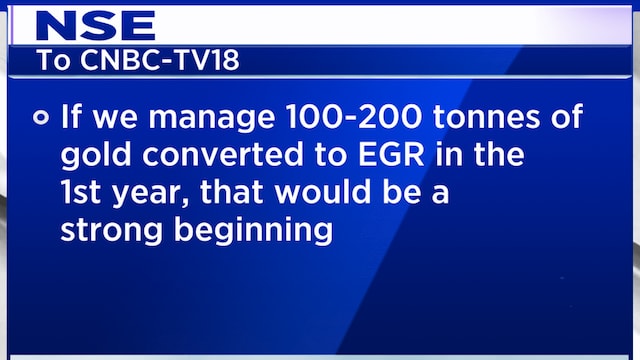
If we can bring even 100-200 tonne of gold into EGRs during the first year, that would be a significant share of India’s annual gold imports, which are typically around 600-700 tonne.
If this momentum continues into the second and third years, it is only a matter of time before more domestic gold supply moves into EGRs. People will realise that converting gold into EGRs offers several advantages.
Watch the full conversation here

In the future, once lending and borrowing are permitted, investors may also be able to lend their EGR holdings and earn lending fees, creating an additional income stream from gold that is currently lying idle.
Q: NSE has signed an agreement with the Steel Users Federation. Can we expect a steel derivatives contract soon?
A: A few products are currently being discussed with colleagues from the Steel Users Federation.
We will come up with the right products as and when we are clear about what the market requires.