
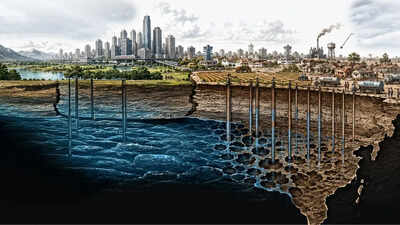
NEW DELHI: India’s groundwater crisis is becoming increasingly severe, with several regions reporting alarming levels of depletion, drinking water shortages and contamination. Among the major cities, Hyderabad has become India’s worst-affected metropolitan region for groundwater depletion, overtaking larger cities such as Delhi and Mumbai, according to the Dynamic Groundwater Resource Assessment Report 2025 released by the Union ministry of Jal Shakti.The report found that 26 mandals and tehsils across Greater Hyderabad, including areas in Rangareddy and Medchal-Malkajgiri districts, have been classified as either “critical” or “over-exploited” due to excessive groundwater extraction. This is the highest number recorded among all Indian metros.
Delhi, despite having a population of around 3.3 crore, has 21 such units, while Bengaluru has 16. The concentration of groundwater-stressed zones in Greater Hyderabad is higher than that seen in several large states, including Andhra Pradesh, Bihar and Maharashtra.Hyderabad district records no safe groundwater zonesThe report paints an especially worrying picture for Hyderabad district, where none of the 16 groundwater assessment units falls under the “safe” category.Only one unit has been classified as semi-critical, while the remaining 15 have been placed in the critical or over-exploited categories. Areas such as Khairatabad, Ameerpet, Himayatnagar, Bachupally, Serilingampally, Hayathnagar and Saroornagar are among the worst affected.
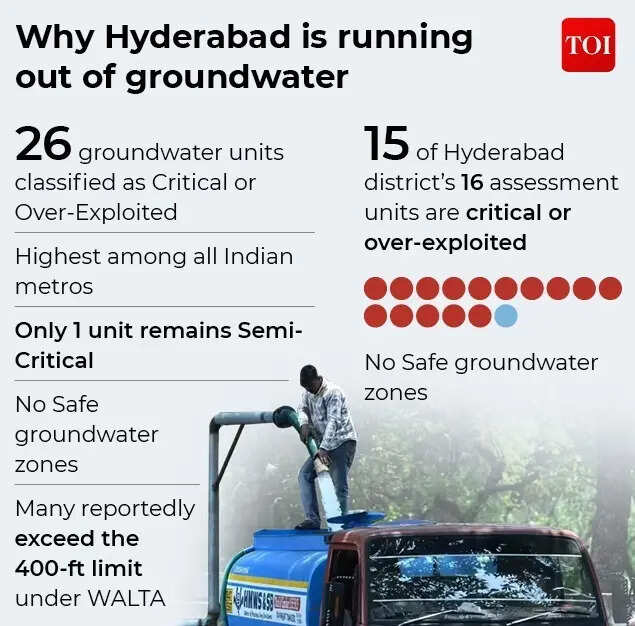
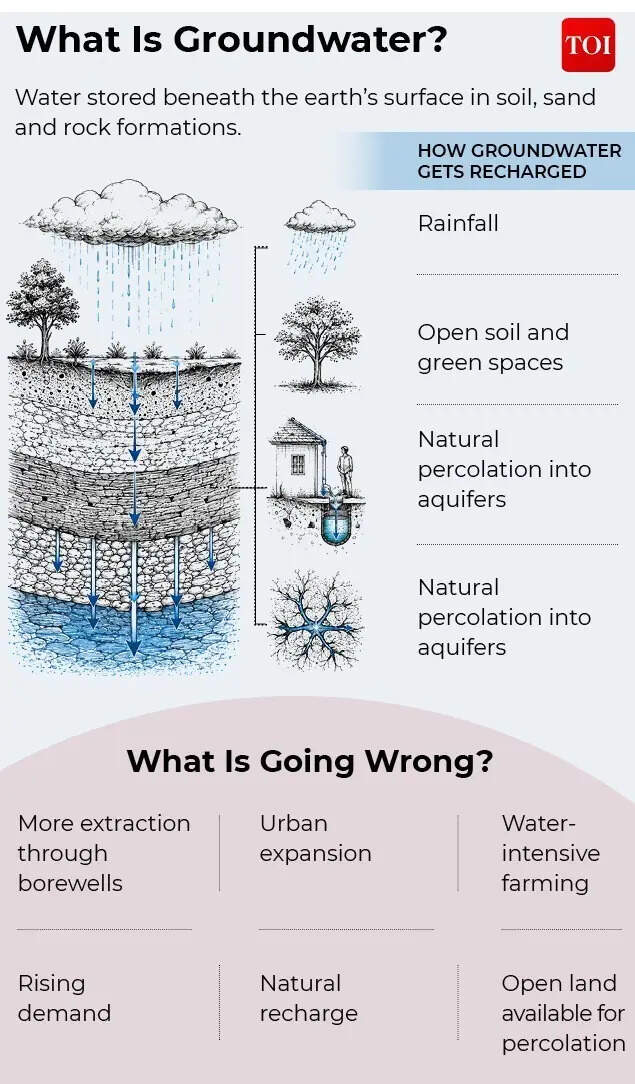
Under Central Ground Water Board guidelines, regions extracting less than 70% of available groundwater are considered safe. Areas extracting 71-90% are categorised as semi-critical, 90-100% as critical, while those extracting more than 100% are termed over-exploited.Excessive borewell drilling and urban growth worsen crisisOfficials attribute the worsening situation to rapid urbanisation, extensive construction activity and widespread drilling of borewells across the city.“Hardly 15% of the city is equipped with rainwater harvesting recharge pits. Despite Hyderabad receiving annual rainfall of 900 mm to 1,000 mm, a significant portion of rainwater flows directly into drains because of inadequate open spaces and green cover for groundwater percolation,” said K Laxma, director of the Telangana Groundwater Department.He warned that groundwater levels are falling steadily due to inadequate recharge efforts.“If rainwater harvesting pits are properly maintained, groundwater levels can remain within 10 metres depth. In the absence of recharge practices, water levels are now falling to depths of 20 metres and beyond,” Laxman said.Rocky terrain and poor recharge systems add to Hyderabad’s challengesExperts say Hyderabad faces a unique geological disadvantage compared to several other major cities.“Unlike cities such as Mumbai, Bengaluru and Delhi, Hyderabad is largely situated on rocky terrain, making natural rainwater percolation more difficult. In softer soil regions, rainwater seeps underground more efficiently during rainfall events, aiding groundwater recharge. The problem in Hyderabad is further aggravated by poor implementation of rainwater harvesting systems,” said B Venkateswara Rao, retired professor at the Centre for Water Resources, JNTUH.Officials estimate that while Hyderabad district officially has around 2.5 lakh borewells, the actual number could be far higher. Across Greater Hyderabad, the number of borewells is believed to be close to 10 lakh.Many borewells are reportedly drilled illegally beyond the 400-foot depth limit prescribed under the Water, Land and Trees Act (WALTA), 2002.One-fourth of Telangana moves out of safe groundwater categoryThe groundwater assessment also highlights growing stress across Telangana.Out of the state’s 620 groundwater assessment units, only 473 remain in the safe category. The remaining units have shifted into semi-critical, critical or over-exploited classifications.Groundwater quality is also becoming a concern. Fluoride contamination has been detected in several areas, including Bachupally, Balanagar, Malkajgiri, Ghatkesar and Medchal.Karnataka villages battle drinking water shortagesWhile Hyderabad grapples with groundwater depletion, Karnataka is facing widespread drinking water shortages ahead of summer.According to data from the Rural Water Supply and Sanitation Department, 344 villages across 58 taluks are currently affected.Bengaluru South in Ramanagara district is the worst-hit area, with 55 villages facing water scarcity. Raichur follows with 41 affected villages, while Uttara Kannada and Tumakuru have reported shortages in 27 and 26 villages respectively.Several districts in north Karnataka and the Bengaluru Rural belt are experiencing increasing pressure due to falling groundwater levels and rising demand.Hundreds of villages depend on tankers and private borewellsAuthorities have deployed large-scale emergency measures to tackle the shortage.Currently, 210 villages depend on water tankers, while 125 villages rely on private borewells. Overall, 99 tankers and 282 borewells have been deployed across affected districts.“Areas around Haliyal and Mundgod are the worst-affected areas because water levels are depleting and supply is constrained due to terrain challenges. We are working on multi-village schemes where we are hiring private borewells and deploying tankers. We have also instructed gram panchayats and officials to ensure adequate water supply across the district. In Kumta, the village is dependent on tankers as borewell water quality is poor,” Dileesh Sasi, chief executive officer of Uttara Kannada, zilla panchayat said.However, officials said 11 districts have not reported any drinking water shortages so far due to stronger infrastructure and drought preparedness.
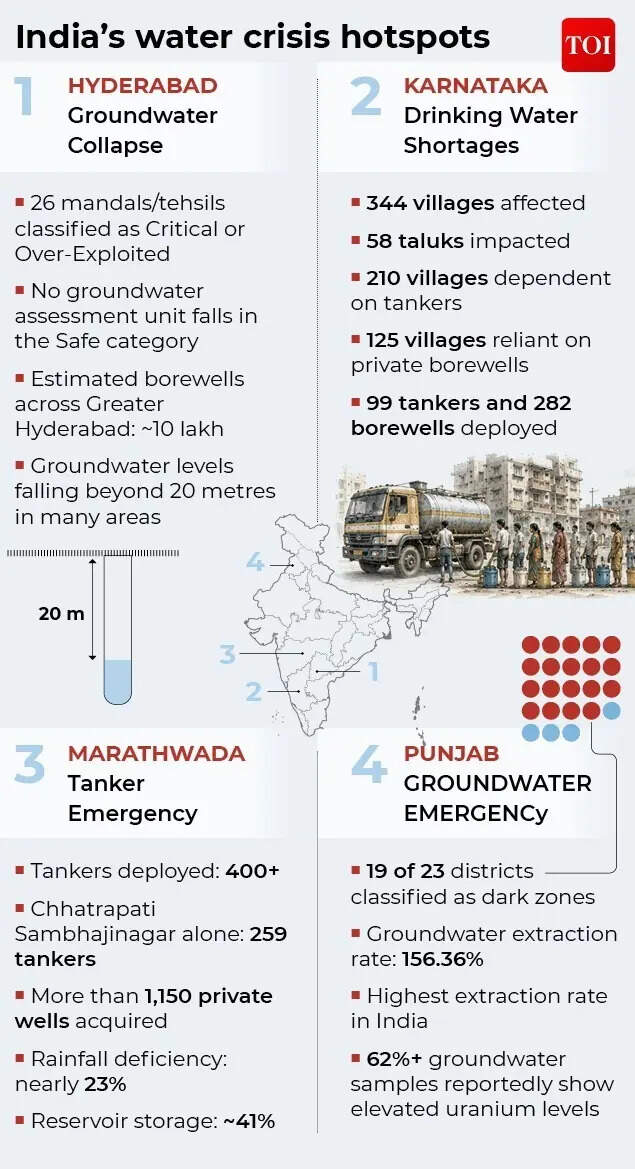
Funding gaps remain a challenge in KarnatakaAuthorities say limited funding is making it difficult to fully address the crisis.Of the Rs 60 crore allocated for emergency drinking water works during 2025-26, only Rs 43.7 crore has been released. Against a total requirement of Rs 132.2 crore, officials have received Rs 91.5 crore.“We are working towards mitigating drinking water supply issues and ensuring that every household has access to sufficient and good quality drinking water,” said Randeep D, director, rural water supply & sanitation department.Maharashtra’s Marathwada sees tanker deployment cross 400In Maharashtra, the water crisis has intensified sharply across the Marathwada region.The number of water tankers deployed has now crossed 400, more than doubling from around 156 tankers recorded a month earlier.Chhatrapati Sambhajinagar is the worst-affected district and accounts for nearly two-thirds of all tanker operations.Official figures show that the district has 259 tankers in service, followed by Jalna with 85, Dharashiv with 17, Nanded with 14, Parbhani with 11, Beed with eight, Latur with three and Hingoli with two.“Over 1,150 private wells have been acquired in the region for refilling tankers and fulfilling the water needs of affected residents. Standing instructions have been in place to arrange a tanker if villagers claim scarcity,” a senior official from the revenue department said, appealing to residents to ensure judicious use of water.Rainfall deficiency worsens Marathwada’s water woesMarathwada has received only 38 mm of rainfall since June 1, reflecting an overall rainfall deficiency of nearly 23%.Some districts have recorded even larger deficits, including Chhatrapati Sambhajinagar at 73%, Jalna at 62% and Hingoli at 55%.Earlier official figures showed that 127 villages and hamlets across the region were facing severe shortages, with Chhatrapati Sambhajinagar accounting for 85 affected settlements.“As the summer progresses, drinking water sources are depleting, leading to scarcity in several pockets. Local authorities have standing instructions to arrange water tankers immediately upon receiving complaints from residents,” said a senior official from the Chhatrapati Sambhajinagar Divisional Commissioner’s office.Reservoir levels and heatwaves add pressureLive storage in major, medium and minor irrigation projects across Marathwada has dropped to around 41%.Although storage levels remain slightly better than last year, several reservoirs have reached concerning levels.The crisis has been worsened by extreme temperatures. During late April, parts of Marathwada recorded temperatures around 43°C, accelerating evaporation losses and increasing pressure on available water resources.Punjab faces groundwater depletion and uranium contaminationPunjab is confronting a different but equally serious water challenge, combining excessive groundwater extraction with contamination concerns.Rajya Sabha MP Satnam Singh Sandhu raised the issue during Question Hour, warning that the state is facing a “water emergency”.According to Sandhu, 19 of Punjab’s 23 districts have been classified as dark zones, indicating severe over-exploitation of groundwater resources.Punjab’s extraction rate highest in the countryAccording to MP Satnam Singh Sandhu said Punjab’s groundwater extraction rate has reached 156.36%, the highest in India and far above the national average of around 60%.He linked the situation largely to water-intensive paddy cultivation.“Punjab is facing a water emergency. Due to paddy cultivation, 19 districts are in the dark zone and more than 62% of the groundwater samples contain uranium levels higher than anywhere else in the country. The high uranium content poses a potential risk of cancer,” he said.He also cited findings suggesting that groundwater levels could fall below 300 metres by 2039 if current extraction trends continue.Centre announces funding for water conservationResponding to the concerns, Union jal shakti minister CR Patil said the Centre has allocated Rs 32,000 crore in the current financial year for water conservation and the revival of dark zones under the Viksit Bharat Guarantee for Rozgar and Ajeevika Mission.The minister said water-stressed regions are being prioritised for intervention and funding.Patil also highlighted the importance of public participation in water conservation efforts, stating that around 44 lakh water conservation structures have already been created nationwide.He added that the “Karmabhoomi se Matrabhoomi” initiative aims to encourage NRIs and migrants to support water conservation projects in their native villages, with a target of creating one crore such structures across the country.Growing warning signs across IndiaThe situations unfolding in Hyderabad, Karnataka, Marathwada and Punjab underline the growing pressure on India’s groundwater resources.From unchecked extraction and rapid urbanisation to drought conditions, contamination and climate stress, the challenges vary across regions. However, experts agree that stronger groundwater recharge measures, sustainable water management and large-scale conservation efforts will be essential to prevent the crisis from worsening in the coming years.
Should rainwater harvesting systems be mandatory for all new constructions in cities facing water shortages?