
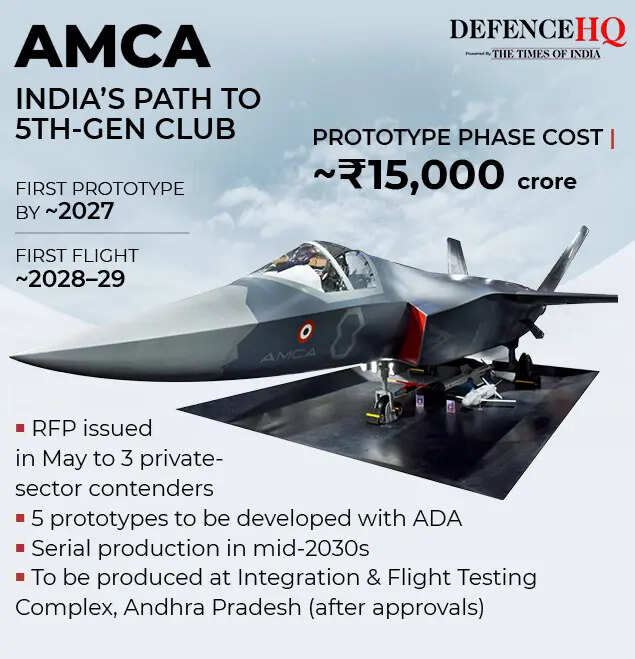
NEW DELHI: India has formally entered one of the most complex aerospace development journeys in its history, launching the next phase of the Advanced Medium Combat Aircraft (AMCA) programme that aims to deliver the country’s first indigenous fifth-generation stealth fighter.The project arrives at a crucial moment for the Indian Air Force (IAF), which faces declining squadron strength amid an increasingly sophisticated security environment in Asia. In May, the defence ministry issued a Request for Proposal (RFP) to three shortlisted private-sector consortia for the development and production of the AMCA, marking a historic shift in India’s defence manufacturing ecosystem.
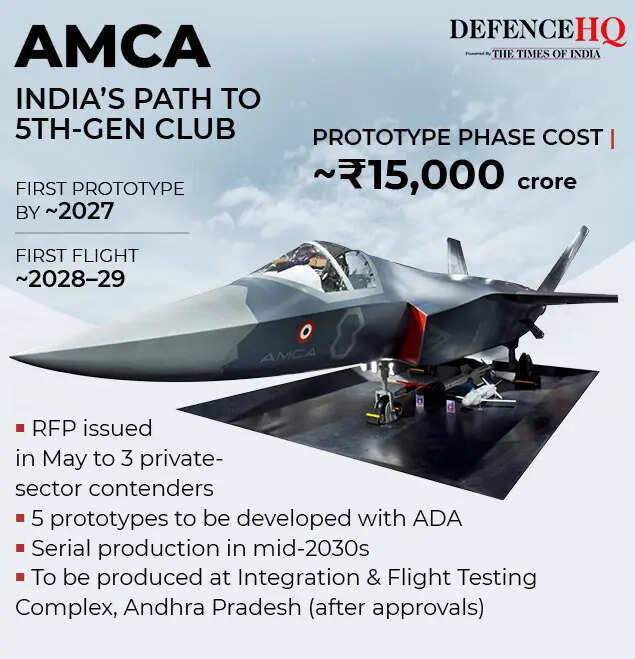
For the first time, a major Indian fighter aircraft programme is expected to be led by private industry, with the selected company partnering with the Aeronautical Development Agency (ADA), the Defence Research and Development Organisation’s aircraft design arm, to develop five flying prototypes. The prototype development phase alone is expected to cost approximately Rs 15,000 crore.If successful, the AMCA would place India among a small group of nations capable of designing, testing and producing operational fifth-generation fighters — a club currently dominated by the United States, China and Russia.
But the significance of the AMCA extends far beyond a new aircraft. It represents India’s attempt to master some of the most advanced technologies ever developed in aerospace engineering, from stealth design and sensor fusion to advanced propulsion systems and artificial intelligence.In a conversation with The Times of India, Srijan Pal Singh, author and former Advisor for Policy and Technology to Dr APJ Abdul Kalam, CEO of Homi Lab and Founder of Kalam Centre, explained the challenges, opportunities and technological hurdles that lie ahead for India’s most ambitious fighter programme.
Why India needs a fifth-generation fighter
The Indian Air Force currently operates a diverse combat fleet that includes the Su-30MKI, Rafale, Mirage 2000, MiG-29 and the indigenous Tejas fighter.While these aircraft continue to provide substantial combat capability, they largely belong to the fourth and 4.5-generation categories. They feature advanced radars, electronic warfare suites, precision-strike weapons and modern avionics, but they lack the integrated stealth architecture and sensor fusion capabilities that define true fifth-generation aircraft.The strategic environment is changing rapidly.
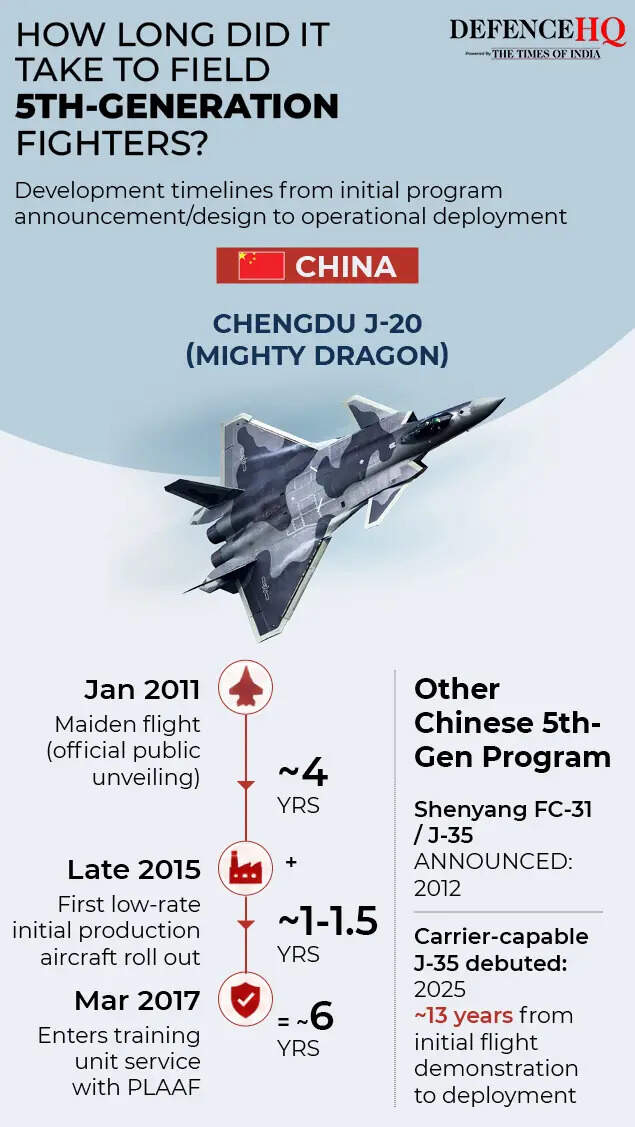
China has already inducted the J-20 stealth fighter and the carrier-capable J-35. Pakistan continues to modernise its air force while deepening defence cooperation with Beijing. At the same time, modern integrated air-defence networks are becoming increasingly capable of detecting and engaging conventional combat aircraft.Against this backdrop, the Indian Air Force requires a platform capable of surviving in highly contested airspace while operating as a central node in a networked battlefield.That platform is expected to be the AMCA.
What makes a fighter truly fifth generation?
Unlike earlier generations of combat aircraft, fifth-generation fighters are not defined by a single technological breakthrough.Instead, they combine multiple advanced technologies into a unified platform.These include stealth shaping, radar-absorbing materials, internal weapons bays, sensor fusion, advanced avionics, highly networked warfare capabilities, supercruise performance and low-probability-of-intercept radar systems.The objective is simple but revolutionary: see first, shoot first and survive first.Modern air combat increasingly revolves around information superiority rather than pure speed or manoeuvrability. A pilot who can detect and identify an adversary before being detected gains a decisive advantage long before a traditional dogfight becomes possible.
Q&A: Why AI and sensor fusion matter
When asked how important artificial intelligence and sensor fusion are compared with traditional measures such as speed and manoeuvrability, Srijan said:“AI and sensor fusion are now becoming as decisive as classic measures like speed and manoeuvrability. Modern air combat is increasingly settled by who can detect, identify and engage an opponent first. Advanced fighters draw data from radar, infrared sensors, electronic-warfare systems, drones and other platforms. Sensor fusion merges that information into a single, coherent picture, helping pilots decide faster and better, while AI can further cut pilot workload by prioritising threats and assisting with mission management.This reflects a shift in air warfare. Modern air-to-air missiles can engage well beyond 100 km, making situational awareness a decisive edge. This is why the ability to ‘see first and shoot first’ matters as much as raw speed or agility. For the AMCA, success will therefore depend not only on aerodynamic performance but on the quality of its sensors, software and data processing.”
The AMCA blueprint
The AMCA is being designed as a twin-engine, medium-weight, multirole stealth fighter capable of performing air-superiority missions, deep-strike operations, suppression of enemy air defences and precision ground attacks.Current plans indicate the aircraft will feature internal weapons bays, advanced electronic warfare systems, supercruise capability and AI-assisted mission management.The aircraft is expected to operate at altitudes of up to 55,000 feet and carry approximately 1,500 kilograms of weapons internally while also accommodating larger external payloads when stealth is not a priority.Beyond the fighter itself, the programme is expected to become a technology incubator for future Indian aerospace projects, including unmanned combat aircraft and next-generation missile systems.
Stage One: Defining military requirements
Every fighter programme begins with a fundamental question: What does the military need the aircraft to do?The answer influences every subsequent design decision.For the Indian Air Force, this means establishing parameters such as combat radius, payload, survivability, radar cross-section, speed, maintenance requirements and sensor performance.Once requirements are finalised, changing them becomes extremely costly. Even minor modifications can trigger redesigns, delays and budget overruns.This is why military planners spend years refining operational requirements before engineers commit to a final aircraft configuration.
Designing an Aircraft from scratch
After operational requirements are established, engineers begin translating military objectives into an actual aircraft.This process involves aerodynamic modelling, digital twins, computer simulations and systems engineering.Every design decision involves compromise.A larger aircraft may carry more fuel and weapons but can become easier to detect. Greater stealth may reduce aerodynamic efficiency. More powerful engines can improve performance while simultaneously increasing infrared signatures.The challenge is to balance all of these competing demands within a single platform.Thousands of design iterations are often evaluated before a final configuration is approved.
The stealth challenge
Stealth remains among the most difficult aspects of fighter development.Contrary to popular perception, stealth does not make an aircraft invisible. Instead, it significantly reduces the aircraft’s detectability across multiple sensor systems.Aircraft surfaces are carefully shaped to redirect radar waves away from enemy sensors. Radar-absorbing materials minimise reflected energy. Exhaust systems are engineered to suppress infrared signatures.Even seemingly minor details can affect stealth performance. An exposed sensor, misaligned access panel or poorly designed surface edge can increase radar visibility.As a result, stealth considerations influence virtually every aspect of the aircraft’s design and manufacturing process.
The biggest technological hurdle: The engine challenge
Among all the technologies required for a fifth-generation fighter, propulsion remains perhaps the most difficult.When asked about the single biggest technological hurdle India must overcome before the AMCA enters service, Srijan said:“The biggest hurdle is the development of a high-thrust fighter jet engine. India has made major advances in aircraft design, avionics, sensors and stealth technologies, but building a modern combat jet engine remains one of the hardest challenges in aerospace engineering. It demands mastery of advanced metallurgy, precision manufacturing and sophisticated control systems, a capability only a handful of countries possess.The AMCA programme reflects this. The first version of the aircraft, the AMCA Mk1, is expected to fly with two American GE F414 engines. For the more advanced AMCA Mk2, India is targeting a more powerful engine in the 110–120 kN thrust class. India has been exploring co-development with Safran for a future high-thrust engine. The long-term goal is to build most of the engine within the country and reduce dependence on foreign suppliers.“
Building the first prototypes
Following years of design work, the programme enters the prototype development phase.For the AMCA, five prototypes will be built by the selected industrial partner in collaboration with ADA.These aircraft serve as flying laboratories rather than production models.Engineers use them to validate aerodynamic assumptions, evaluate onboard systems and identify issues that simulations cannot fully predict.Prototype testing frequently uncovers software integration challenges, structural concerns, vibration problems and thermal-management issues.Such discoveries are not signs of failure. They are an expected part of fighter development.
Why the first flight is only the beginning
A fighter’s maiden flight often generates headlines, but in reality it marks the beginning of the most demanding phase of development.Flight-testing can continue for years. Engineers and test pilots gradually expand the aircraft’s operating envelope, evaluating performance across different altitudes, speeds and mission profiles.Weapons integration, radar performance, electronic warfare systems and emergency procedures must all be validated before certification can begin.
Q&A: What are the major stages before induction?
Explaining the process, Srijan said:“A fighter aircraft must pass through several stages before it can be inducted into an operational squadron. First comes the design and development phase, during which engineers finalize the aircraft’s configuration, systems, sensors, weapons integration, and stealth features. This is followed by the construction of prototypes.Next is the flight-testing phase. Prototype aircraft undergo hundreds, and often thousands, of test flights to evaluate their performance, handling, safety, radar systems, electronic warfare suite, weapons integration, and mission capabilities. Any shortcomings identified during testing must be corrected.
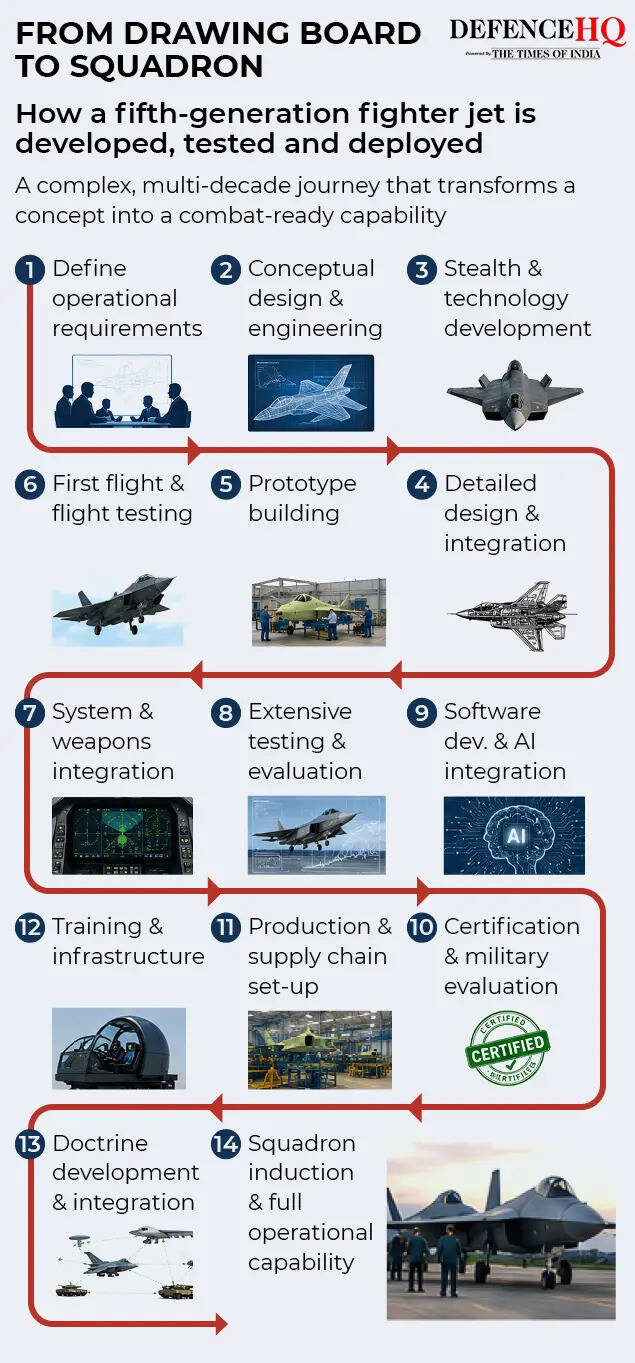
The aircraft then enters certification and user evaluation. The air force assesses whether it meets operational requirements under realistic combat conditions. This stage includes testing in different environments, altitudes, and weather conditions.Once the design is validated, the programme moves to limited series production. A small number of aircraft are built to verify manufacturing processes and ensure consistency between prototypes and production models.The next step is full-scale production, along with the establishment of maintenance infrastructure, pilot training programmes, simulators, spare parts supply chains, and support systems.Finally, the aircraft achieves operational clearance and is inducted into frontline squadrons. Even after induction, upgrades and refinements continue throughout its service life.”
The software-defined fighter
Modern fifth-generation fighters are increasingly described as software-defined aircraft.Millions of lines of code manage flight controls, mission planning, sensor fusion, radar operations and electronic warfare functions.Sensors located across the aircraft continuously collect information from the battlefield.Computers process and merge this information into a single tactical picture, reducing pilot workload and accelerating decision-making.The aircraft effectively becomes a flying data-processing centre.
When does a fighter become truly operational?
A key question in any fighter programme is determining when an aircraft can genuinely be considered combat-ready.According to Srijan:“A fighter aircraft is generally considered truly operational only after it achieves Initial Operational Capability (IOC), though Full Operational Capability (FOC) marks its complete maturity.A first flight simply demonstrates that the aircraft can fly safely. Certification confirms that key systems meet performance and safety requirements. Neither means the aircraft is ready for combat operations.IOC is reached when the aircraft can perform core missions with trained pilots, maintenance crews, and a basic set of weapons and systems. At this stage, it can be inducted into operational squadrons and begin military service.FOC comes later. It signifies that the aircraft can employ its full range of weapons and sensors and perform the complete spectrum of missions for which it was designed. For most air forces, IOC is generally treated as the point when a fighter becomes operational, while FOC reflects full maturity.”
Why the indigenous engine matters
While the AMCA Mk1 will fly with imported GE F414 engines, India’s long-term objective is to develop an indigenous high-thrust engine for future variants.Discussing the importance of this effort, Srijan said:“The indigenous engine programme is critical to the long-term success of the AMCA. The Mk1 will rely on the imported GE F414, but India’s long-term aim is a more powerful 110–120 kN engine for the Mk2 and beyond. And India is considering co-developing the engine with Safran, though the deal is still being worked out and has not been finalized.An indigenous engine would reduce dependence on external suppliers and give India greater control over upgrades, maintenance, production rates and exports. It would also ensure that foreign technology restrictions do not constrain future improvements to the aircraft.Beyond the AMCA itself, mastering fighter-engine technology would be a major leap for India’s aerospace industry. Jet engines are among the most complex machines ever built, and only a few nations can design and produce modern high-performance fighter engines. Success here would significantly strengthen India’s broader push for self-reliance in defence.”
How realistic is the timeline?
Current plans envision the first AMCA prototype emerging around 2027, a maiden flight by 2028-29 and induction into service during the mid-2030s.Asked whether these timelines are realistic, Srijan said:“Developing a fighter aircraft is an enormously complex undertaking. A typical fighter jet contains about 600,000 individual parts. These include structural components, fasteners, advanced sensors, and software systems. All of these must function reliably in extreme operating conditions.Even established aerospace powers have found that designing, testing and certifying a fifth-generation fighter can take well over a decade. For that reason, I consider the proposed AMCA timeline optimistic.That said, several factors work in the AMCA’s favour. Unlike earlier indigenous programmes, it is not starting from scratch. The project builds on decades of experience gained through the Tejas programme, as well as advances in radar, avionics, stealth design, sensors and systems integration. Many of the technologies required for the aircraft are already under development or have been demonstrated in other Indian programmes.Under the prototype-development tender, with the contract expected to be signed around the end of 2026, the RFP sets milestone-based deadlines that target the maiden flight of the first prototype roughly 30 months later. This means the first flight of AMCA would be around 2028–29, with induction into Indian Air Force service in the mid-2030s. This would be broadly consistent with the timelines of other fifth-generation fighter programmes around the world.“
Lessons from the F-35 and Su-57
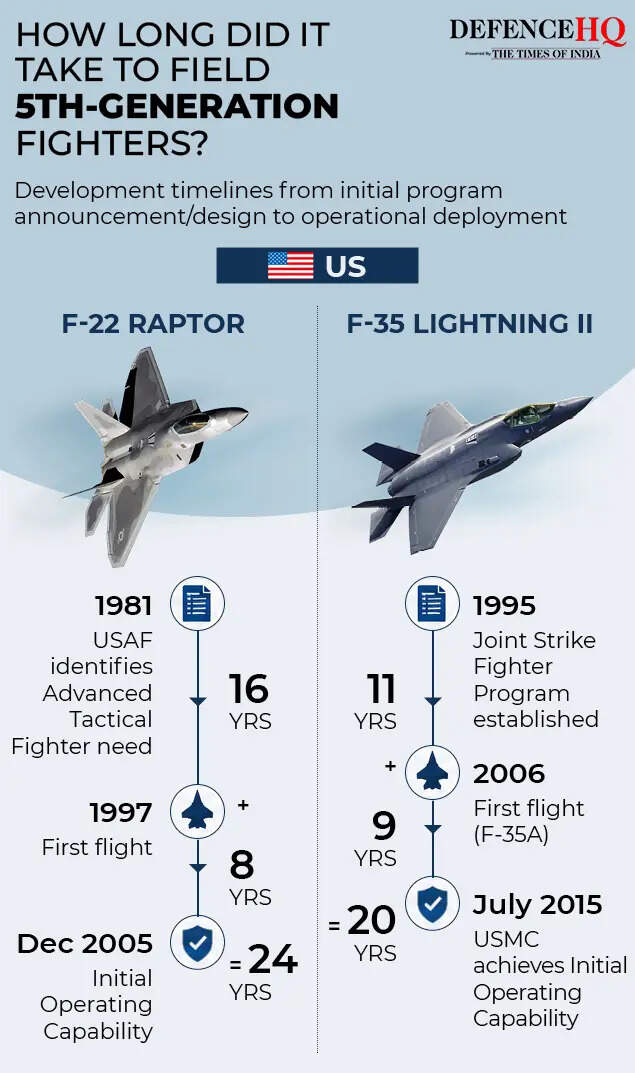
History suggests that developing fifth-generation fighters is rarely straightforward.The United States took nearly 24 years to move from the launch of the Advanced Tactical Fighter programme to the operational deployment of the F-22 Raptor. The F-35 similarly required nearly two decades of development.China’s J-20 and Russia’s Su-57 followed comparable timelines despite significant national investments.
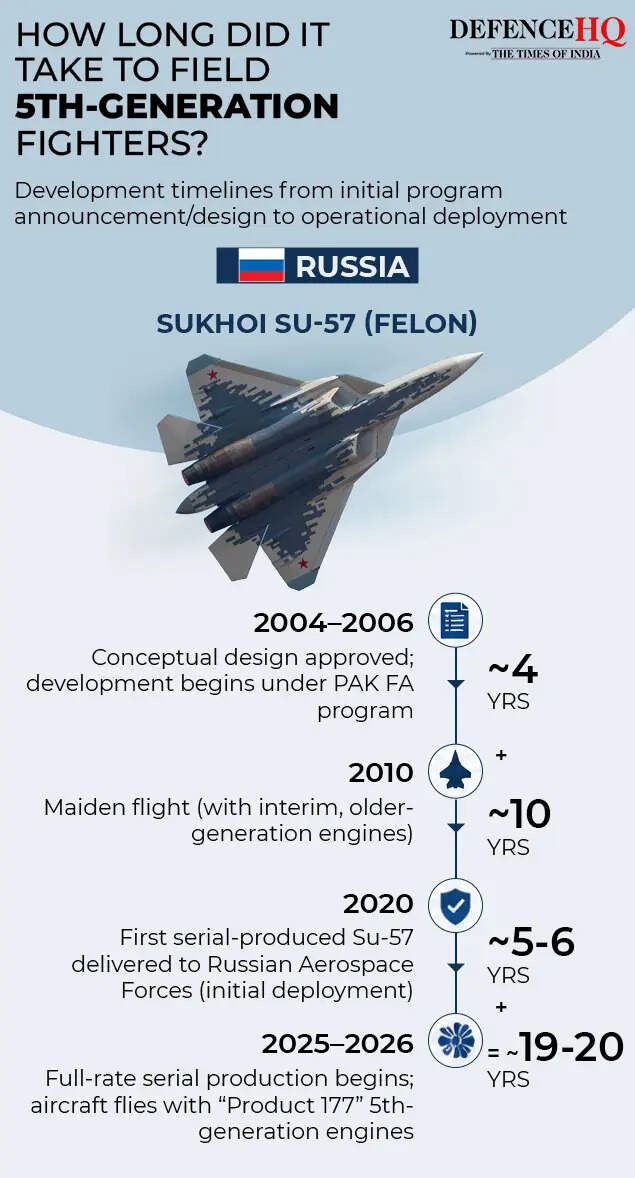
Asked what lessons India can learn from those experiences, Srijan said:“Developing a fifth-generation fighter is long and complex even for established aerospace powers. For example, the American F-35 programme began in 2001. The aircraft first flew in 2006 and entered service with the US Marine Corps in 2015. This means it took about 14 years from launch to induction, and roughly nine from first flight to service entry.Russia’s Su-57 followed a similar arc. Development began in the early 2000s, the first prototype flew in 2010, and the aircraft formally entered service in 2020. This means nearly two decades from programme start to induction, and about ten years from first flight to service entry.One lesson is that integrating multiple cutting-edge technologies simultaneously, including stealth, advanced sensors, mission software, electronic warfare and weapons, throws up unexpected challenges that must all be made to work together.A second is the importance of extensive testing: both jets needed years of trials to find and fix problems, and rushing into production before systems mature tends to raise costs and cause delays later.The engine offers a third lesson. The Su-57 entered service with an interim engine while a more advanced engine was still being developed, closely mirroring India’s plan to fly the Mk1 on the GE F414 before switching to a more powerful engine on the Mk2.Taken together, these examples suggest the AMCA’s timeline is not unusual: a first flight around 2029 and service entry in the mid-2030s would track the development cycle of other fifth-generation fighters.”
Will AMCA be India’s F-35?
The inevitable comparison is with aircraft such as the American F-35 and China’s J-20.However, Srijan believes the comparison should be viewed differently.“The AMCA is best seen as a fifth-generation fighter designed around India’s requirements rather than as a direct rival to any single foreign aircraft. It will incorporate key fifth-generation features such as stealth, advanced sensors, sensor fusion, and internal weapons bays. In that sense, it belongs to the same broad category as aircraft like the F-35 and J-20.
However, each of these aircraft reflects different operational priorities. The F-35 is built around sensor fusion and networked warfare and operates within a large alliance system. The J-20 appears to place greater emphasis on long-range operations and air dominance.The AMCA is expected to follow a different path. India is not trying to match the production scale of the United States or China. Instead, the focus is on building a networked, sensor-rich aircraft that can work closely with drones, airborne early warning aircraft, and ground-based systems. In the future, it may also operate alongside unmanned “loyal wingman” aircraft.Ultimately, the success of the AMCA will not be judged solely by how it compares with the F-35 or J-20. The more important question is whether it can provide the Indian Air Force with a credible indigenous fifth-generation capability suited to India’s operational needs.”
India’s aerospace moment
The AMCA is ultimately about much more than replacing ageing aircraft.It represents a test of India’s ability to master advanced aerospace technologies, integrate public and private industry and establish a sustainable ecosystem for high-end defence manufacturing.The road ahead will be long, technically demanding and expensive.Yet if India succeeds, the reward will extend beyond a new fighter jet. It will signal the arrival of a nation capable of designing, testing and producing one of the most sophisticated military platforms ever created.For India’s aerospace sector, the AMCA may ultimately prove to be its defining moment.