
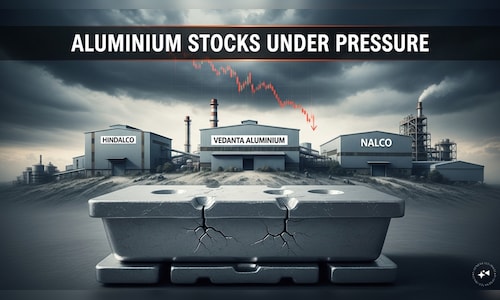
How Are Aluminium Stocks Faring?
Shares of Vedanta Aluminium, which made their stock market debut on Monday, having demerged from their parent company Vedanta Ltd., are locked in a 5% lower circuit for the second straight trading session.
Hindalco, whose unit Novelis resumed operations at the Oswego Hot Mill recently after last year’s fire, are also trading with losses of 3.6% on Tuesday. This is the fifth straight day of losses for the stock, which has now declined in nine out of the last 10 trading sessions.
NALCO’s shares are the top losers on the Nifty Metal index on Tuesday, having declined nearly 5%. The stock has declined in six out of the last nine trading sessions.
Why Are Aluminium Stocks Falling?
The recent interim peace deal announced between the US and Iran has resulted in the global markets repricing the war premium for the metal.
As a result, global Aluminium prices are down nearly 10% from their recent peak. At the end of May 2026, the prices had hit their highest level in four years.
Despite this fall, the analysts are factoring in the average price of Aluminium to be around $3,200 – $3,300 per tonne over the next two years. Additionally, global markets are expected to remain in deficit for the next two years as well.
What Can Support Aluminium Prices Going Ahead?
The gulf countries, along with Iran, have a smelting capacity of around 7 MTPA.
Emirates Global Aluminium said on March 28 that it had sustained significant damage at its site at the Khalifa Port Industrial Zone in Abu Dhabi, following Iranian attacks. Aluminium Bahrain (Alba) had also said that it is assessing the extent of damage to its facility. It further said that it will reduce the production of Value Added Products, which are used in an array of industries, including aerospace and defence.
A resumption of these damaged facilities could take another nine months.
Additionally, China’s aluminium production capacity is capped at 45 MTPA, and is already functioning at utilization levels of 97%.
Lastly, thematic drivers like AI, data centers, energy transition, could continue to keep demand robust, as Aluminium is a key component for all.