
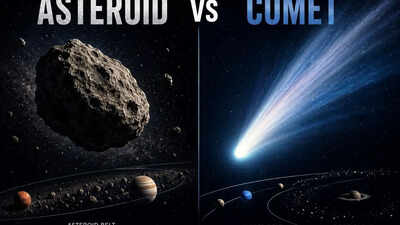
The night sky occasionally offers a reminder that the Solar System is far from empty. Bright comets appear with glowing tails, while reports of passing asteroids often make headlines. Although the two are frequently mentioned together, they are not the same kind of object. Both are remnants from the earliest stages of Solar System formation, surviving for around 4.6 billion years, yet they developed in very different environments and carry distinct characteristics. According to NASA, asteroids are largely rocky leftovers from the formation of the inner Solar System, while comets are icy bodies that originated in the colder outer regions beyond the giant planets. Understanding those differences helps explain why one usually appears as a bright object with a tail while the other often remains an unremarkable rocky traveller in space.
Asteroid vs Comet : Comparing the solar system’s ancient survivors
Key differences between asteroids and comets
Main compositionAsteroids are primarily made of rock, metal and mineral-rich material that formed in the warmer inner Solar System. Comets contain large amounts of ice, frozen gases, dust and rocky particles. This difference in composition explains why comets become active near the Sun while asteroids usually remain unchanged.Place of originAsteroids formed closer to the Sun, where temperatures were too high for volatile compounds to remain frozen. Comets originated much farther away in colder regions of the Solar System. These contrasting birthplaces shaped their composition, structure and behaviour, creating two very different types of ancient celestial objects.Typical location todayMost asteroids are concentrated in the Asteroid Belt between Mars and Jupiter, although some travel elsewhere. Comets are generally found in distant reservoirs such as the Kuiper Belt and Oort Cloud. These remote regions preserve icy bodies that occasionally move inward and become visible from Earth.AppearanceAsteroids usually appear as small rocky objects with irregular shapes and cratered surfaces. Comets can transform dramatically when approaching the Sun, developing a glowing coma and one or more tails. This makes comets among the most visually striking objects in the night sky compared with asteroids.Reaction to the SunSunlight has little effect on most asteroids because they contain relatively little ice. Comets react very differently. As they approach the Sun, heat causes frozen material to vaporise, releasing gas and dust into space. This process creates the bright features that distinguish active comets from asteroids.Orbit lengthMany asteroids follow comparatively stable paths around the Sun and complete their orbits within predictable periods. Comets often travel on highly elongated routes that can take hundreds, thousands or even millions of years to complete. Some long-period comets may visit the inner Solar System only once.SurfaceAsteroid surfaces are generally rocky, metallic and heavily marked by collisions that occurred over billions of years. Comets have darker surfaces covered with dust, organic material and frozen compounds. Spacecraft observations show that comet nuclei can contain cliffs, pits and jets where gases escape into space.Visibility from EarthMost asteroids are too small and faint to be seen without telescopes or specialised equipment. Comets can become much easier to observe when sunlight illuminates their expanding coma and tails. During particularly bright appearances, some comets are visible to the naked eye for several weeks.
Why are these ancient space objects important to modern science
Asteroids and comets are often described as time capsules because they preserve material from the Solar System’s earliest era. Studying them allows researchers to investigate conditions that existed long before Earth reached its current form.Scientists are particularly interested in comets because they may have delivered water and organic compounds to the early Earth. Asteroids are equally valuable, offering clues about how rocky planets developed and evolved. Together, these ancient objects provide some of the clearest evidence of the processes that shaped our planetary neighbourhood billions of years ago, making them far more than wandering rocks and ice drifting through space.