
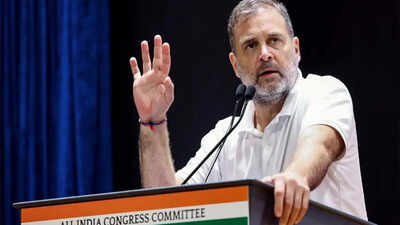
NEW DELHI: Congress leader Rahul Gandhi on Tuesday launched a fresh attack on the Modi government over the temporary ban on Telegram ahead of the NEET-UG 2026 re-examination, calling it a diversionary tactic that targets students rather than the paper leak networks responsible for exam fraud.In a post on X ahead of his “Chhatron Ki Goonj” rally in Kota, Rahul Gandhi criticised the government’s decision to block access to the messaging platform and accused it of failing to act against those behind repeated examination leaks.Calling the move the “Modi Government’s New Trick to Stop Paper Leaks,” Gandhi wrote: “Meaning, instead of catching the thief, just hang a lock on the victim’s door.”The Congress leader argued that Telegram has long been used by students for educational purposes and questioned how restricting access to the platform would address the root cause of paper leaks.“Millions of students have been studying on Telegram for years – notes, test series, discussions, preparation. How does snatching that facility become the solution to paper leaks?” he said.Rahul Gandhi further claimed that the move would not prevent future leaks and suggested that those involved in organised examination fraud would easily find alternative methods.“And it’s not even foolproof – every student in the country knows this, and so does the paper leak mafia. So, who will the next ban be on? WhatsApp?” he asked.Escalating his criticism, Gandhi accused the government of focusing on optics instead of tackling the underlying problem.“On exam day, students will be frisked. Pockets will be cut open with scissors. Question papers will be sent via the Air Force. There won’t be any shortage of theatrics.”“But not a single strike at the root of the disease – because the paper leak mafia is thriving under this very government’s watch, and making the youth cry tears of blood.”Addressing Prime Minister Narendra Modi directly, Gandhi said: “Modi Ji – drop the theatrics. Strike at the mafia, not the students.”He also linked the issue to his nationwide student outreach campaign, adding: “Listen to the ‘Echo of Students’ – or else the youth of the country knows how to claim their rights.”The remarks come as Gandhi prepares to address a major rally in Kota under the banner of #ChhatronKiGoonj, a campaign launched by the Congress to highlight issues such as paper leaks, examination irregularities, recruitment delays and rising education costs.
BJP hits back
The BJP swiftly responded to Gandhi’s remarks, accusing him of attempting to exploit students’ concerns for political gain.Reacting to the Congress leader’s post, BJP MP Sudhanshu Trivedi said Gandhi’s comments reflected a “very obnoxious mindset” and questioned the timing of the criticism.“Whatever Rahul Gandhi has tweeted, I think his nefarious and very obnoxious mindset has come out in the open… We can discuss the future after these 72 hours. What is the urgency of these 72 hours, because he’s using the word battleground. Battleground of what? A defeated leader, a defeated army general who has had his political party defeated by his series of misjudgements. Now he wants to use this sensitive occasion, and he wants to exploit the feelings of students...” Trivedi said.
Kota rally amid examination controversy
Rahul Gandhi’s remarks come days before the NEET-UG 2026 re-examination scheduled for June 21.The National Testing Agency ordered the re-test after the cancellation of the original examination following a paper leak controversy that triggered nationwide protests and investigations.The Congress has made the issue a central plank of its student outreach campaign. According to AICC general secretary K C Venugopal, the first phase of the “Chhatron Ki Goonj” movement begins in Kota and will later expand to Prayagraj, Patna and Delhi.Earlier, Gandhi had urged students to join the rally, accusing the government of failing to protect the future of young people.“Every paper leak, every canceled exam, every stalled recruitment – these aren’t just failures of the system, but blows struck against the dreams of millions,” he had said.The controversy also comes against the backdrop of the Centre’s decision to temporarily block Telegram under Section 69A of the Information Technology Act until June 22. The government and the NTA have argued that the restriction is necessary to curb cheating networks and prevent fraudsters from circulating fake question papers and misleading candidates ahead of the re-examination.Officials have maintained that the move is a temporary and targeted measure designed to protect the integrity of the June 21 examination, while opposition parties have accused the government of inconveniencing millions of students who use the platform for legitimate educational purposes.