
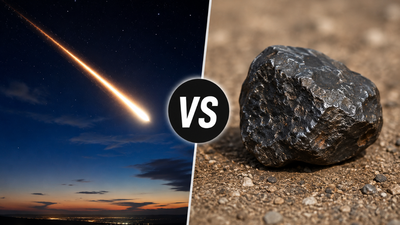
People often use the words meteor and meteorite interchangeably, usually when describing a bright streak of light crossing the night sky. The distinction is simple, though the objects involved are often the same piece of cosmic debris at different stages of its journey. Every day, Earth encounters material left behind by comets, broken asteroids and tiny fragments drifting through the Solar System. Most of these particles never reach the surface. They burn away high above our heads, creating the brief flashes commonly known as shooting stars. A small number survive the intense heat and pressure of atmospheric entry and eventually land on the ground. That location change is what determines whether scientists describe an object as a meteoroid, a meteor or a meteorite.
Meteor vs Meteorite : The science behind two similar-sounding terms
Understanding the meteor–meteorite distinction
DefinitionA meteor is not the object itself but the glowing phenomenon created when a small piece of space material rushes through the atmosphere at tremendous speed. The air around it becomes intensely heated, producing a visible streak of light.A meteorite is the remaining fragment that makes it all the way to the ground. Instead of disappearing in the atmosphere, part of the original object survives and can be recovered for study.LocationThe difference between the two begins with where they are found. Meteors exist only within the atmosphere, often many kilometres above Earth’s surface. Their appearance is temporary and linked to atmospheric entry.Meteorites are found on the ground. They may land in deserts, forests, oceans, ice fields or even populated areas. Once they reach the surface, they become physical specimens rather than fleeting events.AppearanceMost people recognise a meteor as a quick flash crossing the sky. Some are faint and visible only in dark conditions, while larger ones can appear exceptionally bright and leave glowing trails behind them.Meteorites look far less dramatic. They are pieces of rock or metal that often have dark outer surfaces formed by intense heating during their descent. Many resemble ordinary stones at first glance.VisibilityA meteor may be visible for only a second or two. The display is brief because the incoming material is travelling at extremely high speeds while rapidly losing mass through heating and ablation.Meteorites can remain where they land for thousands or even millions of years. Scientists and collectors search for them long after the original event has passed from memory.Formation stageThe meteor stage occurs during a fragment’s passage through the atmosphere. It represents an active process rather than a permanent object. The glowing trail marks the interaction between the incoming debris and atmospheric gases.The meteorite stage begins only after atmospheric entry is complete. Once the surviving fragment reaches the surface, it receives a different classification based on its new location.SurvivalMost incoming space debris never becomes a meteorite. NASA estimates that tens of tonnes of meteoritic material enter Earth’s atmosphere daily, yet nearly all of it is destroyed before reaching the surface.Meteorites represent the minority that endure the descent. Their survival depends on factors such as size, composition, speed and the angle at which they enter the atmosphere.Observation methodMeteor observations usually involve skywatchers, specialised cameras and monitoring networks designed to record bright fireballs. These observations help scientists understand the movement of small objects entering Earth’s atmosphere.Meteorites offer a different opportunity. Researchers can examine them directly in laboratories, analysing their minerals, chemical composition and age to learn more about the history of the Solar System.Scientific valueMeteors reveal information about the streams of debris Earth encounters in space. During annual meteor showers, observations can help scientists track the material left behind by comets along their orbital paths.Meteorites provide actual samples from beyond Earth. Because they originated elsewhere in the Solar System, they preserve evidence about planetary formation, ancient collisions and conditions that existed billions of years ago.
How meteor showers create some of the most familiar sights in the night sky
Meteor showers often add to the confusion. During these events, Earth moves through a trail of dust and debris left behind by a comet. Numerous meteors appear to radiate from the same area of the sky, creating a predictable annual display. Despite the increased activity, very little of this material reaches the ground. Most particles are tiny and burn away completely, meaning meteor showers are largely a spectacle of meteors rather than a source of meteorites. The distinction remains unchanged: if it is glowing in the atmosphere, it is a meteor; if part of it survives and lands on Earth, it becomes a meteorite.