
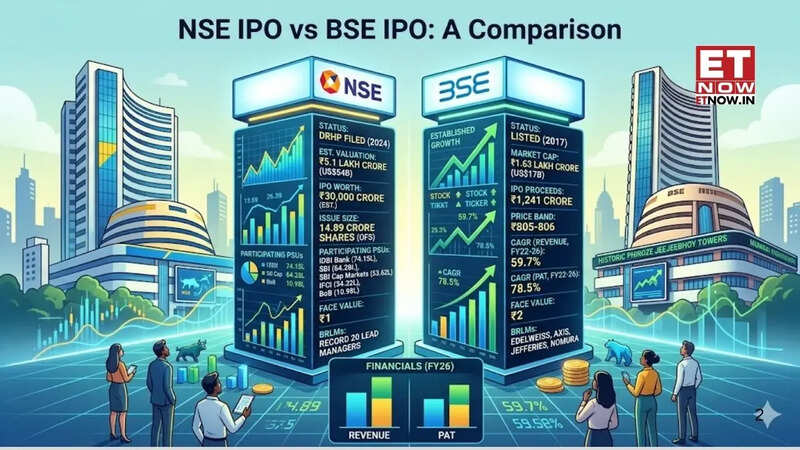
NSE IPO vs BSE IPO: The Indian primary market is gearing up for some significant momentum as the National Stock Exchange (NSE) files its DRHP with Sebi, bringing India’s most highly anticipated public listing to fruition after nearly a decade of delays.
The upcoming initial public offering is poised to transform the country’s stock exchange landscape, highlighting a striking dynamic between the two major rivals – as the unlisted NSE advances toward its stock market debut, its already-listed competitor, BSE Limited (BSE), continues to post massive growth in both revenue and profit, generating immense wealth for its shareholders since entering Dalal Street.
NSE IPO vs BSE IPO: Price Band
Back in 2017, BSE, Asia’s oldest bourse, set a price band of Rs 805-806 for the issue. At the upper end of the price band, the exchange was able to raise Rs 1,241 crore from the issue.
While the price band of the NSE’s IPO is yet to come, its unlisted shares are currently quoted at around Rs 2,055 in the grey market, a level that has fuelled expectations of a richly valued public issue. However, early signals indicate that the IPO price band may be set at a meaningful discount to this level, continuing a pattern seen in several recent high-profile listings.
NSE vs BSE: NSE commands over 3x BSE’s market value
At the current unlisted market price of around Rs 2,055 per share, NSE is valued at approximately Rs 5.1 lakh crore (about US$54 billion), making it India’s most valuable exchange by a significant margin.
On the other hand, BSE, trading near Rs 4,000 per share, commands a market capitalisation of around Rs 1.63 lakh crore (US$17 billion).
NSE’s larger equity base of 247.5 crore shares compared with BSE’s 40.6 crore shares contributes to its significantly higher valuation.
NSE vs BSE: Valuation gap narrows
While NSE is larger, BSE currently trades at richer valuation multiples.
BSE’s trailing price-to-earnings (P/E) ratio stands at 66 times compared with NSE’s 49 times. Similarly, BSE commands a price-to-book (P/B) multiple of 24 times versus NSE’s 16 times and a price-to-sales (P/S) ratio of 34 times against NSE’s 27 times.
The premium indicates investors are willing to pay more for shares of BSE, keeping in view its faster growth trajectory and expanding profitability.
| Metric | NSE (Unlisted / Pre-IPO) | BSE (Listed) |
| Share Price | Rs 2055 | Rs 4000 |
| Shares Outstanding | 247.5 Cr | 40.6 Cr |
| Market Capitalization | Rs 5.1 lakh Cr (US$54 Bn) | Rs 1.6 lakh Cr (US$17 Bn) |
| Trailing P/E | 49x | 66x |
| Book Value per Share | Rs 129.75 | Rs 164 |
| Price-to-Book (P/B) | 16x | 24x |
| Price-to-Sales (P/S) | 27x | 34x |
While the BSE IPO was open for public subscription from January 23, 2017, to January 25, 2017, the official date for the launch of the NSE IPO has not been announced yet. The offering is expected to be launched this year.
BSE IPO vs NSE IPO: Issue size, key stakeholders, face value
BSE IPO comprised an offer for sale of 1.54 crore shares by existing shareholders, including Singapore Exchange, Atticus Mauritius, Acacia Banyan Partners and Caldwell India Holdings Inc. The shares had a face value of Rs 2 each.
On the other hand, NSE’s public issue will be entirely an offer for sale (OFS) of 14.89 crore shares with existing shareholders collectively divesting nearly 6 per cent of the exchange’s stake. It has a face value of Re 1 each.
Institutional investors and state-run financial entities lead the list of selling shareholders in the public issue. The State Bank of India plans to divest the largest block of shares, offloading 24.75 million shares. MS Strategic (Mauritius) Limited follows as the second-largest seller with a proposed sale of 16.00 million shares, while the Canada Pension Plan Investment Board intends to offload 11.87 million shares in the public market.
Other major financial institutions trimmed their ownership through the offer for sale. Aranda Investments (Mauritius) Pte. Ltd. listed 11.25 million shares for divestment, followed closely by the Bank of Baroda with 10.98 million shares and the Stock Holding Corporation of India Limited with 10.89 million shares. State-backed insurers also joined the vendor list, with the General Insurance Corporation of India proposing a sale of 10.66 million shares, and The New India Assurance Company Ltd. liquidating 10.50 million shares. National Insurance Company Limited and United India Insurance Company Limited both offered 6.00 million shares each for sale.
BSE IPO vs NSE IPO: Issue Reservation
NSE offer is being made through the book-building process, wherein not more than 50 per cent of the net offer is allocated to qualified institutional buyers, and not less than 15 per cent and 35 per cent of the net offer is assigned to non-institutional bidders and retail bidders, respectively.
BSE IPO comprised a total issue size of 1,54,27,197 shares. Out of which, 77,13,598 (50 per cent) were allocated to QIB, 23,14,080 (15 per cent) allocated to NII, and 53,99,519 (35 per cent) allocated to RII, respectively.
BSE IPO vs NSE IPO: Book running lead managers and registrar
Edelweiss Financial Services, Axis Capital, Jefferies, and Nomura Financial Advisory and Securities (India) were global coordinators and book-running lead managers to the BSE issue.
Motilal Oswal Investment Advisors, SBI Capital Markets, Spark Capital, and SMC Capitals were the co-book running lead managers to the IPO.
On the other hand, the NSE has appointed a record 20 Book Running Lead Managers (BRLMs) or Merchant Bankers.
The exchange has appointed a diverse syndicate of domestic and global investment banks and financial institutions to manage the issue. The BRLMs include Kotak Mahindra Capital Company, JM Financial, Morgan Stanley India Company (marketing only), Citigroup Global Markets India, HSBC Securities and Capital Markets (India), J.P. Morgan India, SBI Capital Markets (marketing only), Anand Rathi Advisors, Avendus Capital, Axis Capital, DAM Capital Advisors, Equirus Capital, HDFC Bank, ICICI Securities (marketing only), IDBI Capital Markets & Securities, IIFL Capital Services, Motilal Oswal Investment Advisors, Nuvama Wealth Management, Pantomath Capital Advisors and 360 ONE WAM (marketing only).
MUFG Intime India Private Limited has been appointed as the registrar to the issue.
BSE vs NSE Revenue Growth: BSE leaves NSE behind
NSE’s revenue nearly doubled from Rs 8,313 crore in FY22 to Rs 16,601 crore in FY26, translating into a healthy compound annual growth rate (CAGR) of 18.9 per cent.
However, BSE delivered a far stronger performance. The company’s revenue multiplied from just Rs 743 crore in FY22 to Rs 4,834 crore in FY26, representing an impressive CAGR of 59.7 per cent.
| Period | NSE Revenue | BSE Revenue |
| FY22 | 8313 | 743 |
| FY23 | 11856 | 816 |
| FY24 | 14780 | 1371 |
| FY25 | 17141 | 2957 |
| FY26 | 16601 | 4834 |
| CAGR | 18.90% | 59.70% |
BSE vs NSE: Profit growth tells a similar story
NSE remains the earnings powerhouse of Indian capital markets, with its profit after tax (PAT) increasing from Rs 5,198 crore in FY22 to Rs 10,302 crore in FY26.
BSE, however, recorded a much steeper growth trajectory. Its net profit jumped from Rs 245 crore in FY22 to Rs 2,487 crore in FY26.
As a result, BSE posted a PAT CAGR of 78.5 per cent, significantly higher than NSE’s 18.7 per cent.
| Period | PAT | PAT |
| FY22 | Rs 5198 crore | Rs 245 |
| FY23 | Rs 7356 crore | Rs 206 crore |
| FY24 | Rs 8306 crore | Rs 772 crore |
| FY25 | Rs 12188 crore | Rs 1322 crore |
| FY26 | Rs 10302 crore | Rs 2487 crore |
| CAGR | 18.70% | 78.50% |
BSE vs NSE: IPO investors face a key question
As NSE moves closer to its public market debut, investors are likely to weigh its dominant market position, superior profitability, and extensive liquidity against BSE’s remarkable growth momentum and premium market valuation.
While NSE remains the country’s undisputed leader in terms of scale, BSE’s rapid growth in revenues and earnings suggests the competition between the country’s two leading exchanges is becoming increasingly intense.
The upcoming NSE IPO is expected to provide investors with a rare opportunity to participate in one of India’s most profitable financial market infrastructure institutions, while also setting a fresh benchmark for valuing stock exchange businesses in the country.
(Disclaimer: The above article is meant for informational purposes only, and should not be considered as any investment advice. ET NOW DIGITAL suggests its readers/audience to consult their financial advisors before making any money related decisions.)