
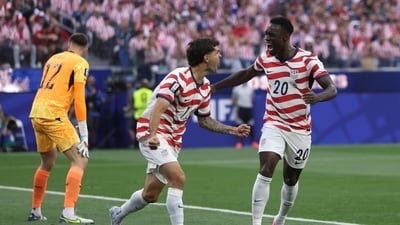
SEATTLE—As the U.S. ran riot in its opening game of the World Cup, the man in the opposing dugout could tell exactly what was happening.
The Americans were scoring goals for fun, cutting off passing moves before they began, and completely owning the middle of the field. That’s when Paraguay coach Gustavo Alfaro recognized the shape that has long instilled fear into American adversaries across the globe.
“They were setting up a pentagon,” he said, “to build attacks.”
The capital-P version outside Washington, D.C. might house America’s chief military strategists, but any tactical mind could appreciate the importance of America’s soccer pentagon to this World Cup campaign.
The four U.S. goals in the victory over Paraguay were the most ever scored by the Americans in the history of the tournament. And as the team prepares to play its second group stage game against Australia on Friday in Seattle, that shape also explains the more aggressive strategy adopted under coach Mauricio Pochettino.
The top of the pentagon was Folarin Balogun, the striker who wound up scoring two of the U.S. goals. Behind him, he had Weston McKennie on the right and Christian Pulisic, the team’s primary playmaker, on the left. Then further back, Malik Tillman and Tyler Adams formed the base in midfield.
Together, they controlled the action and allowed the Americans to press the ball, regain possession and attack again.
“That’s where they ultimately create a numerical advantage,” Alfaro said. “They’re a team that presents many challenges, because they have answers for every problem.”
Complex tactics have never exactly been a hallmark of American soccer. For much of its history, the team was known for its athleticism, its energy, and calling the sport by the wrong name. The hunt for a true U.S. identity outlasted the tenures of half a dozen coaches—without ever yielding what former boss Jurgen Klinsmann once called “a more proactive style of play.”
That’s where Pochettino came in. The proudest achievement of his career had been transforming Tottenham from a young, disjointed side into the one of English soccer’s most entertaining offensive teams, capable of reaching a Champions League final. And he pulled it off by using famously intensive training sessions, day after day, to mold his troops.
The challenge with translating that into international soccer is that Pochettino hardly ever sees his players. But from the moment he was introduced as the American boss in 2024, he committed to instilling a more dynamic playing style in his limited training camps.
“When we don’t have the ball, we need to run, we need to be aggressive, we need to be competitive,” he said then. “When the players arrive to the national team, they need to know exactly what we need to do.”
For most of Pochettino’s tenure, fans waited for that to become a reality. At one point in 2025, the team lost four consecutive matches to Panama, Canada, Turkey and Switzerland. But the camp ahead of the World Cup was the longest stretch Pochettino had with the team, and it all came together—at least for one game here.
The victory over Paraguay represented a marked change in style, and a breath of fresh air. Four years ago in Qatar, the U.S had only three goals across four games. The only times they exceeded five goals in a single World Cup campaign was at the inaugural tournament in 1930 and its run to the quarterfinals in 2002.
But against Paraguay, the U.S. didn’t merely run up the score. It controlled the ball, with 65% of the possession, and dominated positionally. The Americans had 175 passes in the attacking third—or seven times as many as Paraguay’s 25.
“We ended up playing really aggressive,” forward Tim Weah said. “And it worked out super well.”
Write to Andrew Beaton at andrew.beaton@wsj.com and Joshua Robinson at Joshua.Robinson@wsj.com