
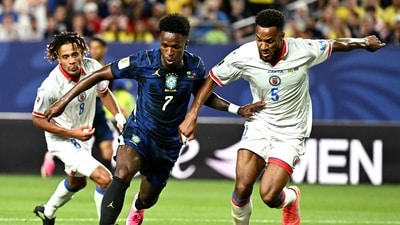
Brazil did not walk into the Haiti match merely needing a win. They needed evidence. The 1-1 draw against Morocco had not created panic, but it had reopened familiar doubts around the five-time world champions: too much dependence on individual brilliance, not enough attacking connection, an unclear centre-forward role, an imbalance between the two flanks, and a midfield that still needed to prove it could control matches without looking slow or stretched.
The 3-0 win over Haiti gave Carlo Ancelotti something to work with. It gave Brazil points, rhythm, goals and a cleaner public mood. It also moved them to the top of Group C on goal difference and eliminated Haiti from the tournament. But the more important question is not whether Brazil won. It is whether they found answers.
The honest verdict is this: Brazil found some answers, but not all. They solved the first layer of their problem. They have not yet proven that the solution will survive against stronger opposition.
Cunha gives Brazil their clearest answer
The biggest positive was Matheus Cunha. His inclusion ahead of Igor Thiago changed the feel of Brazil’s attack. Cunha did not play like a static No. 9 waiting for service. He moved, pressed, connected and attacked space. That gave Brazil exactly what they lacked against Morocco: a forward who could join the dots between midfield and the left-sided threat of Vinicius Junior.
His two goals were important, but the performance was about more than finishing. The first showed sharpness and instinct around the box. The second, from Vinicius’ pass, showed the value of a striker willing to make diagonal runs instead of staying fixed between centre-backs. With Cunha, Brazil looked less predictable. The attack had a reference point, but not a rigid one.
That is the first major answer for Ancelotti. Brazil’s centre-forward problem has not been solved forever, but Cunha has made himself very difficult to drop. Against Haiti, he gave the team a shape that looked more natural than the one seen in the opener.
Vinicius finally had a structure around him
The second answer came through Vinicius. For too long, Brazil’s use of Vinicius has carried a strange contradiction. He is one of the world’s most devastating attackers, yet the national team has often struggled to create the same conditions that make him so dangerous at club level. Against Haiti, Brazil finally gave him company.
Vinicius assisted both Cunha goals and scored the third himself before half-time. More importantly, he was not operating alone. Lucas Paquetá moved close enough to combine, Cunha attacked the spaces he opened, and Brazil’s left side became the team’s most productive route to goal. That triangle – Paquetá, Vinicius and Cunha – was the most encouraging tactical development of the game.
This matters because Brazil cannot afford to turn Vinicius into an isolated winger asked to beat two players every time the attack stalls. Against Haiti, he looked like the centre of a functioning mechanism rather than the emergency escape route. That is progress.
But it is still only a partial answer. Haiti gave Brazil space. They were brave, but also open. Stronger teams will crowd Vinicius, block the inside lane, and force Brazil to find another route. So the Haiti match proved that Vinicius can dominate when the structure supports him. It did not prove Brazil can still create when opponents remove that structure.
Paquetá’s role begins to make sense
Paquetá also benefited from Ancelotti’s adjustment. After a difficult opening game, he looked far more comfortable as the left-sided midfielder in the diamond. His job was not to be a pure playmaker or a luxury attacker. He had to support Vinicius, connect with Cunha and help Brazil create overloads on one side of the pitch.
That role suited him. It made his movements clearer and gave Brazil better spacing. His pass over the top for Vinicius’ goal was one of the cleanest examples of what Brazil can become under Ancelotti: not necessarily a side of endless passing combinations, but one that can use structure to free its most dangerous runner.
This is where the tactical picture becomes interesting. Brazil may not have a Neymar-like central creator available to knit everything together. But with Paquetá drifting left, Cunha moving intelligently, and Vinicius attacking from the outside, Ancelotti may have found a different way to manufacture creativity.
Again, though, the evidence is incomplete. Haiti allowed time on the ball. The real test will come when Brazil’s midfield receives pressure from more athletic, better-organised opponents.
The right side remains unresolved
For all the improvement on the left, Brazil’s right side remains a concern. Raphinha had an early goal ruled out for offside, but he did not truly impose himself before going off in the first half with a physical issue. His role still looks awkward. He is being asked to hold width and time his runs from the right, but he has not yet looked fully comfortable doing it.
That imbalance could become a serious issue. If Brazil’s best attacking pattern is heavily tilted towards Vinicius, opponents will adjust. They will shift bodies across, compress the left side and dare Brazil to hurt them from the opposite flank.
Rayan did not settle the question after coming on. Endrick got minutes and had a goal ruled out, but his involvement did not solve the structural issue either. Brazil still need either Raphinha to recover rhythm, Luiz Henrique to offer a more natural solution, or Ancelotti to reshape the right side entirely.
This was the biggest unanswered attacking question from the Haiti win. Brazil found a left wing. They did not find a balanced front line.
The defence had control, but not a real examination
Brazil’s clean sheet was useful, but it should not be overvalued. Haiti did not register a shot in the first half, which says plenty about Brazil’s early control. Marquinhos, Gabriel and Casemiro protected central areas well, and Alisson was mostly untroubled until Ricardo Ade’s second-half header forced a sharp save.
The numbers support the idea of a deserved Brazil win. Brazil produced 1.5 expected goals from eight shots, while Haiti managed only 0.23 from eight attempts. The problem is that this was not a full defensive stress test. Haiti had energy and spirit, but they lacked the quality to turn promising moments into sustained pressure.
So Brazil received reassurance, not proof. Their defensive structure looked competent against a limited opponent. Whether that same structure holds against faster transitions, more clinical wide players, and stronger midfield runners remains open.
The second half exposed the lingering doubt
The most revealing part of the match may have been what happened after Brazil went 3-0 up. The game was effectively over by half-time. Brazil could have pushed for a larger win, especially with goal difference potentially important in the race with Morocco. Instead, they dropped the tempo and managed the game.
There are two ways to read that. One is generous: tournament football is about control, not entertainment, and Brazil conserved energy once the job was done. The other is more critical: this team still does not naturally sustain attacking rhythm for 90 minutes.
The truth is probably somewhere in between. Brazil did not need to play at full speed after half-time, but the drop-off reinforced the feeling that this side is still searching for a complete identity. When the left-side combinations slowed, there was not enough threat from elsewhere. When Haiti adjusted and showed more purpose, Brazil remained comfortable, but not ruthless.
That is why the performance was encouraging rather than emphatic.
Verdict: Brazil found a shape, not yet an identity
Brazil got answers against Haiti, but not the final answers. They found a centre-forward who made the attack work better. They found a left-sided structure that finally gave Vinicius the support he needs. They found a more useful role for Paquetá. They got a clean sheet and regained momentum after the Morocco draw.
But they did not answer the right-wing question. They did not prove that the midfield can control elite opposition. They did not show that they can create when Vinicius is crowded. They did not turn a comfortable win into a ruthless statement.
That is why this result should be seen as a correction, not a declaration. Brazil are better placed than they were after the Morocco match. Ancelotti has clearer clues now. Cunha should start again. The left side should remain the foundation. The diamond has promise.
But Brazil are still a work in progress. Haiti gave them space, time and opportunity. Scotland will ask different questions. The knockouts, if Brazil get there, will ask harsher ones.
The win gave Brazil relief. The performance gave Ancelotti direction. But the World Cup-winning answers are still pending.