
New Delhi: No Pulisic? No problem! The United States of America booked their place in the round of 32 on Saturday with an emphatic 2-0 victory over Australia in Seattle. In light of thrashing Paraguay 4-1 last week and Paraguay beating Turkey 1-0 today, the USA are the top team of Group D and will face one of the qualifying third-placed teams on July 2 in the San Francisco Bay Area.
The USA opened the scoring in the 11th minute via a Cameron Burgess own goal before Alex Freeman doubled their lead shortly before half-time. The second half was relatively cagey with USA protecting their lead and Australia struggling to create clear-cut chances.
This marks the first time in nearly a century that the USA have won consecutive World Cup games. They last achieved this in the World Cup’s inaugural edition in 1930, beating Belgium and Paraguay 3-0 each in the group stage before losing 6-1 to Argentina in the semi-finals.
As the form team of the group stage so far, the USA look set to better the 1930 record by making it three wins from three when they face an already-eliminated Turkey in their final group game.
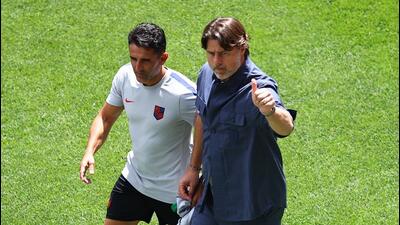
This is largely due to the playing style implemented by their Argentine head coach Mauricio Pochettino, who has been in charge for 28 matches since taking over in September 2024.
Pochettino made his name in the early 2010s with managerial stints at Espanyol and Southampton, transforming both clubs from relegation fodder to mid-table safety.
A five-year reign at Tottenham would follow, during which the club became regular title challengers and reached a Champions League final in 2019. His next two jobs at PSG and Chelsea were unsuccessful relative to their stature before he was hired to coach the US.
During his playing career at Espanyol and PSG, Pochettino was respected as an aggressive, physical centre-back who still retained solid ball-playing abilities. He was nicknamed ‘El Sheriff’ due to his leadership skills during training and in matches.
As a head coach, Pochettino’s playing style has translated into his preferred tactical fundamentals—high octane counter-pressing, direct attacking play, positional fluidity—all of which require squads with top-tier athleticism and strength-conditioning to function at their best.
Pochettino has adopted the same style across his coaching tenures, including the USA, to varying degrees of success. In the past week, it has been especially effective in breaking down Paraguay and Australia, who built their entire qualifying campaigns and prior successes on low, defensive blocks and frustrating opponents with unproductive periods of ball possession.
Against both opponents, Pochettino’s USA employed a 4-2-3-1 formation with 10 of the same players—the only difference being Ricardo Pepi replacing Christian Pulisic on the wing against Australia.
As identified by BBC’s tactics correspondent Umir Irfan, a notable move has been to employ two right-backs—Alex Freeman is tasked with more traditional defensive duties, while Sergino Dest is given licence to be the team’s right winger in attack.
Unlike Freeman, USA’s left-back Antonee Robinson is given a similar licence to attack on the left wing while Pulisic and Pepi cut inside in more forward positions to support the striker Folarin Balogun. In both games, midfielder Tyler Adams stayed deeper to add an extra number in the defense while the other two midfielders—Malik Tillman and Weston McKennie—played more advanced roles in attack.
It’s worth considering a key distinction in the defensive blocks between Paraguay and Australia here. Paraguay operated a 4-4-2 low-to-mid block with a higher line than Australia which gave Balogun and the wide players space to run in behind. Australia adopted a more traditional 5-4-1 in which the entire defensive line was camped out in front of their own box, allowing the USA to use the space in front of the Australians to attack with relative freedom.
As such, the starting 4-2-3-1 formation evolved differently in both games, further reflecting Pochettino’s preferred positional fluidity with the intense press.
Against Paraguay, who hold more physical prowess aerially, the US found it better to create chances from open play—morphing the 4-2-3-1 into a 4-1-2-3 with McKennie and Tillman more involved in ground passes to draw Paraguay’s defense out of position. Paraguay repeatedly lost both aerial and ground duels which meant the USA could take plenty of touches in Paraguay’s box and pick their spot with relative ease.
Against Australia, it resembled more of a 3-5-2 getting more out of Pepi’s strengths as a second central striker allowing Balogun to drift wider in possession when needed. This was seen early with the Burgess own goal, created entirely by Balogun behaving as a traditional left winger running with the ball, outpacing Australia’s defenders and trying to pass to Pepi in the box.
Overall in both cases, the early goal meant both opponents needed to win the ball back more to seek the equaliser. This only further played into the USA’s hands as they continued direct attacks to double their lead, and pressed with greater urgency when out of possession to smother the opposition. This forced more mistakes and more fouls, as evident with Freeman’s goal off a free-kick won at the right-sided edge of the box.
This is clearly reflected in the underlying data as well, with the USA recording 1.42 xG against Paraguay—almost entirely in open play—and 1.08 xG against Australia—in both open play and set-pieces.
As a dead rubber, the Turkey game gives the USA a chance to either rest their starters or further stamp their authority as the form team under Pochettino’s system.