
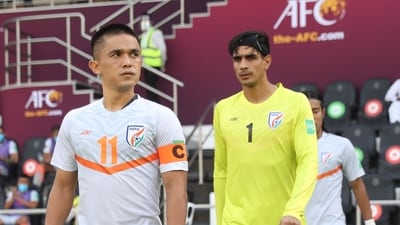
With the FIFA World Cup on in full flow, the positive performance of many Asian countries has seen that familiar question rear its head again — why is India not at the World Cup? For the world’s largest population to not be able to produce a 26-member squad capable of competing with the world’s best teams has long been a source of consternation.
Indian national football team captain Gurpreet Singh Sandhu has pointed to the Asian Cup qualification miss as the bigger story.
Taking to Instagram, the goalkeeper posted: “Absolutely loving the conversation so many people are having about why we are not at the WC. People asking questions and accountability is necessary.”
“As a player i can tell you. We are not at the WC because we are not at the Asian Cup. To reach WC we have to be regulars in the Asian Cup and then be regulars at the knockout stages of the same. Its a step by step process. So the real question is why did we not reach the Asian Cup?”
The short answer? A dismal qualification campaign where India came bottom of their group, losing 3 out of 6 games and recording only one consolatory win in their final match. It was particularly galling given India were the highest-ranked team in the group, but failed to lay a glove on Singapore, Hong Kong or Bangladesh in a series of insipid displays.
The long answer? An existential crisis that has consumed the entire Indian football ecosystem.
The very existence of the top-tier Indian Super League is perennially in doubt, with clubs, corporate partners and the apex AIFF unable to reach a long-term agreement since last year. Uncertainty over the continuity of the league has had knock-on effects at the club level. Last year, the start of the league season was indefinitely delayed. Contractual and legal disputes over expired global broadcast and sponsorship contracts left the league heavily delayed, crippling investor confidence and resulting in unpaid player salaries. In fact, there were serious reservations about whether it would even happen. Many clubs ceased operations, triggering force majeure clauses in player contracts and creating a never-before-seen mass unemployment of professional footballers. An exodus of foreign players saw the competitive standard of the league suffer a dip. Later, when an abbreviated season was finally announced, many clubs struggled to replenish their ranks and played the season with only a partial roster of international players.
Talent development is structurally starved. There is a desperate paucity of high-calibre licensed Indian coaches. Khalid Jamil was appointed head coach of the national side after cutting his teeth in the ISL, but has delivered a regressive brand of low-scoring, low-intensity football that has delivered 6 losses, 3 draws and only 3 wins in 12 matches. Mahesh Gawali has shuttled between being head coach of the youth sides and national team assistant coach over the past few years. Promising Indian coaches, meanwhile, keep being short-changed when showing signs of progress. Women’s senior team coach Crispin Chhetri led the team to a historic qualification for the AFC Women’s Asian Cup in 2026. He was replaced by Costa Rican coach Amelia Valverde six weeks before the tournament and demoted to assistant coach. A disastrous winless campaign, including an 11-0 thrashing by Japan, saw the AIFF decide against extending Valverde’s contract, and return Crispin Chhetri to the head coach position.
Meanwhile, the All India Football Federation has announced its approved a proposal to rename itself the Football Federation of Bharat.
It would seem that structural grassroots development and stability around league football is a lesser priority. The accountability that Gurpreet Singh Sandhu branded necessary seems to be sorely lacking at Indian football’s apex body.
Chaos at the management level and a focus on short-term optics rather than long-term growth have been pernicious. If India, ranked 26th among Asian men’s teams, cannot qualify for a 24-team continental tournament, then the 48-team World Cup is wishful thinking at best and delusion at worst.