
It was in those nine hours between Tuesday night and the early hours of Wednesday morning that football fans found a paradise of goalscoring perfection.
Lionel Messi, Kylian Mbappe and Erling Haaland scored two goals apiece in an exquisite display that married technical brilliance and positional acumen with ruthless efficiency, as Argentina, France and Norway qualified for the Round of 32 with two wins from two.
Messi followed up his first-round hat-trick with two more goals against Austria, while Mbappe and Haaland both scored their second successive brace versus Iraq and Senegal, respectively. The cherry on top of the proverbial cake was the variety in the types of goals they scored, and it all stemmed from the unique profile and playstyle of each of the three superstars.
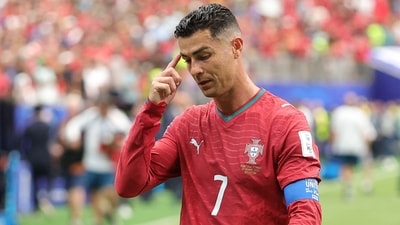
Inevitably, the spotlight will now shift to Cristiano Ronaldo. In stark contrast to the glittering displays of his fellow forwards, the Portugal striker endured a lacklustre goalless outing in his first match. While Messi scored in his sixth straight World Cup match, Ronaldo made it five on the trot without a goal. He will doubtless be doubly motivated to turn things around against Uzbekistan tonight.
So, what worked for Messi, Mbappe and Haaland? And crucially, can that build a two-step blueprint for CR7 to end his goal drought?
1. Movement in the box
Ronaldo is an out-and-out striker. His kingdom is the penalty box, and despite age and rust, he is lethal inside it. His closest stylistic contemporary in this comparison is Erling Haaland. The Norwegian has only registered 20 and 22 touches against Iraq and Senegal, respectively, in an equitable range to Ronaldo’s 25 touches against DR Congo. But Haaland has four goals to Ronaldo’s none. A closer look at their heatmaps (sourced from FotMob) shows how Haaland has been far more active across the breadth of the six-yard box.
Against Iraq, Haaland almost exclusively operated within the keeper’s box, while against Senegal (with keeper Edouard Mendy a much more dominant box presence and deterrence), he operated between the six- and eighteen-yard boxes, with greater activity on the left side. Indeed, it was from this pocket that he converted from Martin Ødegaard’s throughball.
Ronaldo’s movement, in contrast, was remarkably limited. Inside the opposition box, he was almost exclusively rooted to the penalty spot. It was a far cry from the trickery, unpredictability and efficiency that have defined his post-30s career as a centre-forward.
A striker’s movement in the box is a boon for the team, for two main reasons.
First and foremost, it provides clarity for the striker’s teammates. This is where I am running; this is where you should play the pass. Haaland does not attack the back post because that is where the ball is played; David Moller Wolfe crosses the ball to the back post because that is the zone, the blind spot of the defender, that Haaland will lurk and attack and score from for his first goal against Iraq.
Secondly, it attracts the opposition defenders and creates space for others. As Julian Alvarez and Lautaro Martinez did for Lionel Messi’s third goal against Algeria and first goal against Austria, respectively.
Take a look at Messi’s heatmap across the two matches. Against Austria, he was consistently hovering at a twelve-yard distance, between the eighteen- and six-yard box. Against Algeria, he was somewhat active around the penalty spot (although most of that heat activity is from when he tapped in his second goal of the night), but much more active at the edge of the box.
Also Read – Kylian Mbappe will stop at nothing in pursuit of Lionel Messi’s World Cup immortality
Ronaldo offered a hint of this movement against DR Congo, attacking the goal and pushing back the defence as Francisco Conceicao drove in a cross. It proved to be a clever feint, carving out a pocket of space for the cutback, which No. 10 Bruno Fernandes was perfectly positioned to sweep home. Except Ronaldo inexplicably tried to convert the cutback himself, making a mess of it and missing the target entirely.
The veteran will need a greater clarity of thought and commitment to a single darting movement. Not every cross will fall to him, because, simply put, he will not be the best available passing every time. Only by using his immense experience and positioning himself in the right danger zones can he demand the ball and improve his odds of converting.
2. Shots from outside the box
“I honestly feel like this ball is coming onto the goalkeepers a lot faster than they than they feel it is off the foot. [They] just cannot seem to get their timing right with this World Cup football on anything above shoulder height.” That was the verdict of former England goalkeeper Joe Hart on punditry duty for the BBC this World Cup.
The Adidas Trionda, the official match ball for the tournament, is made from four thermally bonded panels. Most footballs have between 12 and 32 panels. Fewer panels mean fewer grooves, producing less friction and air resistance when struck and thus, faster but potentially more erratic flight trajectories when struck. Comparisons have already been drawn to the famous Jabulani matchball used at the 2010 World Cup in South Africa, which notoriously swerved and dipped unpredictably mid-air.
Hart specifically looked at goals scored by Messi (against Algeria) and Mbappe (against Senegal and Iraq). All three goals were struck with venom but not terribly accurately, and all three times, the respective goalkeepers got a hand to the ball but couldn’t keep it out.
“I noticed this with Mbappe against [Senegal keeper] Edouard Mendy earlier in the earlier in the tournament…as it leaves [Mbappe’s] foot, it’s a decent strike, of course it is, but Edouard Mendy is a Champions League winner, and he just doesn’t get his hands up, he doesn’t time it right. These are world-class goalkeepers at World Cup level.”
“With Messi against [Algeria keeper Luca] Zidane — as it leaves his foot, that’s not a brilliant strike…it’s a good strike, but Zidane is more than capable of saving that ball. But again, he doesn’t quite time it right. It seems like it’s on him before he’s got his hands up there in the right position, and he ends up kind of pushing at it rather than pushing it over the bar.”
Also Read – Lionel Messi’s final World Cup miracle? He has the magic, Argentina the belief: Together, they dream again
Mbappe’s goals in particular should interest Ronaldo. While Messi’s long-ranger was a side-footed curling effort, Mbappe’s attempts were of the knuckleball variety. “It’s when it’s that kind of shoulder height…as soon as they’re not using the curling technique, as soon as that ball is not moving [curling], it’s not spinning, the goalkeepers are struggling.” It is a technique all too familiar to Ronaldo, who for two decades has been its most skilled proponent. Given the swerving unpredictability of the Trionda, a well-struck shot stands a strong chance of deceiving the goalkeeper and finding the back of the net.
A combination of Messi’s opener against Algeria — where he positioned himself centrally between the lines, received a throughball, turned and shot from range — and Mbappe’s knuckleball technique — swerving at high velocity — could just be the recipe for success.
Over to you now, Cristiano Ronaldo.