
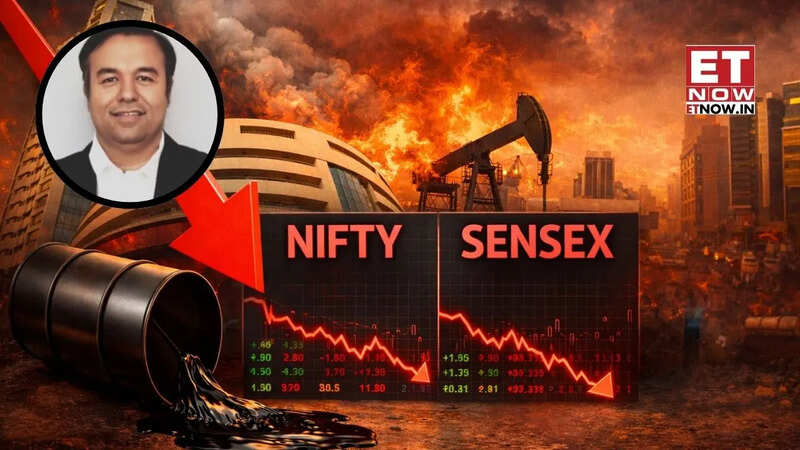
Indian Stock Market Outlook: India’s equity markets could face deeper corrections if geopolitical tensions and oil supply disruptions persist, according to Rajiv Batra, Head of Asia and Co-Head of Global Emerging Markets Equity Strategy at JP Morgan.
With the BSE Sensex down nearly 10 per cent over the past month and 11.8 per cent over three months, and the NSE Nifty 50 declining 9.1 per cent and 10.5 per cent respectively, Batra warned that markets may not have fully priced in the risks.
Peak-to-trough decline could deepen
Batra cautioned that historical patterns suggest more downside is possible if the current oil shock persists.
“I don’t want to shock you but looking at the previous evidences… the peak-to-trough median India decline during this oil supply shock is 22 per cent in dollarized terms,” he said. “You can look at the current market… we are down only 11 to 12 per cent. So if this persists… that means my trough level could be below my base case also.”
This implies a potential additional downside of roughly 10–12 per cent from current levels.
Which strategy to follow during tough times?
In the current volatile environment, Batra emphasised capital preservation over aggressive return expectations.
“There are no hideouts at this juncture… the idea should be to go as lower as possible on the beta… try to protect your capital rather than thinking… 20 or 25 per cent kind of a return.” He described the strategy as a balance between “defense and offense,” urging investors to shift gears depending on market conditions.
Talking about the sectoral strategy he said, while defensive sectors like staples, healthcare, and utilities are traditionally seen as safe, Batra warned that rising input costs are eroding their cushion.
“Rather than taking a sectoral approach people will need to take more a bottom-up approach… attuned towards a factor style… in spaces where… company has not cut down your payout ratio.”
He highlighted quality names, select private banks, and resilient discretionary plays as relatively safer bets.
Earnings risk tied to duration of shock
The impact on corporate earnings of the current scenario will depend on how long the disruption lasts.
“If we move beyond four weeks… the impact is higher on earnings… if this supply disruption goes beyond 3 month then you will go back towards again the single-digit growth mark.” He noted that current estimates could fall from mid-teens growth to low double digits, or worse in a prolonged scenario.
Best vs worst case scenarios
Batra outlined two contrasting outcomes:
Best case: Conflict resolves within 4–5 weeks, oil averages USD 80/barrel
- GDP dips marginally to around 6 per cent
- Inflation rises modestly to around 4 per cent
Worst case: Prolonged disruption, oil at USD 120/barrel
- GDP hit of around 1.3 per cent
- Current account deficit widens sharply
- Inflation breaches RBI comfort levels
Historical perspective: Sharp falls, sharper recoveries
Despite near-term risks, Batra highlighted that past crises have been followed by strong rebounds.
- “During COVID… India declined 38 per cent… but… staged a rally of 82 per cent”
- “After the Iraq war… India… declined… but… staged almost a 500 per cent kind of a rally.”
Outlook: Volatility before clarity
The near-term trajectory for Indian equities hinges on geopolitical clarity and oil price stability. Until then, Batra’s message is clear: protect capital, stay selective, and prepare for further downside before opportunities emerge.
(Disclaimer: The above article is meant for informational purposes only, and should not be considered as any investment advice. ET NOW DIGITAL suggests its readers/audience to consult their financial advisors before making any money-related decisions.)