
In February 2021, then-Philadelphia 76ers president Daryl Morey received an email from an enterprising Harvard student looking to connect with a pioneer of basketball analytics about working in a front office.
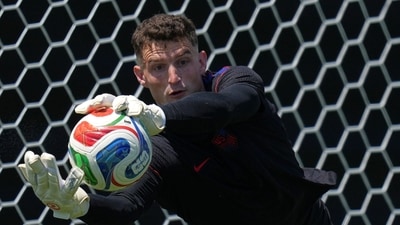
Matt Freese was no ordinary Ivy League student trying to fast track his professional career. He actually had a full-time job already, even though he had yet to graduate. Freese was a backup goalkeeper for the Philadelphia Union in Major League Soccer.
“He was just trying to plot out his future career path,” Morey says, “both in and out of soccer.”
In the years since, the two have stayed in touch. But Freese has paused his hunt for spreadsheet work. These days, he is more focused on standing in goal for the U.S. national team at its home World Cup.
Through two games, a pair of wins that has already sent the U.S. to the knockout stage, Freese has conceded only once heading into Thursday night’s match against Turkey. And on a team full of dual nationals who grew up overseas, he might have the unlikeliest background of anyone on the roster. Freese is an unabashed data geek from a family of scientists who finished his economics degree while playing professionally.
For the 27-year-old Freese, whose late father Andrew was a trailblazer in gene therapy, a love of numbers and his skill between the goal posts are far from different pursuits. Ever since he was a kid, he looked out onto a soccer pitch and understood it as math.
“That was just how I saw the game,” Freese says. “It’s just how I always thought about it.”
Considering he talks about the size of the triangles his teammates form on the pitch when he’s distributing the ball, Harvard made plenty of sense for Freese. It’s also where his father and two brothers went, while his sister earned her doctorate from that other school in Cambridge, Mass., known as MIT.
The difference is that Freese used some of his time as a student to point his coursework at soccer. In one class, he conducted a theoretical analysis behind the rise of MLS franchise valuations. He created a Pythagorean expectation formula, which Morey had once adapted for basketball, and calculates how often a team should have won based on how much it has scored and allowed.
Freese also conducted an elaborate study on penalty kicks—and to this day he considers the results proprietary.
“I like to keep that one private,” he says. “But I”ll be able to talk about it in 15 years when I’m done playing.”
Then during his senior year, Freese coded an expected goals model for an independent research project. At that point he was studying remotely having left Harvard after three semesters to join the Philadelphia Union. Yet back then, he was hardly playing. Over four years with the Union, he appeared in just 13 league matches.
That all changed in 2023 after Freese was traded to NYCFC, where the club came to learn it had acquired an unusually cerebral player, whose mind never stops racing. (In fact, the only way he can wind down at night is by leaving his phone outside his bedroom.) But once he was handed a chance, it didn’t take long for Freese to turn heads around MLS. By 2024, he was a full-time starter and named the MVP of the club.
“You see that in the video room, you see it on the training pitch,” said NYCFC assistant Rob Vartughian. “His ability to take in information and apply it quickly is fantastic.”
Freese soon popped up on the radar of the new national team coach, Mauricio Pochettino. He received his first national team action last June, coincidentally against Turkey, but it was still widely assumed the starting gig belonged to Matt Turner, who manned the post in Qatar. Freese, though, was about to challenge that when Pochettino called his number for last summer’s Gold Cup.
His breakout moment came in the quarterfinals against Costa Rica, when the match went to a penalty shootout. Freese saved the day by stopping three of the Costa Rican attempts. His secret was spending the previous week, including the flight to the game, studying the shooters’ tendencies.
“Penalties are my thing,” he said afterward.
Now, Freese is the unquestioned No. 1 for the Americans at this World Cup. He has yet to face a penalty here, but with the U.S. already assured of a spot in the knockout rounds, potential game-deciding shootouts are just around the corner.
Of course, Freese isn’t ready to boast that his college research on penalty kicks will be decisive. He has taken enough statistics classes to know that he needs a little more data from his time between the sticks with a U.S. jersey on his shoulders.
“We’ll find out,” Freese says. “Sample size needs to be larger for me to draw any conclusions.”
Write to Andrew Beaton at andrew.beaton@wsj.com