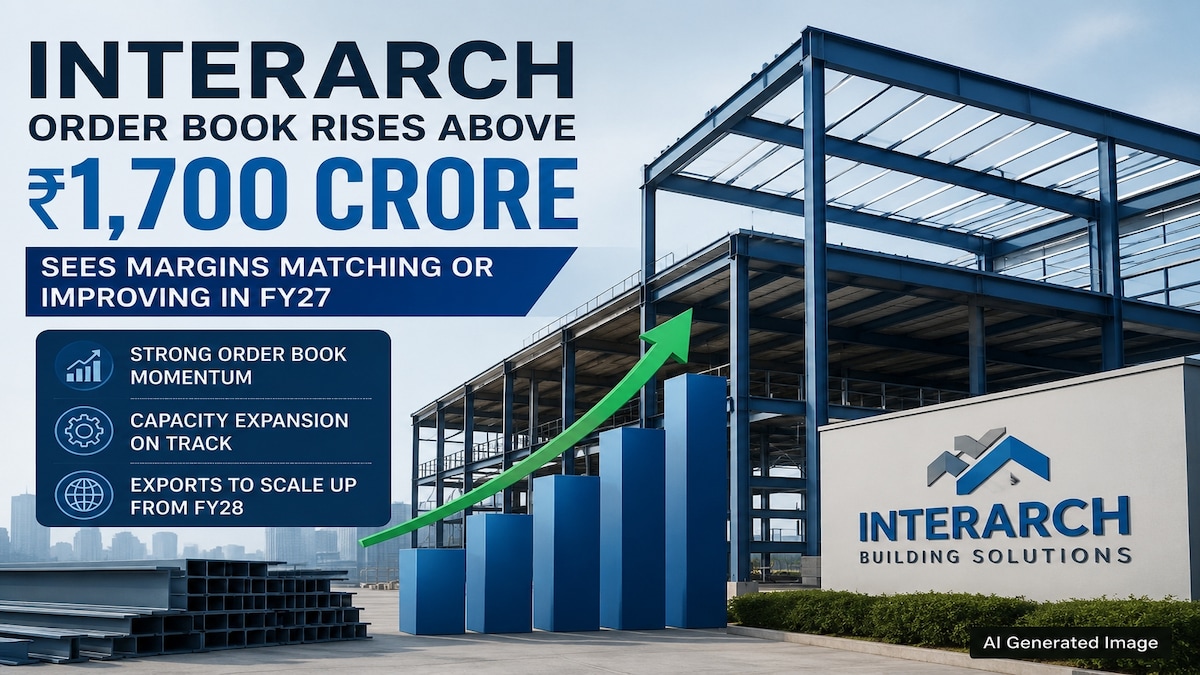
Speaking to CNBC-TV18, Managing Director Arvind Nanda said the company has continued to secure fresh orders since reporting an order book of ₹1,700 crore earlier this year, although the latest net figure is yet to be finalised.
“We don’t have the net order book yet, but it is certainly higher than the ₹1,700 crore order book that we had declared,” Nanda said.
The increase comes after Interarch secured fresh contracts during June, including a domestic order worth around ₹165 crore for the design, engineering, manufacturing, supply and erection of a pre-engineered steel building (PEB) system. The company announced new orders worth ₹375 crore during the month.
Nanda said the recently secured order has a longer execution schedule than the company’s typical projects and is expected to support the order book over a longer period.
“Generally, if we are going to do ₹2,150-2,200 crore of sales in this financial year, then an order book covering eight to nine months is good, unless the orders are long term, which this order is. In that case, the order book will go up,” he said.
While demand remains healthy, the company is balancing fresh order wins with execution capacity.
“The pipeline also still looks very good. However, we have to match our capacity with our ability to deliver the projects. That is the most critical aspect in the pre-engineered building business,” Nanda said.
Interarch expects new manufacturing capacity coming online this year to support future growth. The first phase of its Gujarat manufacturing facility is expected to become operational in early July, followed by the second phase around September or October. Together, the Gujarat plant will add about 40,000 tonnes of annual capacity.
Meanwhile, the heavy steel structures facility in Andhra Pradesh is expected to begin operations in early August, adding another 20,000 tonnes of annual capacity in its first phase.
On profitability, Nanda said the company remains confident of maintaining, or slightly improving, margins this year despite additional spending on exports and the new heavy structures business.
“We are well on track to deliver margins similar to last year, if not better. As turnover goes up, I think operational leverage also kicks in a little better,” he said.
According to the management, stable steel prices, the absence of last year’s one-off labour code-related costs and improved internal efficiencies are expected to support margins. At the same time, export expansion and the heavy structures business continue to require upfront investments in certifications, marketing, engineering and business development before meaningful revenues begin to flow.
The company has recently secured export orders worth around ₹35-40 crore and expects overseas business to become a more meaningful contributor from FY28 as partnerships in North America expand.
Nanda said Interarch is targeting quarterly order inflows of ₹500-600 crore, with the higher run rate likely to materialise towards the final quarter of FY27 as additional manufacturing capacity becomes fully operational.
The ₹165 crore domestic order secured by the company will be executed over approximately 15 months and includes an advance payment of 10% against a bank guarantee. The contract covers the complete scope of design, engineering, manufacturing, supply and erection of the PEB system.
This is an edited transcript of the interview.Q: Last time, when you joined us, you went ahead and raised your FY27 revenue guidance by 10%, from ₹2,000 crore to ₹2,200 crore. Currently, where does the order book stand post this particular acquisition, and is there any tweak in guidance?
Arvind Nanda: As for the order book, it is increasing. We had declared an order book of ₹1,700 crore in early May, and we have got good orders since then, and of course, also made some good sales after that. So, we don’t have the net order book yet, but it is certainly higher than the ₹1,700 crore order book that we had declared.
Normally, we try to keep our order book in view of what our expected sales revenue will be in the following eight to nine months. This order from the energy company has a slightly longer schedule. Ten to twelve months would be the supply period for this, so therefore it will add to our order book.
Generally, if we are going to do ₹2,150-2,200 crore of sales in this financial year, then an order book covering eight to nine months is good, unless the orders are long term, which this order is. In that case, the order book will go up.
I don’t have an exact figure right now for my current order book, but it will be higher than ₹1,700 crore because we have booked good orders, and the pipeline also still looks very good. However, we have to match our capacity with our ability to deliver the projects. That is the most critical aspect in the pre-engineered building business. Orders are not very long term. Very few orders are long term like this one, but you have to deliver. So, we always have to keep our capacity in mind while adding capacity.
We got the full Andhra Pradesh plant into play this year, which came up with its second phase only in September last year. The Gujarat plant will come into play very soon, in early July. By the time both phases come up, it will be maybe October or November, but that will also contribute to this year’s sales. So, I think we are trying to add capacity as fast as possible so that the order book remains robust and we can pick up more orders from the market.
Q: This is a long-term order, which doesn’t come very often. What happens in long-term contracts then? How do the margins work? The last time we spoke, you were not very sure about a margin guidance because things were very uncertain. Now there is a possibility of things changing for the better. Are you in a position to tell us what kind of margins you are looking at, and what are the cost pressures that the business is still facing?
Arvind Nanda: Well, the margin guidance we had given earlier was very similar to last year, maybe with a little increase, which we are expecting from better internal efficiencies. Larger orders do normally lead to better margins because they don’t have the same costs as small and medium-sized orders. But the actual picture emerges only when we have the results with us.
The additional aspect putting pressure on our margins is that we are trying to go in for exports. A lot of certification was required, which we undertook last year. Exports also involve expenses like travel and participating in conferences and exhibitions, while the turnover still needs to build up. We have started getting export orders, but of course, it will take a year or so for them to scale up.
Also, because of the heavy structures plant that we are setting up, that requires a lot of expenditure—not only capex but also a lot of opex—in terms of people going into the market, selling, marketing, engineering, and whatever other activities are required. Those have to come into play much earlier than production itself.
So, those are the additional costs that we have to bear. I don’t see any other margin hit in terms of sudden steel price increases after we have taken orders. Steel prices are pretty benign now, and they are following a certain pattern. Our costs should go down.
Last year, we had an additional cost burden from the labour codes as well, of about ₹3.5 crore or so, which we don’t expect this year. So, I think we are well on track to deliver margins similar to last year, if not better. As turnover goes up, I think operational leverage also kicks in a little better.
Q: Okay, Mr. Nanda, you mentioned two very interesting points. First, you said there will be certain marketing expenses involved in order to secure those order wins. We assume this is mainly for the export market that you are talking about. You have also mentioned that you expect to hit an order inflow run rate of close to ₹600 crore per quarter. So that leads us to an FY27 order inflow expectation, or guidance, of around ₹2,400 crore. Is that on track? What will be the split between the domestic and international markets?
Arvind Nanda: Well, the order book will gradually build up because we are targeting ₹2,500 crore for FY28. So, I think towards the later quarters of this financial year, the order book will pick up to reflect that kind of turnover.
We are aiming for ₹500-600 crore a quarter now, but we have to deliver. So, I think the real effect of reaching ₹600 crore a quarter should come, perhaps by the last quarter of this financial year.
Exports will not be a very large chunk of this. We have recently secured good export orders in the last couple of months, worth about ₹35-40 crore, which we feel are very encouraging.
We are playing a slightly long-term game in exports by establishing good partnerships and building relationships with people who will use our products. They will leverage our expertise in engineering and production while bidding for their projects.
Over the last year, we have spent more on getting certifications, participating in fairs and conferences, meeting a lot of people, and establishing partnerships, like the one you have already seen with a Canadian company. We hope to have more such arrangements with other companies in Canada and the US. So, I think the real export opportunity will probably be seen in the next financial year in a much larger way.
Q: One other thing we want to talk to you about is that you briefly mentioned you are expecting new capacity to come on board. When can we expect this capacity to come? Specifically, the Andhra Pradesh heavy steel structure facility as well as the Gujarat PEB facility. With that, what is the incremental capacity that will come on board? And when you look at asset turns, how do they typically work for this new capacity?
Arvind Nanda: The Gujarat Phase I should come up next month, as we had indicated earlier, in the first half of July. Phase II should follow because we have already completed most of the work for it as part of Phase I. The building is already complete, a lot of the internal work has already been done, and the machinery has already been ordered. So, there is very little work left apart from getting the first phase fully operational in terms of manpower and commercial production.
Then we will move into the second phase, which should happen by September or October, according to my current estimate.
The total Gujarat plant will add around another 40,000 tonnes to our capacity. Of course, we won’t get the benefit for the full year because both phases are coming online at different times, but certainly the full 40,000 tonnes will be available to us in FY28.
The heavy structures facility will add 20,000 tonnes annually in Phase I, which will also become operational by early August, as planned earlier. That business will see a slower off-take because it is a relatively new product. Some of the production will be used for our existing buildings, but our idea is also to deal in heavy structures as a standalone business and supply to large orders from steel plants, power stations, high-rise buildings, etc. That will take a little longer.
So, I think it will be a 20,000-tonne capacity, which should be fully utilisable in the following year itself. This year, we don’t have very high expectations from that plant.
Watch video for full conversation.