Over millennia, philosophers have struggled to clearly answer the question: ‘who is rich?’ A useful metric, easy to measure as well as compare, is income. The somewhat subjective factors that affect happiness (Good health? Freedom? Control of one’s time? Leisure?) also correlate well with it: People in high income countries also tend to have more leisure and better health, for example.The most widely followed categorisation of countries is by the World Bank and uses a per capita nominal GDP threshold of $14,000 for high-income status. This was fixed at $6,000 in 1987 prices, and has risen at around 2% annually since then, broadly tracking developed-economy inflation. At least 85 countries (around 40% of those ranked) were classified high-income in 2024.Per capita GDP is not a perfect measure. First, it ignores income distribution within a country. If income is concentrated in the hands of a few, even if the mean per capita income is high, many people would be poor. One can track median income, which is the middle-value when incomes are lined from smallest to largest. If there are too many poor and very few rich, the median would be lower than the mean. We note though that the gap between them tends to narrow significantly as economies become prosperous.
Second, consumption may better indicate material well-being and differs from income, as savings, the gap between income and consumption, vary between economies, and between the rich and the poor. Some researchers even adjust for leisure and life-expectancy to arrive at ‘consumptionequivalent welfare’. However, this is hard to measure and compare accurately and frequently.
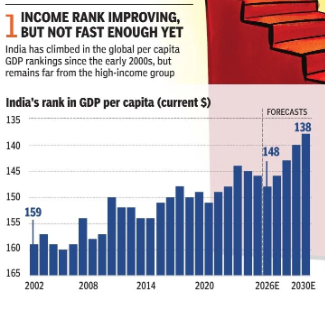
Third, purchasing power parity (PPP)-based per capita GDP is a better measure of welfare, as it adjusts for cost-of-living differences. For example, a haircut or a taxi ride would be much cheaper in India than in the US, even though they deliver similar value. Per capita GDP in the US is 29 times India’s in nominal USD terms, but only seven times India’s in PPP-adjusted terms. On nominal GDP per capita, India ranked 140 globally among 196 nations, versus 162 in 2005, and is expected to rank 134 by 2030. Its PPP-adjusted rank was 124 and expected to rise to 117 by 2030. Over time, though, these series converge.
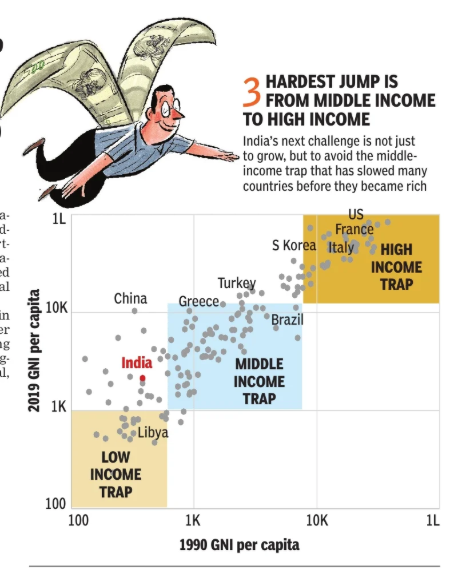
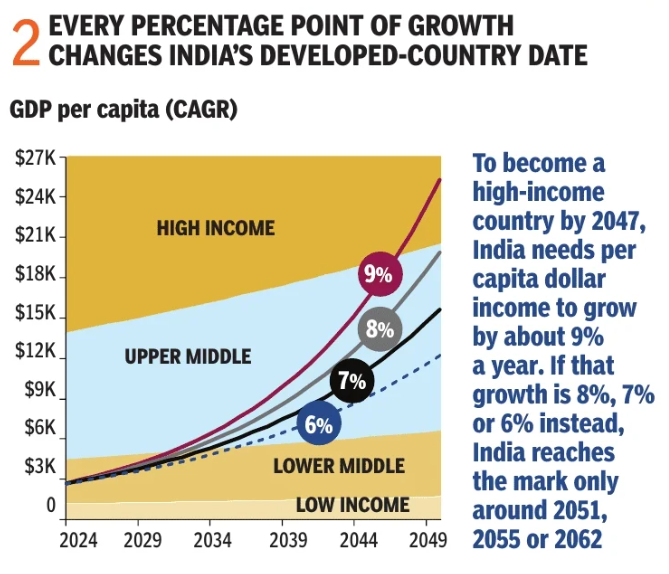
Thus, a macroeconomic target based on per capita GDP, though not perfect, is the most appropriate.India’s move up the ranks over the past two decades has been among the most consistent globally, but China and Vietnam have moved faster. China was at India’s 2025 per capita GDP in 2007 and ranked 123. It has moved up to 73 and is on the verge of high-income status with a per capita income nearly five times that of India. Vietnam was at our level in 2016 and is now ranked 122, with per capita GDP around 60% higher than India’s.Can India reach high-income status? And by when? As chart 2 shows, to cross the high-income threshold by 2047, India must grow per capita GDP in USD terms by at least 9% annually, and GDP by 9.5%. If inflation averages 4%, and the rupee depreciates 2% annually against the USD, real growth needs to average 7.5% annually for the next 25 years.While this is indeed India’s current growth rate, as the economy moves towards the productivity frontier, growth will begin to taper: economies at the frontier grow less than 2.5% annually. Thus, growth must be faster over the next decade to compensate for the nearly inevitable slowdown in the 2040s.How must one accelerate growth? It helps to view growth in GDP as coming from growth in labour input, in capital formation, and in productivity.While labour input is linked to slow-changing-demographics, and cannot be changed quickly, India can and must lift its abysmally low female workforce participation in paid work. A large part of India’s demographic dividend would otherwise be wasted. While weak demand for labour is a major challenge, improved law-and order, regulations that ease part time work, and focus on job-creation in sectors that are dominated by women globally are essential interventions.The bulk of the acceleration in growth must come from faster capital formation. The starting conditions are in place, with a significant drop in the cost of capital, driven by the govt’s fiscal discipline and the remarkable flow of household savings into equities (through systematic investment plans, and insurance and pension funds) worth nearly 2% of GDP annually. The significant expansion in financial system capacity to provide credit now needs channels to facilitate flows to where credit is needed, like to MSMEs, via frameworks like OCEN (open credit enablement network).Policy must also prioritise easing real estate supply via regulatory changes and construction of urban infrastructure. Real estate and infrastructure form a major part of capital stock in developed economies — their construction creates demand for labour and materials and are an important driver of growth.India must also maintain its current rapid pace of productivity improvement. Individual prosperity cannot be achieved without productivity growth.Among other requirements (like better health and education), this needs significant investments in science and technology. Unlike what Japan, Taiwan, Korea and even China saw while they grew, India cannot hope for an ‘assisted’ rise and instead must prepare for a ‘resisted’ rise, where it must develop its own critical technology. This is also important to prevent getting stuck in the middle-income trap, which has plagued many Latin American and eastern Europeans. Building a risk-capital and innovation ecosystem well in advance is important to make the transition from middle-income to high-income.While new technologies like artificial intelligence (AI) and robotics will improve productivity globally, we believe they can help India much more, by bringing down unit costs across a range of critical sectors, breaking through vicious cycles that slow progress.Lastly, some of the societal shifts that Joel Mokyr emphasises in his book ‘A Culture of Growth,’ drove the industrial revolution in Britain, seem to be underway in India. Entrepreneurship is becoming socially respected and is now getting rewarded, the seeds of an innovation system are now falling in place, and the govt is beginning to see itself as a partner of business instead of viewing it with distrust.If we focus relentlessly on building a high-trust society (enabled by a modernising judiciary), with higher risk appetite (not just for entrepreneurs and investors but also policymakers), a high-income India by the late 2040s is not an unachievable dream.The writer is chief economist, Axis Bank