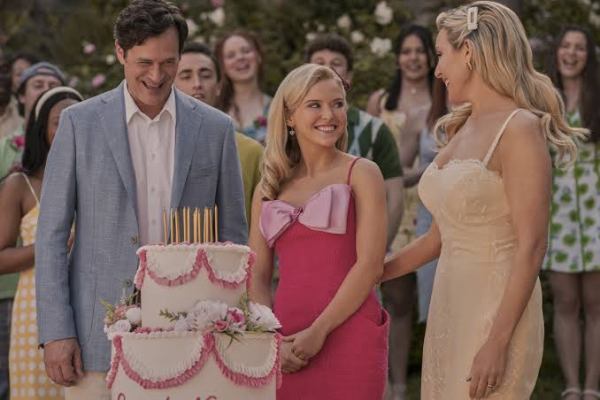
Elle review: After the third installment of her beloved courtroom comedy Legally Blonde couldn’t escape development hell, producer Reese Witherspoon decided to go the Wednesday Addams way and tracked her ditzy character Elle Woods’ high school years through a prequel series. The idea itself raised the question: would a privileged Los Angeles blonde like Elle even have a past worth telling? Given where she is at the start of Legally Blonde (2001), would she even have to encounter any strife while growing up? Are we in for something legally bland instead? I’m happy to report — and without Elle’s undying optimism — that’s far from the case.
Finding Elle
Half of Reese’s battle was won with the on-point casting of Lexi Minetree as the titular character. Besides her uncanny resemblance to Reese, Lexi has nailed (without breaking any of her acrylic nail extensions, as is her distinct skill) the body language, aesthetic, and most crucially, that distinctive voice of Elle Woods. Her dewy eyes also aid the DNA matching, and her natural exuberance hits the sweet spot between signature sweet excess and flippant mimicry. She’s also the perfect find for Reese to serve as the mascot of her production house, Hello Sunshine.
Another essential trait that Lexi’s portrayal shares with the legion of blondes (natural or otherwise) — Reese’s Elle, Alicia Silverstone’s Cher in Clueless (1995), and closer to home, Kareena Kapoor’s Poo and Ananya Panday’s Bae — is to not take herself too seriously. Besides the tricky unintentional self-deprecating humour, she’s able to take jabs from everyone around her, including her socialite-mother Eva, when she says, “Is your love unrequited? Wait, who am I even talking to? You’re Elle Woods.” Because she knows that, despite all her conditioning, her daughter can never keep things bottled up.
It’s Elle’s world and we’re all living in it
Showrunners Laura Kittrell and Caroline Dries paint the world pink in just the right Elle Woods shade. Even though her mom spells it out much later, we know from the very first scene — of a lavish cotton candy-coated birthday bash in her Los Angeles mansion — that she hails from a family whose “favourite bistro is in Paris”, who have a “private jet pilot on speed dial”, and who “use summer as a verb”. When another character quips that Elle is used to Harrison Ford showing up at her Christmas party, she swiftly corrects her, “It’s Halloween, and he comes dressed as Indiana Jones, which is honestly very first-thought.”
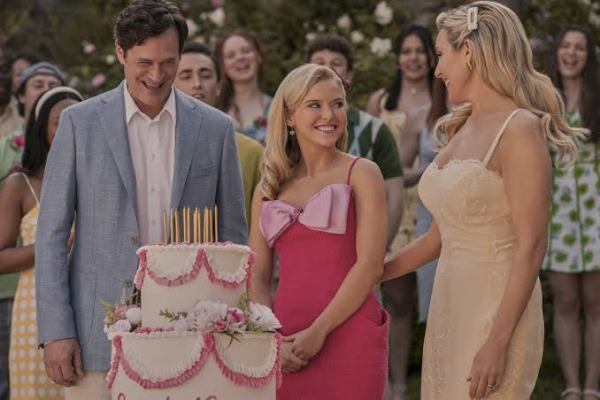 Elle with her parents Wyatt and Eva Woods.
To pluck her out of that world and dump her in a Seattle high school is irony at its best. Her father Wyatt, a renowned plastic surgeon, botches up a high-profile surgery. When Elle is told by her parents to “lie low”, it’s already a fairly big ask, but she assures her support. But the idea of moving to a whole new city — and that too as Washington as Seattle — is a dreary detention she has neither earned nor deserved. In order to make the transition slightly smoother, her mom gifts her Elle’s loyal chihuahua for years to come, introducing Bruiser’s origin story.
It’s not just a geographical relocation for Elle, but a shapeshifting cultural one. Her world has moved from the pop of Madonna and Bryan Adams to the grunge of Nirvana and Pearl Jam, from the glossy bible of Cosmopolitan to the punk, self-published zines, from bra-brandishing femininity to bra-burning feminism, and from the balmy, breezy summers of LA to the gloomy, sultry overcast of Seattle. Homesickness takes over to a point that Elle even complains to her friend back in California that she even misses the rather frequent earthquakes. Little does she know that she’d emerge as the Barbie-coded earthquake that Seattle needs to shake it out of its self-proclaimed cultural supremacy.
Highway to Elle
Elle slowly and surely finds her pockets of sunshine in Seattle, and persistently inches her goody-two-shoes ways into the high school ecosystem. In the process, Kittrell, who’s also developed the prequel show, makes us meet almost a dozen memorable and friendly characters, from her lesbian friend Liz, Mean Girls-represent arch nemesis Kimberly, friendly BFF Shannon, Black boy-buddy Dustin, and the volcano of high school hotness, Miles. But out of these stock campus caper stereotypes, who are all relatable and living, breathing personalities of their own, Miles stands out the most. Because he’s not the iron-pumping brat that’s expected of the school’s most popular boy. Jacob Moskovitz brings an earnest sensitivity and unassuming charm to his performance, which is later explained by the fact that he’s the only son of a gay couple.
Story continues below this ad
Amy Pietz as Donna, the principal’s secretary, also stands out because of her no-frills way of living her life with kindness — as opposed to Elle’s out-there, pronounced manner. It’s also interesting to see how it’s not only Elle, but also her parents who’re struggling with the relocation. While her father, an extremely occupied doctor back home, gets all the time in the world to try out all the adventure sports — including the toughest one to offer a friendly ear to Elle’s girls talk — her mother is battling an identity crisis thanks to her losing the higher ground of LA’s most efficient hostess. Even after planning the most chic housewarming, she can’t wrap her head around the guests’ casual demands for beer and bread. She also lacks the ability to adapt, unlike her fairly gung-ho husband who can win over a party with his acoustic rendition of Oasis’ “Wonderwall” while his wife manages a hurried escape to grab a bag of baguettes from the neighbourhood.
Elle is also a telling time capsule, representing 1995 with its fashion aesthetic, pre social media revelry and rivalry, and pop-culture references (Kurt Cobain’s death, exorcism of Marlena Evans on Days of Our Lives, and a recreation of The Breakfast Club). It also positioned its protagonist as an antithesis to the third-wave feminism, when she utters the F-word in a rather disappointing tone, only for her mother to console her by assuring “it’s very in right now”. When Miles tells Elle that they don’t have a cheerleaders team because the girls there don’t like to cheer for the boys, a confused Elle asks innocuously, “So, they just cheer for themselves?”
Also Read — Salman Khan to leave Galaxy: Star lived in 1-BHK for 52 years, and why he’s leaving now
That’s not the feminism Elle subscribes to. It comes with its share of self-doubt as she wonders if the lens through which she looks at the world is too rose-tinted for its monochromatic ugliness. As long as she stays on that path of reflection and reaches its rousing conclusion, Elle remains fun, sparkling, and meaningful. But by extending its course with just one episode, it ends up diluting its own potential. That last episode is an absolute stretch, given the convenient narrative U-turn, the uncharacteristic change in a character’s primary nature, and forcing in the most tired campus cliché ever — the love triangle. If the idea behind this extended lease of life was to take a page out of Elle Woods’ book, it’s a letdown that the page is a pink of one shade too dark, and scented with lavender that instead of “giving it a little something extra”, makes you choke with its downright excess.