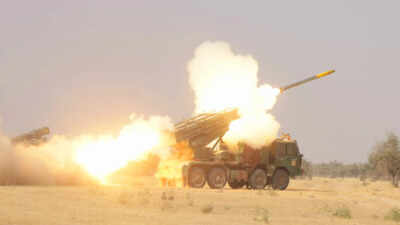
Within months of Pakistan’s inability to counter India during Operation Sindoor, the Pakistani armed forces launched the Army Rocket Force Command (ARFC). The move highlighted Pakistan’s understanding of the new normal, in which the Indian armed forces are likely to respond to terror strikes.These strikes by India are carried out in a manner that remains below the strategic threshold, thereby denying Pakistan the use of nuclear rhetoric and reducing the sense of security that Rawalpindi derives from its strategic weapons.Pakistan’s failure to cause any significant damage to India during the 88-hour conflict in May last year — despite using its air force, drones and Fatah-series rockets — is also seen as a factor behind the raising of such a force. Indian air defences, centred around the S-400 surface-to-air missile system, acted as a strong shield against Pakistani attacks.As part of its misinformation campaign, Pakistan claimed to have destroyed this system, but the claim was soon countered when Prime Minister Narendra Modi visited the S-400 unit just days after the active phase of Operation Sindoor ended.Pakistani Prime Minister Shehbaz Sharif stated during his Independence Day address in 2025 that the aim of establishing the ARFC was to strengthen Pakistan’s conventional strike capability. The new force will thus act as a conventional, or non-nuclear, entity. The Pakistani military will retain its nuclear-capable missiles under a different command structure.### Era of non-contact warfareDuring the 88-hour Operation Sindoor in May last year, India demonstrated elements of its non-contact war-waging capability. Non-contact warfare seeks to minimise casualties by avoiding direct physical engagement between two opposing forces. It integrates cyber operations, unmanned vehicles, precision strikes, missile warfare, directed-energy weapons, space warfare and robotics.This type of conflict is dependent on network-centric warfare. It relies on battlefield transparency and advanced command, control, communications, computers, information, intelligence, surveillance and reconnaissance systems — C4I2SR — to deliver cohesive, technology-driven military capabilities. The primary aim of such operations is to minimise human casualties.The US and Israel also demonstrated the use of non-contact combat during their strikes on Iran. Iran, too, with its extensive use of drones and ballistic missiles, drew the wider region into the conflict.### India’s demonstration of non-contact warfareNew Delhi began Operation Sindoor with a series of missile, artillery and drone strikes across the Line of Control and the international border. India described these as strikes against terror infrastructure.Pakistan retaliated against India, targeting both civilian and military sites. The instruments used by Pakistan also centred around drones, artillery, rockets and missiles. Indian defences blunted the Pakistani assaults. Even now, well over a year after the cessation of hostilities, Rawalpindi is yet to provide credible proof of the targets it hit in India.Pakistan’s failed offensive in defence of terror infrastructure forced India to hit back. In its response, Indian strikes punched holes in Pakistan’s air defence radar coverage and hit 11 airbases, which are critical for carrying out offensive air operations. These operations forced Pakistan to sue for peace.Both countries walked away from the conflict with similar lessons but different priorities. India sought to improve its air defence network, as announced by PM Modi from the ramparts of the Red Fort, while also focusing on its strike capabilities. Pakistan, meanwhile, announced the creation of a rocket force to improve its strike capability. Islamabad is also seeking to procure the J-35 fifth-generation aircraft of Chinese origin.In the same breath, Islamabad created the Army Rocket Force Command, an establishment that can hit back at India. According to a report by the New Delhi-based think tank Centre for Land Warfare Studies (CLAWS), the ARFC is a unified command that will integrate rockets and missiles in the conventional realm.Modelled after China’s rocket force, the ARFC will be responsible for the consolidation of these assets. The force will also be responsible for doctrine planning, procurement and sustenance.The Pakistani ARFC will use weapons such as the Fatah-1, which has a range of 140km. The Fatah-II rocket system, with a reported range of 400km, is also expected to be part of the force. The system was used by Pakistan during Operation Sindoor and was shot down near Sirsa, as reported by The Wall Street Journal. The A-100 rocket system, a Chinese weapon based on the Russian Smerch and with a range of 100km, is also part of the ARFC.In the Army chief’s annual press conference earlier this year, General Upendra Dwivedi, who retired recently, stated that the Indian Army too is considering raising a similar force. If raised, this force is expected to be equipped with conventionally armed Pinaka, Smerch, BrahMos, Suryastra and Pralay systems.