Global crude oil prices have crashed to a four month low and are now hovering around the pre-war levels. From around $120 per barrel to near $70 per barrel – the crash has been driven by the US-Iran ceasefire and reopening of the Strait of Hormuz. The big question now is: when will petrol and diesel prices come down in India? Petrol and diesel prices in India have risen by around Rs 7.5 per litre since May 15. The first hike in the retail rates came over two and a half months after the US-Iran war began. Private retailer Nayara Energy has already cut rates of petrol and diesel. So when will state-run oil marketing companies like Indian Oil Corporation, Hindustan Petroleum, and Bharat Petroleum cut rates? Not soon, indicate experts. According to the government, India’s hike in petrol and diesel rates was much less compared to the rise seen in other major economies of the world. There are several reasons why petrol and diesel prices may not come down anytime soon.
Excise duty cut: The government revenue loss
The fundamental reason is the same as why India did not see a big hike in petrol and diesel rates in line with the global economies.The government cut excise duties on petrol and diesel, hence absorbing the impact of higher crude prices in the form of a revenue loss. The excise duties were cut by Rs 10 per litre on petrol and diesel, resulting in a fortnightly revenue loss of around Rs 7,000 crore per fortnight, according estimates.It’s important to understand that the government’s move to reduce excise duties is not a long-term structural change. It’s a response to the crisis, and is hence likely to be temporary in nature. In fact, DK Srivastava, Chief Policy Advisor, EY India is of the view that a price cut and restoration of excise duties is likely to be related.“These two actions may be taken close to each other. The government may restore excise duties on petrol and diesel ahead of price cut after making an assessment of its fiscal situation,” he says.Sourav Mitra, Partner – Oil & Gas, Grant Thornton Bharat cites historical precedent: When global crude prices fall sharply, the government has often increased excise duties on petrol and diesel to capture part of the benefit and support fiscal revenues, rather than immediately passing through the full benefit to consumers. “The same logic is likely to be applied in reverse: as crude prices decline, the Centre will first roll back the emergency excise concessions, either partially or fully, before considering any reduction in retail prices,” he tells TOI. Ranen Banerjee, Partner and Leader, Economic Advisory, PwC India also points to other expenditures or taxes foregone by the government.“Given the requirement for the government to continue with the capex push and impending pay commission related pressures on the fiscal that are on the horizon, the government could continue with the higher prices,” he tells TOI.
OMCs suffer losses
Oil marketing companies are still losing crores every day at the current retail rates. With crude oil prices coming down, it would provide them with some breather to recover.According to Oil minister Hardeep Puri, state-run oil companies have so far incurred a cumulative loss of Rs 74,781 crore on the sale of petrol, diesel and subsidised LPG.This is because petrol and diesel are being sold at below their cost for over four months now.Industry estimates suggest that at crude prices sustained around $75/barrel, OMCs would begin to recover past losses over a 6-12-month horizon.
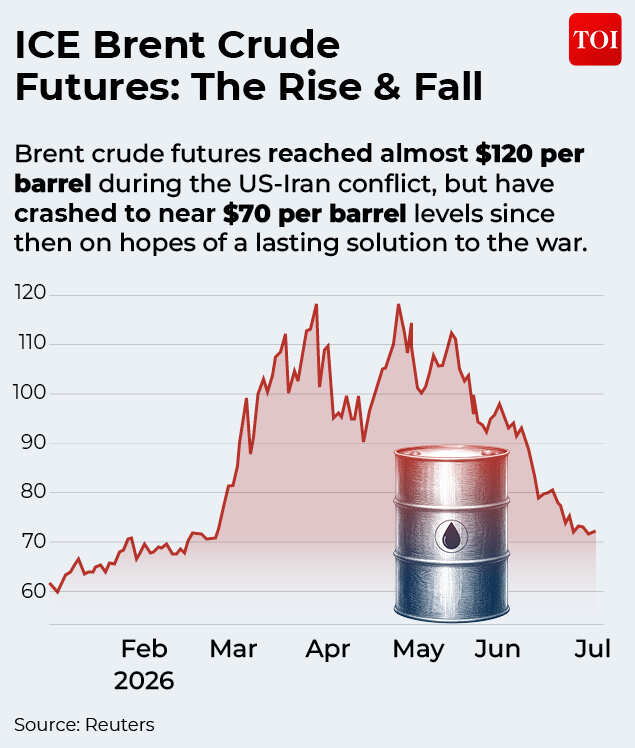
Brent crude futures: The rise and fall
“At that point, with government guidance, price reductions could become feasible without unduly damaging OMC finances. However, any retail price cut decided before OMCs return to profitability would effectively represent a further implicit subsidy; one that would need to be supported either through budgetary compensation or further excise concessions. In the absence of such support, the scope for OMC-driven price cuts remains constrained,” says Mitra.He again draws on historical lessons: There is also a broader policy consideration, India has historically used periods of low crude prices to either rebuild exchequer revenues or strengthen OMC balance sheets and not always to pass the full benefit to consumers immediately.“Unless crude prices sustain at significantly lower levels for an extended period, and the geopolitical situation in West Asia stabilises, a retail price reduction is unlikely in the immediate term. A reduction, if it comes, is more plausible in the second half of 2026, contingent on crude trading comfortably below $70-75 per barrel and OMC under-recoveries narrowing substantially,” he adds.DK Srivastava, Chief Policy Advisor, EY India explains that since adjustments to retail prices came only after substantive increases in the price of Indian Crude basket, OMCs will take quite some time to reach breakeven levels. “If retail prices are cut prior to that, it will call for large subsidies which will add to the fiscal burden of the government. OMCs may not be in a position to cut prices in the next few months,” he says.The takeaway for consumers: For petrol and diesel prices to come down, the above conditions need to align.
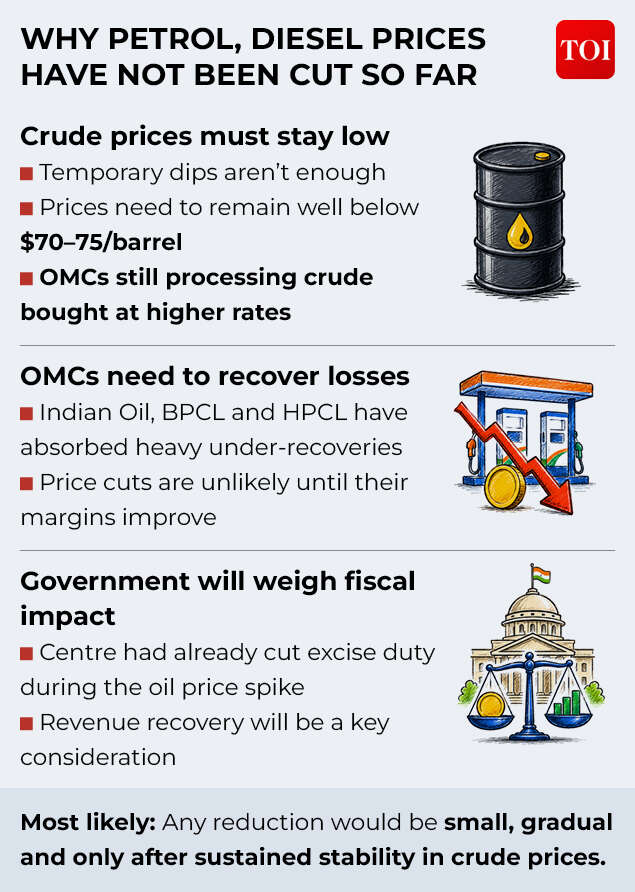
Why petrol, diesel prices have not been cut so far
Wait-and-watch mode
Then there is the fact that the government may be checking the durability of the truce between the US and Iran to have a better gauge on the trendline of crude oil prices.DK Srivastava tells TOI, “It may be better to ascertain that the US-Iran truce is firmed up and hostilities cease in all respects. It is only after that crude oil prices can be considered to settle on a stable basis. As such, any immediate cut in petrol and diesel prices may not be expected or warranted.”Sourav Mitra says that crude oil prices must stabilize or decline meaningfully for sustained periods.Simply put, a phased approach which balances fiscal prudence, OMC financial health, political optics, and end consumer considerations appears to be the most likely course of action the government will adopt, says Sourav Mitra. And even if a cut is announced, it is likely to be modest.Another factor that is stopping an immediate reduction is that the crude that is being processed to churn out petrol and diesel has been procured at high rates.Hardeep Puri said that refiners are still processing crude that was bought during the war.
What Oil minister has said
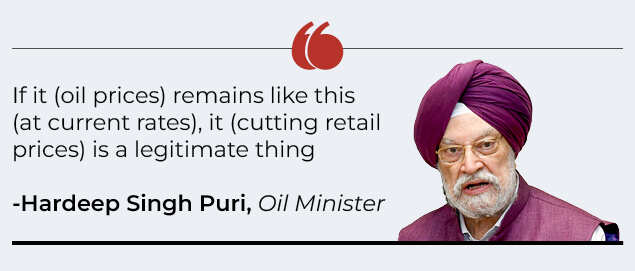
“That crude would have been obtained two months back (when) prices were high, cost of insurance was high, cost of freight was high,” he said. “Crude priced at current lower rates will arrive (at refineries) later.”A fuel price cut can be looked at if oil prices remain at low levels for a sustained period, he said. “If it (oil prices) remains like this (at current rates), it (cutting retail prices) is a legitimate thing,” he said.He also explained that the reason Nayara was able to cut rates was because it had hiked prices in March when state-run refiners kept rates unchanged. So in effect, Nayara’s cut brings it on par with the state OMCs now.
Case for strategic pricing reserves
The Middle East conflict has exposed the vulnerability of India’s oil supply and its pricing. While India has diversified its import basket and managed to secure supplies, some experts suggest a focus on ‘strategic pricing reserves’ as much as strategic petroleum reserves. This would act as a buffer against risks arising from rising global crude oil prices.The concept of a Strategic Pricing Reserves is straightforward: It’s a dedicated financial fund that accumulates savings when crude prices are low and deploys them to cushion the economy during price spikes is logically sound and deserves serious policy consideration. DK Srivastava of EY India says there is a strong case for establishing an ‘Oil Price Stabilization Fund’. “Earlier, in the 1990s, India used to have oil price stabilization funds called ‘oil pool account’ funds. This was discontinued in 2002,” he tells TOI.However, he cautions that managing such funds requires considerable discipline. “When international crude oil prices are high and one draws from the fund, there should be replenishment of funds when the cycle turns and international crude oil prices fall. If this replenishment does not happen, then such stabilization funds go into deficits and become unviable. Thus with appropriate fiscal discipline, the ‘oil price stabilization fund’ may play a positive role in the management of the economy,” he explains.On the other hand, Ranen Banerjee of PwC advocates focus on strategic petroleum reserves and also points to fiscal concerns.“Setting aside money for a strategic pricing reserve by the government is not possible as it will lead to a spike in fiscal deficits and there will be idle funds that could have been put to more strategic use. Creating strategic oil reserves is a better option as the recent conflict was not only about higher prices but also availability and strategic oil reserves can help not only to tide temporary price spikes but also ensure availability in times of supply disruption,” he says.To Sourav Mitra of Grant Thornton Bharat, the case for strategic oil pricing reserves is a compelling one. It represents a meaningful evolution from the existing reliance on physical strategic petroleum reserves and ad hoc excise duty adjustments, he says.But he also flags implementation challenges. “The fund’s governance, i.e., who manages it, under what rules contributions are made, and how withdrawals are authorised would need to be carefully designed to enable it to become a truly effective fiscal measure,” he tells TOI.“On balance, a well-designed Strategic Pricing Reserve would be a positive structural reform for India’s energy policy. It would reduce the reactive nature of fuel pricing decisions, provide greater certainty to OMCs on their cost environment, and reduce the frequency of disruptive excise adjustments,” he concludes.