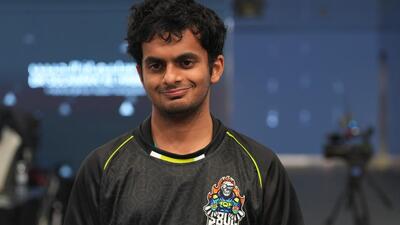
Bengaluru: After the World Teams Rapid and Blitz Championship in Hong Kong two weeks ago, Nihal Sarin made the unusual decision to not travel back home to Kerala. Instead, he flew to Mumbai to play the 2026 Bullet Chess Championship, online, from his manager’s home and a gaming facility, eventually becoming the first Indian to win the title.
The idea behind playing from Mumbai, where Chess.com has a server, was to take advantage of high-performance hardware, faster internet speeds and lower latency – the delay in data transmission measured in milliseconds, between device and server.
Mumbai offered something he did not have back home. S8UL, the esports and gaming content organisation Nihal represented at last year’s Esports World Cup, has a 15,000-square-feet state-of-the-art gaming facility in the city. He spent the final day of the Championship there, swapping his home setup for a high-performance gaming desktop while keeping one constant, his trusted wireless mouse. He played the Chess.Com Open playoffs last year too from the S8UL gaming house in Mumbai to qualify for the E-sports World Cup.
In online bullet, internet speed, server proximity and hardware, can make a difference. Nihal left little to chance.
“The server being in Mumbai helped significantly, I believe,” Nihal told HT. “I played the final day of the Bullet Championship from the S8UL gaming house. I took my personal mouse, the Logitech G Pro, which I’ve seen Hikaru (Nakamura) use as well, but I used their desktop, which is a lot more powerful than the one I have back home. These things definitely matter, especially in bullet.”
In 1+0 bullet chess, where each player starts with one minute on the clock and receives no increment, every second is critical, and the decision proved to be a smart one.
The 21- year-old Indian grandmaster put up a remarkable performance.
Facing three-time champion and defending title-holder Alireza Firouzja – widely regarded as one of the strongest bullet players in the world – Nihal reeled off 15 consecutive victories in the final, a streak so improbable that even he did not realise it until the commentators mentioned it afterwards. When it was over, he leaned back in his chair, closed his eyes and rested his head against the backrest.
He had played 118 bullet games on the final day. He had taken down GMs Andrew Tang and Arjun Erigaisi in the Losers Bracket before pummeling Firouzja.
“I was shocked when I learnt that I had gone on a 15-game winning streak against Alireza. I had no idea,” he said, breaking into a laugh. “Though bullet is not exactly mainstream chess, it feels really good not just have put up a fight but to beat a strong player like Alireza.”
As French-Iranian grandmaster’s mistakes became increasingly uncharacteristic, Nihal sensed exactly what was happening. “He was starting to blunder heavily and trying to play too fast. That’s just a sign of tilt…Everybody goes on tilt,” he says, borrowing the gaming term for the spiral of frustration that often follows a string of losses. “What really matters is how you control it.”
He is quick, however, to temper any suggestion that he is now game’s top bullet specialist.
“I have always considered myself among the top five. Maybe, I have improved. Alireza is still objectively stronger,” he insists. “Hikaru is probably the greatest of all time.”
Until recently, the lag when playing online from India, was pretty big. “Not just internet speed, but server too. The ping (latency) used to be quite high. When you pre-move, it’s supposed to take 0.1 seconds. With the lag, sometimes it becomes 0.2 seconds. It might seem negligible, but it makes a massive difference. In a second, you can already make only five moves instead of ten. The server being set up in Mumbai makes a big difference.”
Unlike many of his Indian GM peers, Nihal played online extensively as a young boy. The internet, in many ways, served as a coach.
Nihal counts his 100-game bullet chess session against Magnus Carlsen during the pandemic among his most memorable. “I guess I challenged him or he challenged me, I don’t recall clearly. I was just very happy to get a chance to play him. This was right after some classical tournament that he played. He was playing at his worst and was really, really slow I think. Of course, he beat me,” he laughs.
By now, he’s used to the peculiar silence that follows an online tournament victory. Unlike an over-the-board event, where a trophy presentation, applause and congratulatory handshakes mark the occasion, there is little in the outside world to indicate that anything extraordinary has happened. One moment, a player is locked into hours of intense concentration in front of a screen; the next, they shut the laptop and step back into everyday life. The contrast can be disorienting. A major victory reduced to a browser tab.
As Nihal puts it, “During a long online match, you’re so zoned in… it’s almost as if you’re existing in another dimension. And when you come back to the normal world, it feels a bit weird.”
The speed monster will feature in the India A team for the Olympiad in September, which is played in the classical format. “The faster time controls help develop better instincts and better play under time pressure and see tactics faster and just make better moves with less time in general. Classical chess, in general, just improves the understanding of the game tremendously. It’s where the depth of chess really comes to light. I think I can switch quite effortlessly between formats.”
In a year when a fellow Indian and world champion, Gukesh, readies to defend his title, how does Nihal look at his own classical chess ambitions? “I’m not actively thinking about the World Championship. I’ll just try to keep improving, keep enjoying my chess and see where it takes me.”