MIAMI GARDENS, Fla.—Nobody in the soccer universe expected Lionel Messi and reigning World Cup champions to find themselves in a battle Friday night.
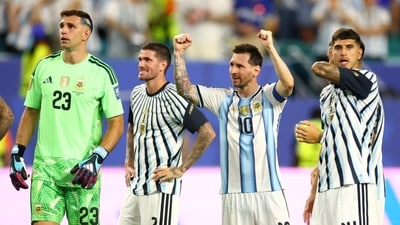
Emiliano Martinez (No. 23), Rodrigo De Paul (No. 7), Lionel Messi (No. 10) and Exequiel Palacios (No. 14) celebrate after Argentina’s win.
But a battle is exactly what Argentina—and the best player in history—got here against Cape Verde. Facing the smallest country ever to reach the World Cup’s knockout rounds, Argentina found itself in the shocking position of a 2-2 score line deep into extra time, barreling toward a penalty shootout. Messi and Co. were teetering on the edge not only of defeat, but of suffering the most ignominious upset in the 96-year history of the tournament.
Then, in the 111th minute, soccer’s world order was restored. Messi curled a corner kick to the mouth of the goal and Cristian Romero thunked it off a Cape Verde arm and into the net. Argentina had pulled a 3-2 victory from the jaws of utter humiliation, 3-2.
At the final whistle, the exhausted world champions fell to the turf, crushed by the heat and breathing a collective sigh of relief. Their title defense, which had suddenly looked so wobbly, was still alive. Argentina will now face Egypt in the round of 16.
At the outset of the game, Cape Verde giving Argentina a scare didn’t just seem unlikely. It was all but impossible to fathom. A country with a population barely above 500,000 was facing off against the three-time winners and the tournament’s all-time leading scorer. The game, taking place in the city where Messi plays his club soccer for Inter Miami, was played in front of almost entirely Argentina die-hards, whose raucous roars shook the stadium concrete.
Cape Verde’s Blue Sharks, meanwhile, were the World Cup’s smallest minnows. They came from clubs in every corner of the earth as the African island nation leaned on far-flung family lineage to build a World Cup roster. Their starters played professionally for clubs as distant and remote as Ireland’s Shamrock Rovers and Ludogorets, based in Razgrad, Bulgaria.
But although Argentina commanded the first half, with Messi netting his seventh goal of the tournament, Cape Verde’s fearsome defense found its legs in the second. Cape Verde’s hero was Vozinha, the 40-year-year old journeyman goalkeeper, who had already shut out Spain in the group stage.
While Messi has spent his entire life playing for the world’s grandest teams—Barcelona, Paris Saint-Germain, and Argentina—Vozinha had only turned professional at 25, plying his trade in Angola, Moldova and Cyprus. But as Argentina attacked the Cape Verde net relentlessly, Vozinha turned them away time and again. He punched away crosses, repelled free kick after free kick and, in one breath-catching moment, spread his limbs to deny Messi in a one-on-one.
Argentina went ahead two minutes into extra time on a strike from Lisandro Martinez, but Cape Verde equalized in the 103rd minute with a curving effort from Sidny Lopes Cabral. That meant that Messi had to conjure magic—or risk what is almost certainly the final World Cup of his storied career on the crapshoot of penalties.
Fortunately for Argentina, magic is exactly what Messi supplied. Wearing a shoe called “El Último Tango”—”The Last Dance”—Messi sent a corner kick curving into the most dangerous zone on the pitch, head-high just in front of the net.
The resulting chaos ultimately turned into an own goal. But as Argentine players lay prostrate on the pitch and Argentine fans lost their minds, they didn’t care that it wasn’t pretty.
Argentina had survived a shocking night—and Messi’s last dance could go on.