The expanded FIFA World Cup has finally reached the stage where the noise becomes sharper, the margins thinner, and the names bigger. After a dramatic Round of 32 trimmed the tournament down to its final 16 contenders, the competition now enters the phase where reputations are no longer protected.
This is where a World Cup changes shape. The early rounds test depth, preparation and resilience. The Round of 16 tests nerve. One bad defensive touch, one loose pass under pressure, one moment of genius from a player built for the spotlight can decide whether a campaign becomes history or heartbreak.
What makes this last-16 lineup especially compelling is not just the quality of the teams involved, but the individual confrontations threaded through the draw. Almost every fixture carries a marquee duel: a generational handover, a battle of captains, a clash of pure speed, or a meeting between a global icon and a new-age disruptor.
From Vinicius Jr taking on Erling Haaland to Lamine Yamal sharing the stage with Cristiano Ronaldo, the Round of 16 has produced a set of player battles that feel almost designed for knockout football.
Vinicius Jr vs Erling Haaland: Brazil’s electricity meets Norway’s cold-blooded finisher
Brazil vs Norway did not need extra decoration, but it has received it anyway. This is a meeting between one of football’s most thrilling carriers and one of its most ruthless finishers.
Vinicius Jr gives Brazil the kind of menace that stretches a match even before he touches the ball. His speed forces defenders to retreat, his directness breaks structure, and his appetite for one-v-one situations gives Brazil a constant route into chaos. Around him, Brazil have grown into the tournament, finding attacking rhythm through their forward line after surviving Japan in the Round of 32.
Norway, however, arrive with the one weapon every favourite fears in a knockout tie: a striker who does not need volume to change the result. Erling Haaland turns half-chances into punishment. If Norway can survive long enough, if Martin Odegaard can find the correct passing lane even twice, Brazil’s superiority on paper could suddenly feel irrelevant.
There is history, too. Brazil have never beaten Norway in four previous meetings, including a famous World Cup defeat in 1998. That gives this battle a sharper edge. It is not merely Brazil’s glamour against Norway’s power. It is Brazil trying to impose their mythology on an opponent who has never bowed to it.
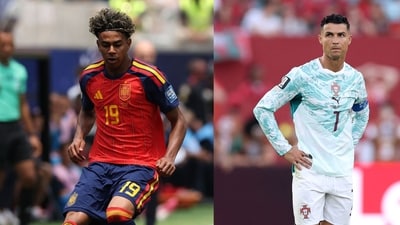
Lamine Yamal vs Cristiano Ronaldo: The heir and the monument
Spain vs Portugal is already one of the great emotional fixtures of European football. Add Lamine Yamal and Cristiano Ronaldo to the centre of the story, and it becomes something larger than a derby.
Yamal represents the future moving at a frightening speed. He plays with the freedom of a teenager and the decision-making of someone far older, offering Spain width, invention and the ability to disturb settled defensive lines. Spain enter the tie with swagger restored, carrying the aura of European champions who have rediscovered their authority at the right time.
Ronaldo, meanwhile, remains the monument Portugal still orbit around. He scored in Portugal’s 2-1 Round of 32 win over Croatia, keeping alive what could be the final World Cup chapter of one of the most extraordinary careers in football history. Yet Portugal’s campaign has not been entirely convincing, and that makes his presence both a weapon and a question.
That is what gives the duel its theatre. On one side, a teenager already being treated like the next face of the game. On the other, a legend refusing to leave the stage quietly. Yamal vs Ronaldo is not just a football contest. It is a visual summary of time passing.
Lionel Messi vs Mohamed Salah: Two icons, one narrowing road
Argentina vs Egypt carries a different kind of gravity. It is not about pace or tactical matchups as much as it is about aura.
Lionel Messi has already lived the full World Cup arc: heartbreak, burden, redemption and immortality. Yet here he is again, still dragging defenders towards him, still bending matches around his left foot, still making Argentina feel possible in moments when they look vulnerable. His goal against Cape Verde helped Argentina survive a Round of 32 thriller that went to extra time before the defending champions finally escaped.
Across from him stands Mohamed Salah, the face of Egypt’s modern football identity and the player around whom their belief naturally gathers. Egypt’s own route has already carried historic weight: they beat Australia on penalties to secure their first-ever World Cup knockout victory, with Salah among those converting from the spot.
This may not be a direct duel in positional terms, but in emotional terms it is enormous. Messi and Salah are two of the defining attackers of the last decade. For both, the World Cup road is narrowing. For one, it will end here.
Kylian Mbappe vs Julio Enciso: The superstar and the giant-killer’s spark
France vs Paraguay should, by most conventional measures, be a straightforward hierarchy. France have the deeper squad, the greater pedigree and one of the most terrifying forwards in world football. But knockout football rarely respects hierarchy for 90 clean minutes.
Kylian Mbappe remains the player capable of making tactical plans look fragile. His acceleration changes the geometry of a match. Teams can sit deep, double up, compress space and still find themselves exposed by one burst into the channel. France enter as favourites, but their greatest insurance policy remains his ability to make the spectacular feel routine.
Paraguay’s counterweight is Julio Enciso, a player built for defiance. He does not carry Mbappe’s global weight, but he carries the kind of unpredictability that underdogs need. Paraguay have already removed Germany from the tournament on penalties, and that result gives them something far more dangerous than hope: proof.
This duel is France’s certainty against Paraguay’s nerve. If Mbappe controls the night, the favourite marches on. If Enciso finds space between the lines, another heavyweight could be forced into discomfort.
Harry Kane vs Santiago Gimenez: Centre-forward pressure in the Azteca furnace
Mexico vs England has atmosphere before a ball is kicked. It brings England back to the Azteca, into altitude, noise and memory, against a host nation that has turned its World Cup run into a national surge.
Harry Kane remains England’s reference point. In tense knockout matches, England still look to him for more than goals: link play, composure, penalty-box movement and emotional authority. His late double against DR Congo rescued England in the Round of 32 and ensured that their campaign did not collapse before meeting one of the tournament hosts.
For Mexico, Santiago Gimenez offers a different kind of centre-forward threat. He gives the hosts a focal point who can pin defenders, attack crosses, and turn territorial pressure into something more dangerous. In a match where England must manage altitude, and Mexico must manage expectation, the efficiency of the two No. 9s could decide the tie.
Mexico are unbeaten and yet to concede, while England face the emotional weight of the Azteca, a venue already loaded with World Cup history. This is not merely Kane against Gimenez. It is England’s control against Mexico’s fire.
Christian Pulisic vs Kevin De Bruyne: America’s face against Belgium’s old master
United States vs Belgium gives the Round of 16 one of its cleanest narrative contrasts: the co-host nation’s defining star against a playmaker who has spent a decade bending elite matches to his rhythm.
Christian Pulisic carries the public weight of American football in a way few players from the country ever have. In a home World Cup, that responsibility becomes louder. Every touch arrives with expectation, every run is treated as a possible national moment, and every dead ball carries the promise of something larger than the match itself.
Kevin De Bruyne brings the opposite energy: colder, more surgical, almost anti-theatrical in the way he hurts teams. Belgium survived a chaotic Round of 32 test against Senegal, coming from 2-0 down to win 3-2 in extra time, but they know they cannot keep relying on rescue acts. Against the United States, control will matter as much as courage.
That makes this duel fascinating. Pulisic is asked to ignite. De Bruyne is asked to organise. One plays with the emotional pulse of a host nation behind him. The other plays as if he can slow the game down by thinking faster than everyone else.
Alphonso Davies vs Achraf Hakimi: A race disguised as a football match
Canada vs Morocco offers the fastest-looking battle of the round. Alphonso Davies and Achraf Hakimi are not just full-backs in the traditional sense. They are transition weapons, capable of turning defensive positions into attacking launchpads within seconds.
Davies has only recently returned from a hamstring issue, and Canada have been weighing how best to use their captain. Even if his role is managed, his presence changes how opponents defend. He gives Canada pace, ambition and a sense that the left flank can become an escape route at any moment.
Hakimi, meanwhile, brings Morocco elite athleticism with a more settled tournament rhythm. Morocco have already survived a heavyweight knockout test against the Netherlands, and their confidence is no longer based on surprise. They know they belong at this level.
This is the kind of duel that can decide territory. If Davies pins Morocco back, Canada breathe. If Hakimi forces Canada deeper, Morocco control the emotional temperature of the tie.
Luis Diaz vs Granit Xhaka: Chaos against control
Switzerland vs Colombia may not have the same billboard appeal as Spain vs Portugal or Brazil vs Norway, but it may contain one of the round’s most tactically interesting individual battles.
Luis Diaz gives Colombia incision. He runs at defenders with the urgency of a player who believes every possession can become a rupture. Colombia reached the Round of 16 after edging Ghana 1-0, extending their unbeaten run and setting up a meeting with Switzerland in Vancouver. Diaz had several dangerous moments in that match, including a disallowed goal for offside.
Granit Xhaka gives Switzerland order. He is not there to dazzle in the same way, but to set the game’s rhythm, move his team up the pitch and slow down opponents who want the match to become emotional. Against a Colombian side that thrives when the crowd rises and the tempo breaks open, his calm could be Switzerland’s most valuable weapon.
That is the beauty of this duel. Diaz wants the game to become wild. Xhaka wants it to become legible. The team that wins that argument may well win the match.
The Round of 16 has arrived with a rare balance of glamour and tension. There are legends chasing one more run, young stars trying to seize the future, hosts carrying national expectation and underdogs already hardened by the first knockout cut.
The Round of 32 gave the tournament its first serious casualties. The Round of 16 now asks a harsher question: which stars can make the World Cup bend around them when there is no room left to recover?