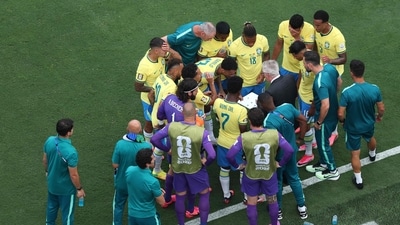
As upsetting as Brazil’s exit was, it once again highlighted a familiar pattern in their recent World Cup history — comfortably navigating the early rounds before stumbling against the first major European opponent they encounter. The golden Dutch side in 2014, Belgium in 2018, Croatia in 2022, and now Norway. Brazil have now lost their last seven World Cup knockout matches against European opposition. This time, though, the defeat carried greater significance.
Carlo Ancelotti‘s appointment arrived with romance and expectation. The idea was simple: build a Real Madrid-style transition machine around Brazil’s pace, flair and attacking talent. Against Norway in the Round of 16, however, that vision cracked. Brazil struggled to control possession, and whenever they looked threatening, it came through isolated transitions rather than a coherent attacking structure.
The turning point arrived even before Erling Haaland opened the scoring in the 79th minute. Sensing that Brazil were struggling to see enough of the ball, Ancelotti withdrew Bruno Guimaraes, Brazil’s only genuine progressive passer, and introduced fresh legs in midfield to lean even further into counter-attacking football.
ALSO READ: The penalty that defined Brazil’s World Cup: Was Carlo Ancelotti right to overlook Vinicius Jr?
Instead, the move had the opposite effect. Brazil lost their only reliable outlet in the build-up, handed Norway greater control of possession, and spent the next 10 minutes chasing shadows. The pressure eventually told as Haaland struck again, putting the game beyond Brazil’s reach before they could regain any control.
The bigger talking point, however, was Ancelotti’s handling of Endrick. The teenage forward has been hailed as Brazil’s next superstar, yet the Italian has consistently kept him on the bench for both club and country. Then there was the Neymar subplot. The veteran was never expected to feature prominently after struggling with injuries, yet he was included in the World Cup squad and introduced late, a decision that appeared driven as much by dressing-room management as footballing logic.
Both Endrick and Neymar were thrown into the game in its closing stages. Both had chances. Neither could change the outcome. Endrick’s heavy touch squandered a one-on-one opportunity, while Neymar’s stoppage-time penalty merely reduced the deficit after the contest had effectively been decided.
Then came the penalty debate.
Bruno Guimaraes’ first-half miss ultimately proved costly, and much of the post-match criticism centred on Ancelotti’s decision not to hand the responsibility to Vinicius Jr. Statistically, the coach’s reasoning was understandable. Vinicius owns a below-average career conversion rate from the spot, while Guimaraes had converted all three of his previous penalties.
Yet the numbers also exposed a flaw in Brazil’s choice. Guimaraes’ recent penalties for Newcastle followed an almost identical pattern — a stuttering run-up before placing the ball to the goalkeeper’s right. Norway keeper Orjan Nyland had clearly done his homework. He waited patiently, anticipated the direction, and produced a comfortable save. In hindsight, Brazil sorely missed the injured Raphinha, whose remarkable record of converting 18 of his 19 career penalties, including all three for Brazil, would have made him the obvious choice.
Tactically, Norway adapted far better as the contest unfolded. They began with a direct approach, feeding Haaland and Alexander Sørloth early and exploiting Brazil’s defensive uncertainty. After the break, they introduced Oscar Bobb and Andreas Schjelderup, adding greater technical quality between the lines while still retaining their counter-attacking threat.
Brazil, by contrast, never found solutions. They struggled to play through Norway’s press from goal kicks, neither full-back consistently stepped into midfield to aid progression, and once Guimaraes departed, there was virtually no structure left in possession.
Ancelotti now faces uncomfortable questions, not only about his tactical decisions, but also about trust. Trust in youth. Trust in form. And trust in a squad selection that, at times, appeared shaped more by reputation than by what Brazil actually required on the pitch.
Brazil possessed enough individual brilliance to hurt Norway. What they lacked was a system capable of bringing that brilliance together when it mattered most.