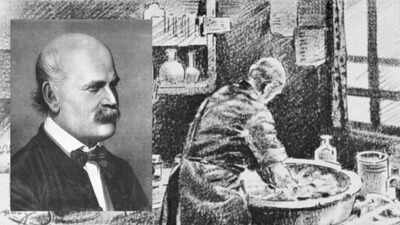
In 1847, a Hungarian obstetrician working at Vienna General Hospital found a way to stop one of the deadliest threats facing women in childbirth. By ordering doctors and medical students to wash their hands in a chlorine solution before examining patients, Ignaz Semmelweis cut deaths from childbed fever on the hospital’s doctors’ ward from about one mother in ten to roughly one in eighty within a year.The numbers were hard to ignore. Yet instead of changing medical practice across Europe, Semmelweis faced backlash from many of his colleagues. He could prove that his method worked, but he could not explain why. That gap between evidence and scientific theory would define the rest of his career.
A deadly difference between two wards
The mystery had been sitting in plain sight at Vienna General Hospital.The hospital had two maternity clinics. The First Obstetrical Clinic trained doctors and medical students. The Second trained midwives. Women were admitted on alternating days, so patients were divided more or less at random.Yet the outcomes were very different.During the six years before Semmelweis introduced handwashing, about one in ten mothers died of childbed fever in the doctors’ clinic. In the midwives’ clinic, the death rate was closer to one in thirty.Women knew the statistics. Many begged to be admitted to the midwives’ ward instead of the doctors’ ward because they believed they had a better chance of surviving childbirth there.The women treated by doctors were not noticeably poorer or sicker than those treated by midwives. The difference had to lie somewhere else.
The accepted explanation did not fit
At the time, most physicians blamed disease on miasma, the idea that illnesses spread through poisonous or “bad” air rising from decaying matter.Semmelweis found too many problems with that explanation.If bad air caused childbed fever, both wards should have been affected in much the same way because they were in the same hospital. Women who gave birth at home or delivered before reaching the hospital should also have died at similar rates. Instead, they developed childbed fever far less often than women treated in the doctors’ clinic.Semmelweis began testing every explanation he could think of.He looked at overcrowding, climate and even whether the route taken by a priest through the ward frightened patients enough to affect their health. None of those ideas matched the evidence.One major difference remained. Medical students spent their mornings dissecting human bodies before walking into the maternity ward to examine women in labour. Many did so without washing their hands.
A colleague’s death changes everything
The turning point came in 1847 after the death of Semmelweis’s friend, Jakob Kolletschka, a professor of forensic medicine.Kolletschka accidentally cut his finger while performing an autopsy. He later died from an illness that, to Semmelweis, looked strikingly similar to the fever that was killing new mothers.Semmelweis reached a conclusion that challenged accepted medical thinking.If material from a corpse could enter Kolletschka’s bloodstream through a wound and kill him, perhaps doctors and students were carrying the same deadly material from the dissecting room into the bodies of women during childbirth.He called these substances “cadaverous particles.”He had no microscope image to support the idea and no knowledge of bacteria or germs. All he had was a pattern that seemed impossible to ignore.
The order that transformed the ward
In the spring of 1847, Semmelweis ordered everyone working in the First Clinic to wash their hands in a chlorinated lime solution before examining patients.He chose chlorine because it removed the smell left by dissections. He reasoned that if it destroyed the odour of decay, it might also remove whatever caused the disease.The results were immediate.Deaths from childbed fever, which had reached roughly 18 percent in 1847, dropped to just over 1 percent the following year. Mortality remained around one to two percent in the months after the order was introduced.Later, after moving to a hospital in Pest, Semmelweis enforced the same handwashing rule again. Maternal deaths once more fell below 1 percent.He carefully recorded every result because the figures were the strongest evidence he possessed.He had no medical theory that physicians in 1847 were prepared to accept. He had only columns of hospital records showing that mothers stopped dying when doctors washed their hands.
Why the evidence was not enough
The popular version of Semmelweis’s story shows him as a lone genius defeated by many foolish colleagues.The reality was more complicated.His results were genuine, but they came from observations inside a busy hospital rather than from a controlled scientific experiment. The two clinics differed in more than handwashing, and Semmelweis could not isolate every possible factor.He was almost certainly right, but the evidence available to him was not as neat as later accounts sometimes suggest.His colleagues also faced a genuine scientific problem.Germ theory did not yet exist. “Cadaverous particles” described an effect without explaining the mechanism behind it. Physicians were being asked to accept that their own hands were killing patients without being shown an invisible cause they could observe or understand.For many, that was a difficult claim to accept.
A growing battle with the medical establishment
Semmelweis also made his own case harder to win.Although he had gathered years of evidence, he delayed publishing his findings. When he finally released his book in 1861, it was lengthy, dense and often combative.Instead of patiently answering critics, he frequently responded with anger.Leading figures in European medicine opposed his conclusions. Among them was the pathologist Rudolf Virchow.Closer to home, Semmelweis’s own superior at the hospital continued to support the bad-air theory. He remained unconvinced that handwashing explained the drop in deaths and eventually dismissed Semmelweis from his position.Political tensions added another obstacle. Semmelweis had supported the Hungarian Revolution of 1848, creating further friction between Vienna and Hungary.
A tragic end
After leaving Vienna, Semmelweis’s behaviour became questionable during the late 1850s. In 1865, he was admitted to an asylum, where he died within weeks.Even today, historians continue to debate the cause of his mental decline and the exact circumstances of his death. One account says he died from an infection after being beaten by attendants. The man who devoted his career to preventing one form of fatal infection may himself have died from another.
Recognition came after his death
The explanation Semmelweis never had arrived within a generation.Louis Pasteur established that living microbes cause infectious disease, giving scientists the mechanism Semmelweis had lacked. Building on those ideas, Joseph Lister introduced antiseptic surgery from 1867 onward.Once germs became accepted as the cause of infection, the hospital records collected by Semmelweis no longer looked like coincidence. They became powerful evidence that handwashing saved lives.The years between Semmelweis’s work in Vienna and Lister’s reforms came at a heavy cost. Mothers continued dying from infections that a basin of chlorinated solution could often have prevented, even in hospitals that had seen Semmelweis’s numbers and rejected them.Today, his name lives on through a university and, since 2015, a global day dedicated to hand hygiene.The women in his ward never needed a complex theory of microbes. They only needed doctors to simply wash their hands.