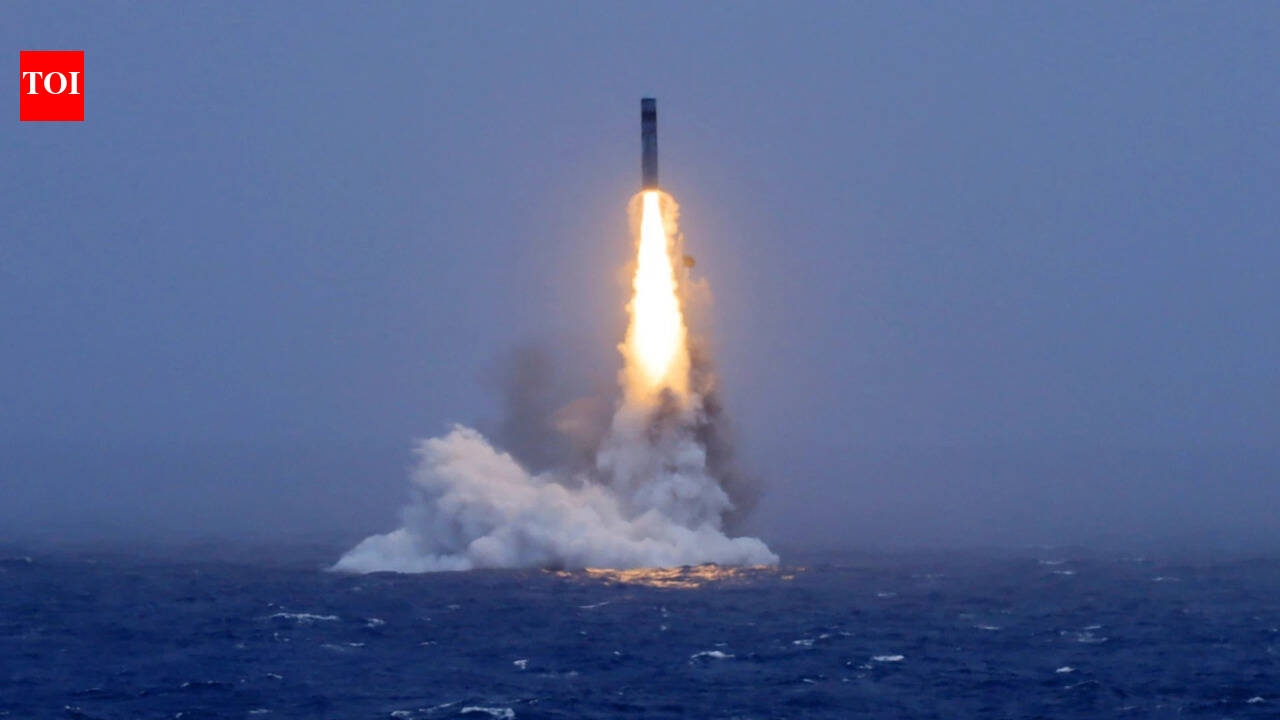
The Chinese Navy, or the People’s Liberation Army–Navy (PLAN), on Monday fired a ballistic missile from a submarine during a joint exercise with Russia. According to the U.S. Naval Institute (USNI), the missile flew approximately 6,000 km — well short of the JL-2 submarine-launched missile’s maximum range of about 7,200 km and far below the JL-3’s reported 10,000 km range.The primary carrier of these missiles is the Type-094 class — classified by NATO as the Jin class after the Chinese dynasty — a nuclear-powered ballistic missile submarine (SSBN). The PLAN operates six Type-094s, and each vessel can carry up to a dozen missiles. China is also producing the larger, more advanced Type-096 SSBN (classified as Tang class).
This missile launch is part of a series of tests carried out by the PLA.China has carried out at least ten ballistic missile tests in as many years, including the one on Monday.
- September 2024: China fired a land-based intercontinental ballistic missile into the Pacific, its first such long-range test over international waters in more than four decades.
- 2023: China tested the JL-3 submarine-launched missile in the Bohai Sea.
- 2022: The DF-41 ICBM was tested from western China, demonstrating multiple warhead capability.
- 2021: China surprised observers with a test of the DF-17 hypersonic glide vehicle.
- 2020: A JL-2 missile was launched from a Type 094 submarine in the South China Sea.
- 2019: The DF-41 was tested again, confirming its deployment with multiple warheads.
- 2018: The DF-26 intermediate-range missile was tested against maritime targets, earning the nickname “carrier killer.”
- 2017: The DF-31AG road-mobile ICBM was tested.
- 2016: China carried out multiple successful DF-41 flight tests, establishing its longest-range missile capability.
Meanwhile, India is building a layered Ballistic Missile Defence (BMD) system. The Defence Research and Development Organisation (DRDO) recently tested two ballistic missile interceptors as part of a multi-tier shield. India is coordinating some aspects of its effort with Israel, which fields the Arrow system alongside THAAD, David’s Sling and Iron Dome.In last month’s DRDO tests, interceptors destroyed targets both inside the atmosphere and in exo-atmospheric space as part of Phase II of the BMD programme. These systems are designed to counter faster, longer-range missiles, scaling up toward intercontinental threats. India’s BMD effort began in the mid-2000s with Phase I, which used the Prithvi Air Defence and Advanced Air Defence interceptors. Phase II began with the AD-1 test in November 2022 and included a full-system trial in July 2024 against 5,000 km-class targets. The programme relies on indigenous radars, communications links and advanced kill vehicles, and is aimed at countering China’s Dongfeng family and Pakistan’s Shaheen-III. Work on Phase III — intended to counter hypersonic glide vehicles and MIRV-equipped missiles — is underway but remains largely conceptual.India is also developing SSBN capability. The navy has three of the four Advanced Technology Vessels (ATVs) of the Arihant (S4) class in service, with the fourth undergoing trials. New Delhi is developing an additional S5 class. The S4 class carries the K-4 missile (range ~3,500 km) and the K-5 (range ~5,000 km). The S5 is expected to field the K-6 SLBM with a projected range near 8,000 km. India’s SSBNs are viewed as an insurance against nuclear strikes, tasked with assured retaliatory capability.