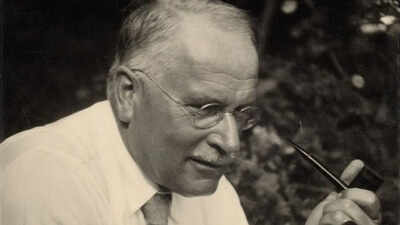
Carl Jung is widely credited with this line: “The first half of life is devoted to forming a healthy ego, the second half is going inward and letting go of it.” It splits a human life into two very different jobs. In your younger years, the task is building a self, a career, an identity, a sense of who you are in the world. Later on, according to Jung, the task reverses. The self you spent decades constructing becomes something to loosen your grip on, not something to keep polishing. It is a simple enough idea to state in one sentence, but it captures something Jung actually spent much of his working life studying, long before it became the kind of line people put on a mug or a wall print.
Quote of the day by psychiatrist Carl Jung
“The first half of life is devoted to forming a healthy ego, the second half is going inward and letting go of it.”
A modern paraphrase of an older idea
This exact sentence does not appear to trace back to a specific page in Jung’s own published writing, despite showing up everywhere under his name. What is genuinely his is the underlying idea. In his 1930 essay The Stages of Life, Jung wrote that the afternoon of life must have a significance of its own and cannot be treated as a pitiful leftover from the morning. The popular version in circulation today reads like a tidy summary of that essay rather than a line lifted directly from it.
What the quote by Carl Jung actually means
The first half of life, in Jung’s framework, is about building. You develop a career, relationships, a reputation, a set of beliefs about who you are and where you belong. This is necessary work. Without it, a person has no solid footing to stand on.The second half asks something almost opposite. Rather than continuing to build and defend that identity, Jung believed people needed to turn inward, questioning the roles and masks they had spent years constructing, and become willing to let parts of that identity go. Holding on too tightly to the ego built in youth, in his view, is exactly what stops a person from growing into something deeper in the second half of life.
Where this idea comes from in Jung’s own work
Jung spent much of his career studying what he called individuation, the process of becoming a fully integrated person rather than just a collection of roles and social masks. He believed this process tends to intensify in midlife, often triggered by a crisis, a loss, or a growing sense that outward success no longer feels like enough.That is the real theory behind today’s quote. The ego built in early adulthood is useful and necessary, but Jung thought clinging to it past its purpose was a common source of the dissatisfaction he saw in many of his patients, people who had achieved everything they were supposed to want and still felt hollow.
Why this still resonates at midlife
The phrase “midlife crisis” has become almost a joke in popular culture, but the underlying experience Jung was describing is taken far more seriously by therapists today than the stereotype suggests. A career, a marriage, or a sense of identity that worked well in someone’s twenties and thirties does not always hold up decades later, and the discomfort that follows is not necessarily a malfunction. Jung would have seen it as an invitation.This is part of why his ideas about the two halves of life still get quoted so often, even without a precise citation attached. The pattern he was describing keeps showing up, in therapy rooms and ordinary conversations, long after his original essay was written.
Putting the idea to use
You do not need to be in midlife to use this. The relevant question at any age is whether you are still building an identity because it genuinely reflects who you are, or defending one out of habit because letting it go feels risky.A useful exercise is to notice which parts of your self-image you would protect most fiercely if challenged, your job title, a belief about your own talents, a role within your family, and ask honestly whether that protectiveness is still serving you or simply became automatic somewhere along the way.
Other famous Carl Jung quotes
- “Until you make the unconscious conscious, it will direct your life and you will call it fate.”
- “The privilege of a lifetime is to become who you truly are.”
- “Everything that irritates us about others can lead us to an understanding of ourselves.”
- “Wholeness is not achieved by cutting off a portion of one’s being, but by integration of the contraries.”