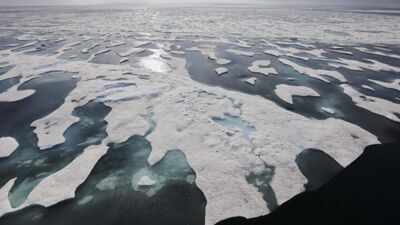
Scientists have tested an idea that could help reduce the melting of Arctic sea ice, and the initial results are promising. The method involves spraying of seawater onto existing sea ice in winter and letting it freeze into a new layer.The on-site experiment took place in Cambridge Bay in Nunavut, Canada, during the winter of 2024-25. Scientists also found that the treated ice was thicker and more reflective than untreated ice. This makes it more resilient against summer melting.The findings, published on May 22 in the journal Earth’s Future, suggest the method could one day help Arctic communities deal with shrinking sea ice. However, the researchers also say much more work is needed before it can be considered for use on a larger scale.
Alternative to controversial geoengineering
Scientists have been exploring several ways to slow the rapid loss of Arctic sea ice. Some proposed geoengineering methods, such as stratospheric aerosol injection, involve releasing tiny sulphur particles into the atmosphere to reflect sunlight away from Earth. The idea became controversial because of their possible environmental impacts.Sea ice thickening is much simpler and not new. According to the researchers, Nordic and Arctic communities have used similar methods for decades. Ice hockey rinks also rely on the same basic principle to keep their ice strong.Previous computer modelling has also suggested that thicker sea ice could help reduce coastal erosion near Arctic towns, make travel easier and support animal migration and hunting.
How the experiment was carried out
The researchers set up eight test areas and three control sites in Cambridge Bay, Canada. Using submersible pumps that each consumed less electricity than a household toaster, they pumped up to 20 centimetres of seawater onto the test areas either once or twice. The control sites were left untouched.Later, one of the control sites was used for a separate melt pond drainage experiment. Researchers drilled small holes to drain meltwater from the surface and expose the brighter ice underneath.By the end of winter, the treated areas had grown up to 32 centimetres thicker than the untreated sites. According to the study, that is roughly equal to the amount of Arctic sea ice thinning recorded over the past 50 years. Areas flooded twice, also became thicker than those flooded only once.During the melt season between late May and September, the treated ice also stayed brighter and melted more slowly, remaining thicker than the ice at the control sites.
Why pumping seawater makes ice stronger
When seawater is pumped onto sea ice, it mixes with the snow covering the surface. The snow-water mixture freezes into a new layer of ice, while the reduction in snow insulation allows colder atmospheric temperatures to accelerate natural ice growth from below.Thicker ice is generally brighter than thinner ice. A brighter surface reflects more sunlight back into space instead of absorbing it, which helps keep the region cooler.If similar results can eventually be achieved over much larger areas, the increased reflectivity could contribute to regional cooling. It could also help slow permafrost thaw and reduce ice loss from Greenland.
Can this work across the Arctic?
While the early results are promising, the researchers acknowledge that expanding the technique across the Arctic would be extremely difficult.A 2016 study estimated that about 10 million wind-powered pumps would be needed to treat just 10% of the Arctic Ocean. Covering the entire Arctic would require around 100 million pumps.Arctic sea ice has already shrunk by about 20% since 1979, and the decline is continuing as global temperatures rise. A 2021 study noted that if sea ice thickening is ever to be used on a large scale, the pumps would need to be deployed quickly while enough sea ice still remains.A review published last year concluded that, because of governance challenges, maintenance requirements and the sheer scale involved, sea-ice thickening is simply not feasible for use at a scale and at a rate that would be meaningful for sea ice protection. Even so, they more recent winter trials have produced encouraging results.