Conspiracy theories have long been football’s favourite travelling companion. They usually begin as whispers on social media, grow louder with every controversial refereeing decision and, more often than not, fade away with time. The one surrounding Lionel Messi‘s Argentina, however, has refused to disappear.
It first gathered momentum during the 2022 FIFA World Cup in Qatar, where every contentious decision involving the eventual champions was scrutinised through the lens of perceived favouritism. It began as little more than background noise. Some supporters questioned the amount of stoppage time added in Argentina’s shock opening defeat to Saudi Arabia, claiming officials were desperate to help the South Americans find an equaliser. Days later came the group-stage clash against Poland, when Dutch referee Danny Makkelie was sent to the pitchside monitor after a VAR review and awarded Argentina a penalty for a challenge on Messi. Rio Ferdinand, on the BBC, called it a “disgraceful and outrageous decision”. Others agreed, arguing that the intervention itself was unnecessary, reigniting accusations that marginal decisions consistently favoured Argentina. None of those incidents proved any conspiracy, but together they fuelled a narrative that lingered well beyond Qatar.
Four years later, that narrative has returned with renewed force. It reached its loudest point yet after Argentina‘s dramatic 3-2 comeback win over Egypt in the Round of 16 on Tuesday, reigniting accusations that the defending champions continue to receive favourable treatment from match officials.
Egypt believed they had moved 2-0 ahead when Mostafa Ziko found the net in the 58th minute, only for referee François Letexier to disallow the goal following a VAR review for a foul in the build-up. Argentina survived the scare before scoring three times in the final 13 minutes to snatch victory and advance to the quarter-finals.
The final whistle did little to end the controversy. Egypt coach Hossam Hassan accused FIFA of steering the tournament towards Argentina, saying: “Perhaps they wanted the world champions to stay in the competition. Perhaps they wanted Messi to stay in the running.” He went even further, adding: “I’ll never watch the World Cup again, because there’s no justice in this competition.”
Ziko echoed those sentiments, telling reporters: “It was not fair from the referee. He wasted all of our efforts with his decisions… The cup is directed towards Argentina.”
Whether those claims ultimately withstand scrutiny is another matter, but the debate that first surfaced in Qatar has suddenly become louder than ever.
Let’s start with the disallowed goal.
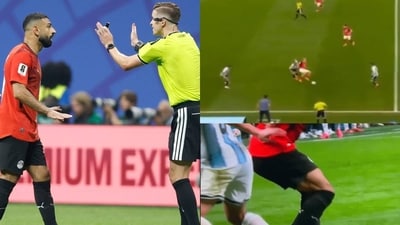
Egypt defender Marwan Attia’s challenge on Lisandro Martinez, almost 100 yards from Argentina’s goal, was reviewed after Ziko found the net 13 minutes into the second half. VAR showed Attia briefly grabbing Martinez’s shirt while simultaneously stepping on his foot. Since the incident occurred during the attacking phase of play that led to the goal, Letexier ruled it out after an on-field review.
That decision quickly became the centrepiece of Egypt’s allegations.
Former Premier League referee Graham Scott argued in his analysis for The Athletic that the incident amounted to nothing more than normal football contact and did not warrant VAR intervention. He also explained that the greater the distance and time between an incident and a goal, the more obvious and significant the offence must be before VAR intervention is justified. In this case, Argentina had ample time and opportunity to regroup defensively after losing possession.
Former FIFA referee Fernando Guerrero, who officiated at the 2022 World Cup, echoed that view in a social media post.
“There was no foul on the Argentine player, and even if they considered it a foul, it should not have been reviewed as part of the APP (Attacking Possession Phase), because Argentina had plenty of time, space and their defenders were properly positioned,” he wrote.
“The Argentine team had three opportunities to recover the ball and failed to do so. Therefore, the decision goes completely against the VAR protocol, which states that officials should only intervene when there is a clear attacking sequence and the team that lost possession has no realistic chance of regaining the ball. VAR and the referee made a mistake, harming Egypt and ultimately contributing to their elimination.”
Earlier last week, FIFA head of refereeing Pierluigi Collina reiterated that officials had been instructed to allow normal football contact in an effort to increase the tempo of matches. If that interpretation is applied consistently, it inevitably raises the question of whether Ziko’s disallowed goal should have stood.
There will, of course, be those who believe Attia committed a foul. The debate is less about whether contact existed than whether similar incidents have been judged consistently.
And if this is indeed how the VAR protocol is to be interpreted, then a similar argument could be made about Messi’s World Cup record-breaking goal against Austria in the group stage.
In the build-up to the goal, Argentina regained possession after Alexis Mac Allister lunged in from behind and brought down Xaver Schlager without appearing to make contact with the ball. Play continued, despite Austrian appeals, and Messi eventually found the net. Austria wanted VAR to intervene, but no review was recommended.
Speaking on Fox Sports, Peter Schmeichel questioned the decision.
“I don’t think that goal should have stood. Think about how they got the penalty. It was a kick from behind by a player. There goes Xaver down, and that should have been a free kick, but it went on to the goal from there. VAR should have taken that back. It was a clear and obvious mistake.”
Likewise, Egypt also felt they should have been awarded a penalty shortly before Enzo Fernandez’s winner. Mohamed Salah went down inside the area after slight contact on his boot, while another Egyptian attacker appeared to have his shirt pulled inside the box. Neither incident prompted a VAR review.
Ian Wright, speaking on ITV Sport, believed consistency demanded another look.
“That’s what’s happening with VAR now, they’re pulling it back. If you’re going to pull it back for Argentina on the edge of the box to disallow a goal, you have to pull it back for this one with Mo Salah. He’s been caught. Whatever we say, it might be minimal, he’s been caught and then they go up the other end.”
There was also Messi’s challenge against Algeria during the group stage, which escaped a VAR review, let alone a possible red card. USA striker Folarin Balogun, meanwhile, received an automatic one-match suspension for a broadly comparable incident, although that ban was later suspended following FIFA’s controversial Article 27 ruling. Algeria lodged a complaint with FIFA over the incident but, according to reports, received no response.
There was another contentious moment against Egypt, too. In the 43rd minute, an Argentine player appeared to strike an Egyptian opponent in the face off the ball, yet play continued without intervention. Social media users later compiled several other disputed incidents from the match, further fuelling the debate around consistency.
Ultimately, every major tournament produces its share of refereeing controversies. This World Cup has been no different, with inconsistency in decision-making emerging as one of its defining themes. The application of VAR protocols, too, remains open to interpretation. When similar incidents appear to be judged differently, questions over consistency become inevitable.
Whether Argentina have genuinely benefited from favourable officiating or have simply found themselves at the centre of football’s biggest talking points is a debate that will continue long after this World Cup. What is beyond dispute, however, is that the Egypt match has reignited a conversation that first surfaced in Qatar. FIFA’s refereeing department will now find itself under greater scrutiny than ever before, with every major decision involving Argentina likely to be viewed through that same lens.