
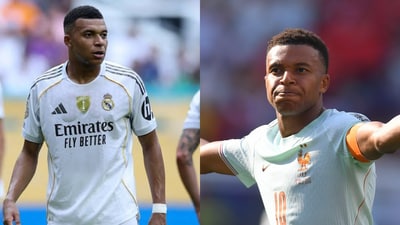
Kylian Mbappé left Morocco behind with another collection of almost absurd numbers. His goal in France’s 2-0 quarter-final victory took him to eight at the 2026 World Cup, matching his tally from Qatar four years ago. He became the first player to score at least eight goals in two separate editions, reached 20 World Cup goals in 20 appearances and moved to 11 direct involvements at this tournament – eight goals and three assists, the highest single-edition total since Gerd Müller in 1970.
Yet Mbappé had hardly endured a poor season at Real Madrid: 42 goals in 44 matches, the Pichichi with 25 league goals and another Champions League Golden Boot with 15. The contrast is not between an ineffective club forward and an irresistible international one. It is between two versions of the same phenomenon, produced by different environments.
Madrid ask him to fit; France make others fit around him
At Madrid, Mbappé is one superstar among several. Vinícius Júnior naturally wants the left flank and inside-left channel – precisely the territory from which Mbappé is most destructive. Jude Bellingham attacks central spaces, while Madrid’s midfielders and full-backs also require defined lanes.
That creates compromises. Mbappé may begin as the centre-forward, but instinctively drifts left. Vinícius can move wider, yet his threat diminishes if he is permanently pushed from his preferred zone. Madrid must balance elite talents whose strongest movements occasionally lead them towards the same patch of grass.
France face no such identity crisis. Mbappé’s primacy is absolute. Ousmane Dembele stretches the right, Michael Olise creates between the lines, and Desire Doue can combine without demanding Mbappé’s territory. The supporting cast does not compete with his gravitational pull; it gives that pull direction.
Club football closes space; tournament football eventually opens it
Madrid dominate possession in most domestic matches. Opponents retreat, compress the penalty area and force them to attack an established defensive block. Mbappé consequently receives more passes with defenders already set, often with his back to goal and little room to accelerate.
That is not his weakness, but it limits the quality that makes him uniquely terrifying: turning towards goal with space ahead.
World Cup football is more volatile. International sides have less time to perfect pressing structures and defensive distances. Knockout matches also compel losing teams to abandon caution. Once the game stretches, Mbappé is no longer solving a crowded puzzle; he is attacking defenders moving anxiously towards their own goal.
France understand this better than anyone. Even when defending deeper, they preserve Mbappé as the first outlet. He is often spared the heaviest defensive duties so that, upon regaining possession, France can find him early and vertically. Madrid require him to participate in a repeatable structure. France preserve him for the rupture.
France give him clarity rather than constant responsibility
A club season demands completeness. Mbappé must score, press, combine, connect midfield with attack and remain productive through repeated fixtures against opponents specifically coached to stop him.
The World Cup compresses his task. France do not need a perfectly balanced model for 55 matches; they need one capable of surviving eight. Didier Deschamps can accept some defensive imbalance because the reward is Mbappé remaining fresh, high and ready to decide the game.
France’s 2026 evolution has made this arrangement even more dangerous. They are no longer dependent solely on sitting deep and releasing Mbappé into transitions. Against Morocco, they pressed higher, created sustained pressure and eventually found their breakthrough against an organised defence. Mbappé can now destroy open matches without being restricted to them.
World Cup moments make his dominance feel larger
Mbappé’s club goals arrive across ten months and are quickly followed by another fixture. His World Cup goals exist as historical events. A burst against Argentina, a final hat-trick, or a quarter-final strike against Morocco acquires permanence because elimination, national identity and legacy are attached to every touch.
That is why the two versions feel so different even when both remain extraordinarily productive.
Real Madrid Mbappé is a magnificent forward asked to function within an ecosystem of competing stars and crowded spaces. World Cup Mbappé is the ecosystem. France remove the territorial conflict, accept the tactical compromise and shape the match around the instant in which he becomes unstoppable.
Madrid reveal the breadth of his game. The World Cup distils its most devastating essence.