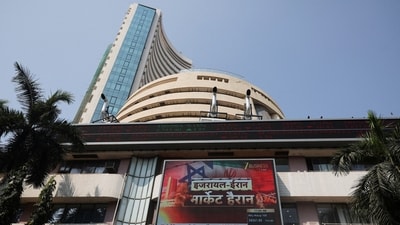
Indian markets started the week with a sharp decline amid fresh geopolitical tensions between the US and Iran, consequently contributing to rising crude oil prices.
The BSE SENSEX stood at 76,899.27 points, down by 670.12 points or 0.86 per cent. Similarly, NSE NIFTY 50 stood at 24,014.75 points, shedding 192.15 points or 0.79 per cent.
“Indian markets recovered last week but ended a 4-week positive move with a small negative weekly performance,” said Ajay Bagga, banking and market expert. “This morning the Gift Nifty is pointing to a weak start.”
However, he maintained a constructive outlook on domestic equities despite the surrounding instability. “We remain positive on Indian markets on the back of improving earnings, two years of underperformance and strong domestic flows. It remains a buy on dips market despite the clouded picture from the Persian gulf,” Bagga added. Track LIVE updates on US-Iran war here
The domestic downturn tracked severe weakness across Asian indices, where Japan’s Nikkei 225 plummeted 1,237.73 points, or 1.81 per cent, to 67,320.00, and South Korea’s KOSPI dipped 7.25 per cent to 6,970.89.
The negative momentum follows a sharp escalation in the Middle East after the collapse of the hard-won United States-Iran ceasefire, an event that instantly disrupted crucial global energy corridors.
Consequently, at the time of reporting, commodity markets registered massive volatility, with Brent crude surging 4.01 per cent to hit USD 79.06 per barrel, while crude oil jumped 4.00 per cent to USD 74.27 per barrel. On the other hand, Gold fell by 1.49 per cent to USD 4,059.73.
Analyzing the geopolitical landscape, Bagga stated, “The US-Iran war escalation is more like a game of ‘who blinks first,’ but it is roiling oil and gas supplies once more and transmitting risk off to all markets.”
Western markets had previously shown some resilience, with the S&P 500 rising 0.42 per cent to 7,575.39 and the Nasdaq gaining 0.29 per cent to 26,281.61, though Dow Jones Futures slipped 0.39 per cent to 52,429.29 on Monday morning.
“With annualized inflation hovering around a sticky four per cent, new Fed Chair Kevin Warsh signaled that interest rates–currently sitting at a restrictive range of three and a half to three and three-quarters per cent–might actually need to tick higher by year-end,” Bagga mentioned.
This hawkish stance, along with a trimmed IMF global growth forecast of three per cent driven by immense corporate artificial intelligence infrastructure expenses, has intensified corporate cash flow strains globally.
Vinit Bolinjkar, Head of Research at Ventura, noted that despite these macro pressures, local market participants highlight strong structural underpinnings within the Indian capital ecosystem. Foreign Institutional Investors (FIIs) have effectively turned net buyers in the first week of July 2026, recording cumulative inflows of over ₹3,421 crore in the cash market, completely reversing the cautious stance seen in late June.
“This shift reflects improving sentiment amid stabilizing global cues, expectations of a constructive Q1 earnings season, and selective buying in financials and autos,” Bolinjkar said. “However, markets remain sensitive to developments in India-US trade negotiations and geopolitical risks.”
Looking ahead at technical support levels, Bolinjkar noted that “While the near-term trend appears constructive, we expect continued volatility with Nifty finding support around 23,700-23,800 and resistance near 24,200-24,300. Investors should maintain a stock-specific approach, focusing on fundamentally strong large caps and sectors likely to benefit from earnings upgrades and domestic growth momentum.”
At the time of reporting, Indigo dipped by 2 per cent to stand at ₹5,199.50, Tata Steel dropped 2.02 per cent to ₹187.32, and Maruti Suzuki India lost 1.71 per cent to settle at ₹13,617.00.
On the other hand, Tata Consultancy Services gained 1.98 per cent to reach ₹2,110.00, ONCG rose 0.93 per cent to ₹247.25, and NTPC gained 0.55 per cent to ₹346.45.