
Kolkata: There are bigger football rivalries and more frequent ones. Perhaps, even fiercer local derbies. But no game has accumulated as much political baggage, sporting mythology and emotional residue as an England-Argentina World Cup fixture.
Its roots stretch beyond football. The failed British invasions of Río de la Plata in 1806 and 1807, followed nearly two centuries later by the Falklands War in 1982, ensured that every meeting between the two nations was more than just a game.
Add football’s capacity for producing unforgettable drama and the result is what many describe as the World Cup’s only true trans-continental derby. Across five meetings, there have been three English victories and two for Argentina — one of them on penalties — yet statistics barely capture the significance of this rivalry.
It has reflected history, politics, identity and football at its most theatrical. It has produced refereeing controversy, football’s most infamous handball, one of its greatest goals, a teenager’s coming of age and a captain’s redemption. But it all began quietly enough, way back in 1962.
England 3-1 Argentina (Group Stage, 1962)
The first World Cup meeting lacked the political edge that would later define the fixture but was dramatic nonetheless. Ron Flowers, Bobby Charlton and Jimmy Greaves put England 3-0 up before José Sanfilippo grabbed a late consolation. The victory proved decisive, lifting England above Argentina on goal difference and into the quarter-finals while Argentina returned home. At the time it was merely a significant group-stage victory. In hindsight, it marked the beginning of a rivalry that would become inseparable from the World Cup itself.
England 1-0 Argentina (Quarter-final, 1966)
Four years later came the match that transformed suspicion into genuine hostility. England, eventually crowned world champions, met an uncompromising Argentina side in a bruising quarter-final at Wembley. The defining moment arrived when captain Antonio Rattín was dismissed by German referee Rudolf Kreitlein, reportedly for dissent, despite the language barrier between them. Refusing to leave, Rattín delayed play for almost ten minutes before police escorted him away.
Geoff Hurst’s late header settled the contest, but the controversy endured. Argentina believed the referee had favoured the hosts, while the chaotic scenes prompted FIFA to accelerate the adoption of yellow and red cards before the next World Cup. One match had altered both the rivalry and football’s laws.
Argentina 2-1 England (Quarter-final, 1986)
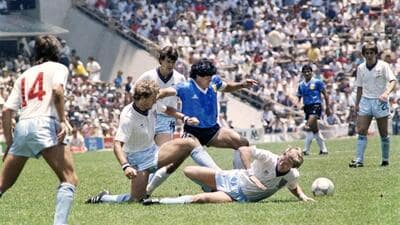
No fixture in World Cup history has produced two goals so contradictory, or so enduring. Against the fresh backdrop of the Falklands War, Diego Maradona first punched Steve Hodge’s looping ball beyond Peter Shilton in what he later immortalised as the “Hand of God”. England’s protests were ignored.
Four minutes later came redemption of an altogether different kind. Collecting possession inside his own half, Maradona slalomed past half the England team before finishing brilliantly. If the first goal embodied cunning, the second represented pure genius. Gary Lineker’s late header narrowed the deficit, but Argentina prevailed before lifting the trophy in Mexico City. Both goals entered football folklore, one infamous, the other almost universally regarded as the greatest ever scored at a World Cup.
The scoreline won’t say how agonisingly close England had come to scoring the equaliser, with substitute John Barnes providing the cross for Lineker before an Argentine defender reached the ball first. With just a few minutes remaining the missed chance proved to be England’s last opportunity.
Argentina 2-2 England (Argentina won 4-3 on penalties, Round of 16, 1998)
If 1986 belonged to Maradona, France ‘98 belonged to chaos. Gabriel Batistuta and Alan Shearer exchanged penalties before an 18-year-old Michael Owen announced himself with a dazzling solo run that remains among England’s finest World Cup goals. Javier Zanetti levelled with an ingenious free-kick routine on the stroke of half-time.
Then came another flashpoint. Diego Simeone bundled David Beckham to the ground and, after a brief exchange, Beckham flicked a boot at the Argentine midfielder. Simeone collapsed theatrically, prompting referee Kim Milton Nielsen to send off Beckham and England were left to survive with ten men. They almost did. Instead, another penalty shootout defeat followed, David Batty missing the decisive kick while Beckham returned home as the nation’s scapegoat.
Argentina 0-1 England (Group Stage, 2002)
Football rarely offers redemption, but Beckham snatched his chance in 2002. Four years after Saint-Étienne, England’s captain rewrote his own story. Just before half-time, Michael Owen was fouled by Mauricio Pochettino, and Beckham stepped forward to dispatch the penalty emphatically down the middle.
England defended resolutely to secure a famous victory under Sven-Göran Eriksson, while Argentina, among the pre-tournament favourites, crashed out in the group stage. Beckham’s celebration was one of release rather than triumph.