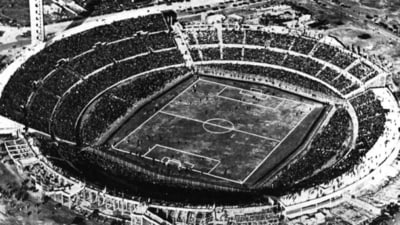
The 1930 FIFA World Cup was the tournament’s inaugural edition, with Uruguay beat Argentina 4-2 in the final. Argentina had a dominant run to the final, and their campaign also saw some controversy as Fernando Paternoster also deliberately missed from the spot. Argentina clinched a 6-3 win in that match, and it’s often cited as one of the earliest examples of fair play.
Argentina faced Mexico in their second match of the campaign, following a 1-0 win over France. Before the game, Argentina skipper Manuel Ferreira had to temporarily leave for Buenos Aires for his law examination, which led to Guillermo Stabile’s international debut.
Also Read: The chess match behind Lionel Messi: How Lionel Scaloni can outfox Thomas Tuchel
Stabile justified his head coach’s decision by scoring a hat-trick against Mexico. Meanwhile, Adolfo Zumelzu got a brace for the Argentines.
The handball moment arrived when Argentina were already comfortably leading, 3-0. In the first half, Bolivian referee Ulises Saucedo awarded Argentina a penalty after ruling that a defender had handled the ball inside the area. It was an incorrect decision. But what happened next became one of the biggest sporting moments in history.
Argentine defender Fernando Paternoster had stepped up to take the penalty, but also believed that the referee had made the wrong call. Rather than trying to score, he shot it straight and softly to Mexico goalkeeper Oscar Bonfiglio, who made an easy save.
It is also said that the referee realised his mistake after awarding Argentina a penalty. To compensate for it, he paced out a longer distance, around 16 steps instead of the customary 12, making it more difficult to score.
The missed penalty didn’t affect the result, as Argentina cruised to victory and put them firmly on course for the semi-finals, where they beat the USA 6-1, before reaching the final.
Almost a century later, the incident still remains as one of the World Cup’s most heartwarming fair play stories. Long before VAR, a disputed penalty was remembered for its fair play rather than controversy.
The match was also one of the highest-scoring games of the inaugural World Cup, and it saw nine goals in total. Stabile would go on to finish as the tournament’s top scorer with eight goals in only four matches. He also missed Argentina’s opener vs France. Mexico also became the first team in World Cup history to leak six goals in a single match.