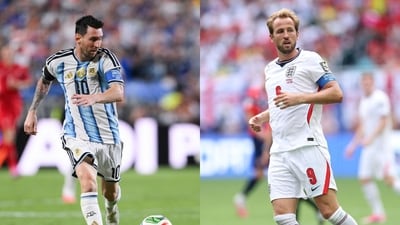
England and Argentina meet in Atlanta tonight for a place in the World Cup 2026 final. It is their first meeting at this stage, their first encounter since 2005 and their first competitive clash since David Beckham’s penalty settled a group game in 2002.
Spain await the winners. Argentina are trying to defend the title they won in 2022, while England are chasing a second World Cup, 60 years after their only triumph. Yet few international rivalries have produced so many arguments about cheating, justice, national honour and political history from so few meetings.
A rivalry older than the Falklands War
The hostility is often explained through the 1982 Falklands or Malvinas War, but the football rivalry had already become toxic 16 years earlier.
Its roots are complicated. British immigrants, railway workers and teachers played a central role in establishing football in Argentina during the nineteenth century. Argentina then reshaped the imported game around technique, imagination and street intelligence – a contrast to English structure, physicality and fair play.
That cultural argument became personal at the 1966 World Cup. England beat Argentina 1-0 in a quarter-final at Wembley, but the match is remembered primarily for the dismissal of Argentine captain Antonio Rattín.
German referee Rudolf Kreitlein sent Rattín off despite neither man speaking the other’s language. Rattín said he had been requesting an interpreter and refused to leave immediately.
England manager Alf Ramsey later described Argentina’s players as “animals” and stopped his team from exchanging shirts. Argentina viewed the game as a robbery and a national humiliation. The confusion surrounding Rattín’s dismissal also helped inspire the later introduction of yellow and red cards.
That match, rather than the war, created the rivalry’s sporting hatred.
Maradona turned hostility into mythology
The Falklands War gave the next World Cup meeting a different emotional charge. When Argentina and England met in the 1986 quarter-final in Mexico, only four years had passed since the conflict.
Diego Maradona then scored two goals that came to represent competing views of Argentine football.
First came the “Hand of God”. Maradona used his fist to beat Peter Shilton to the ball, but the referee missed the offence. For England, it became the ultimate theft – an illegal goal in a World Cup knockout match. Four minutes later came the answer to every complaint. Maradona collected the ball inside his own half, escaped several challenges, rounded Shilton and scored the Goal of the Century.
One goal was deception; the other was genius. Together, they made the match immortal.
Argentina won 2-1 and later lifted the trophy. Maradona openly connected the victory to the pain of the war. In England, the handball remained an unforgivable injustice. In Argentina, the match became symbolic revenge against a historically more powerful country.
Beckham, Simeone and another English scar
The rivalry returned in the last 16 of the 1998 World Cup. Michael Owen scored a sensational goal, Argentina equalised through a clever free-kick routine, and the game appeared balanced until David Beckham reacted to a foul by Diego Simeone.
Beckham flicked his leg towards Simeone while on the ground. Simeone exaggerated the contact, Beckham was sent off, and England eventually lost on penalties.
The red card transformed Beckham into a national villain, while Argentina celebrated another knockout victory, shaped in part by gamesmanship and England’s loss of control.
Four years later, Beckham found redemption. He converted the penalty that gave England a 1-0 victory over Argentina at the 2002 World Cup. Even that incident carried controversy, with Michael Owen going down under Mauricio Pochettino’s challenge.
It was the perfect continuation of a rivalry in which almost every major match leaves the losing side with an incident to resent.
Tonight brings a new generation into an old argument
The modern players know one another far better than earlier generations, with several Argentine stars playing in England. Lionel Scaloni and Thomas Tuchel have little interest in turning a football match into a political confrontation.
But history cannot be removed from this fixture simply because the players speak carefully.
England remember Rattín, the Hand of God, Beckham’s red card and repeated tournament pain. Argentina remember Ramsey’s insult, the grievance of 1966, the Malvinas and Maradona’s revenge.
Tonight’s semi-final offers something this rivalry has never had before: a direct battle for a place in the World Cup final. The names have changed, but the argument remains familiar. England and Argentina will again contest more than the ball. They will contest whose nerve holds, whose methods are accepted and whose version of the night becomes history.