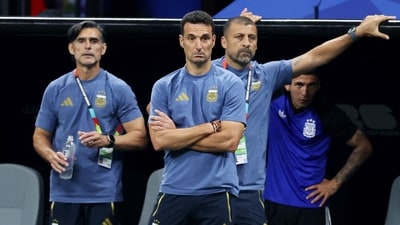
For 55 minutes, England were in control and Thomas Tuchel’s game plan was working perfectly. England had frustrated Lionel Messi, taken the lead through Anthony Gordon and restricted Argentina to speculative chances. At that stage, England looked firmly on course for the World Cup final. But Lionel Scaloni had other ideas. A series of subtle tactical adjustments gradually shifted the momentum in Argentina’s favour, paving the way for another remarkable comeback.
Argentina’s 2-1 comeback will be remembered for Messi’s two assists, Enzo Fernández’s equaliser and Lautaro Martínez’s stoppage-time winner. But beneath those defining moments lay Lionel Scaloni’s coaching masterclass.
After Gordon’s opener, Scaloni instructed his players to push higher up the pitch. Argentina committed more bodies into England’s half, won the second balls and launched attacks with greater urgency. Their press became relentless. Instead of allowing England to build from the back, Argentina hunted the ball immediately after losing possession, forcing hurried clearances rather than controlled spells of possession.
Although England captain Harry Kane revealed after the match that Thomas Tuchel had instructed his players to chase a second goal, England gradually began to drop deeper. Tuchel also introduced an additional defender, switched to a back five and surrendered control of midfield. England came under a wave of Argentine attacks. Scaloni’s side refused to let them string together passes to relieve the pressure, winning possession back almost immediately after losing it. After the match, Tuchel admitted that fatigue and Argentina’s growing momentum contributed to England’s collapse.
Instead of forcing attacks through the middle, Argentina stretched England across the pitch. Messi drifted towards the right flank, receiving possession in wider pockets where England struggled to crowd him out. At this stage of his career, Messi no longer relies on explosive acceleration. He simply needs an extra second on the ball. England did well to contain him for much of the match, but once Argentina raised the intensity of their press, they found it increasingly difficult to keep him quiet.
The pressure built, and England had to surrender
That became evident in the build-up to Fernández’s equaliser. England anticipated another cross into the penalty area, but Messi instead spotted Fernández 25 yards from goal and picked him out with pinpoint accuracy. The finish was outstanding, but the move also highlighted Argentina’s patience, positional play and intelligent use of space rather than individual brilliance alone. Scaloni’s decision to introduce Lautaro Martinez as a natural penalty-box striker also proved decisive. Until then, Argentina’s attacks had been built around movement and intricate combinations. Martinez’s arrival gave them a genuine aerial presence and a constant target inside the box.
He repaid his manager’s faith in stoppage time, heading home Messi’s teasing cross. The comeback was also built on composure. While many teams lose their structure after falling behind in the second half, Argentina remained organised. Their passing stayed measured, the press remained coordinated, and they continued to find pockets of space.
Anxiety gradually crept into England’s play as every clearance came straight back. They struggled to retain possession, allowing Argentina to sustain relentless pressure. Jordan Pickford made several important saves and England’s defenders threw themselves into blocks, but the momentum had firmly swung in Argentina’s favour. Alexis Mac Allister struck the post before Fernández finally found the breakthrough.
Scaloni did not reinvent the game. He simply recognised that the match required subtle adjustments rather than wholesale changes. By the time Fernandez and Martinez completed the comeback, England had already lost the tactical battle. The headlines belonged to Messi, as they so often do. But behind his brilliance stood Scaloni’s tactical masterclass, guiding the defending champions into another World Cup final.