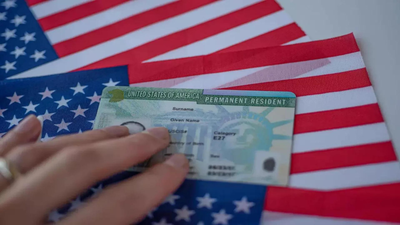
The Trump administration is considering requiring some green card applicants applying from overseas to post a bond of up to $100,000, according to a report by The Wall Street Journal. The proposal, still under discussion within the US State Department, is part of a broader push to tighten legal immigration and ensure that new immigrants are financially self-sufficient.If implemented, the policy would apply to certain applicants seeking immigrant visas at US consulates abroad. These visas automatically grant lawful permanent resident status, or a green card, upon entry into the United States. While officials have discussed a bond of around $100,000, people familiar with the matter told the WSJ that the amount could vary depending on individual circumstances.The proposal comes amid a series of immigration measures introduced during US President Donald Trump’s second term, including higher naturalisation fees, stricter green card processing rules and tighter scrutiny of legal immigration pathways. For Indians, who account for one of the largest backlogs in the US employment-based green card system, the latest proposal could add another layer of financial and procedural uncertainty.
What is the proposed green card bond?
According to The Wall Street Journal, the State Department is considering asking certain immigrant visa applicants to deposit a bond before they are allowed to move to the US.The discussions have centred on applicants applying through US embassies and consulates outside the country. Officials are also considering launching the programme as a pilot in a limited number of countries before deciding whether to expand it.People familiar with the discussions told the newspaper that applicants would likely receive the money back only after becoming US citizens — a process that generally takes at least five years. Family members could also post the bond on behalf of applicants.
What could it mean for Indians?
The proposal could disproportionately affect Indians, who make up one of the largest groups waiting for US permanent residency through employment-based visas.Many Indian professionals spend years, and in some cases decades, waiting for green cards because of the per-country cap on employment-based immigrant visas. If they are eventually required to complete the final stage of the process from India, a sizeable bond requirement could significantly raise the financial burden on families already navigating lengthy immigration queues.The uncertainty also comes as thousands of Indians continue to become US citizens each year. According to DHS data, 65,960 Indians acquired US citizenship in FY2022, 59,100 in FY2023 and 49,700 in FY2024, making India the second-largest source country for new American citizens despite the recent decline in numbers.
Part of a wider immigration crackdown
The bond proposal is the latest in a string of measures aimed at tightening legal immigration.Earlier, the Department of Homeland Security (DHS) proposed sharply increasing naturalisation fees. The filing fee for Form N-400, used by green card holders applying for US citizenship, would rise from $760 to $1,330 for paper applications and from $710 to $1,280 for online filings. The proposal would also eliminate reduced-fee options and fee waivers for lower-income applicants.The administration has also recently directed many temporary visa holders seeking permanent residency to leave the United States and complete green card processing from their home countries rather than adjusting their status while remaining in the country.Together, these measures reflect the administration’s broader “America First” approach, which places greater emphasis on financial self-sufficiency, stricter vetting and reducing legal immigration.