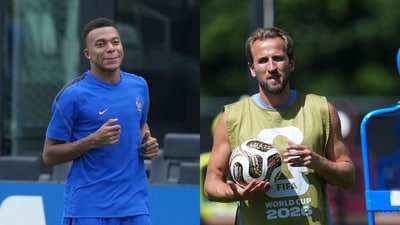
Thomas Tuchel did not attempt to manufacture enthusiasm after England’s World Cup dream ended in the semi-finals. “None of our players and none of the French players want to play this match,” Tuchel said. “They want to play the final. We gave everything to achieve that.”
Didier Deschamps confirmed the mood from the other camp. “England does not want to play this game, and neither do we. But here we are,” the France coach said, while stressing that representing the national team still carried a duty. “It is not a friendly. It is a third-place playoff.”
That is the contradiction of the World Cup’s most awkward match. It brings together two teams still processing the collapse of their greatest ambition, asks them to recover within days and then presents bronze as a prize. The finalists prepare for immortality; the losing semi-finalists must return for one more game.
Yet the playoff was not invented as consolation or created to fill television time. It emerged from a practical problem in the structure of a knockout tournament: how should third place be decided?
Why FIFA introduced the third-place match
The inaugural World Cup in Uruguay in 1930 had no third-place playoff. The United States and Yugoslavia lost their semi-finals and did not meet again, leaving no result on the field to separate third from fourth.
Historical accounts of how the two teams were subsequently classified have differed. Later publications even created confusion by referring to a match that did not take place. What is certain is that the inaugural tournament itself produced no footballing answer to the question of who had finished third.
Italy 1934 changed the World Cup format to a straight 16-team knockout competition. The bracket automatically produced a champion and runner-up, but its two defeated semi-finalists remained level. FIFA therefore scheduled Germany and Austria to play in Naples, creating the first official World Cup match for third place.
Germany won 3-2. Ernst Lehner scored after only 25 seconds, still one of the quickest goals recorded in World Cup history and an early sign of the fast, open football that would eventually become associated with the fixture.
The decision also fitted the sporting culture from which the World Cup had emerged. Before creating its own global championship, FIFA had organised Olympic football tournaments, where medals and a complete podium were already established ideas. Bronze-medal contests had been staged in Olympic football before the first World Cup, including the tournament immediately preceding it in 1928.
No widely available FIFA declaration identifies one official as the inventor of the playoff or records a single stated reason for its introduction. The logic, however, was evident: the remaining podium position should be earned on the pitch rather than assigned afterwards through goal difference, tournament record or administrative judgement.
The match returned in 1938, when Brazil recovered from two goals down to defeat Sweden 4-2. It was absent in 1950 because that World Cup concluded with a four-team final round rather than semi-finals and a conventional final.
From 1954 onwards, a third-place contest appeared at every World Cup. Even in 1974 and 1978, when a second group phase replaced the semi-finals, the runners-up from the two groups met to determine who would finish third.
Its original purpose gradually became tradition, and tradition acquired commercial value. The fixture now provides another ticketed stadium event, another global broadcast, a definitive final ranking and one more opportunity to influence individual awards.
UEFA eventually took a different view. The European Championship held its final third-place playoff in 1980, when Czechoslovakia defeated hosts Italy on penalties, and then removed the match from later editions. FIFA continued with it, even as the World Cup expanded to 48 teams and 104 matches in 2026.
The ‘unwanted’ game that keeps producing records
The reluctance expressed by Tuchel and Deschamps is understandable. The players have spent years preparing to win the World Cup, not to decide which defeated semi-finalist should stand on the lowest step of the podium.
History, however, shows that the reduced pressure has often produced unusually open football.
The 20 third-place playoffs contested between 1934 and 2022 produced 76 goals, an average of 3.8 per match. None ended goalless, and only three finished 1-0. Just one required extra time: France and Belgium were level at 2-2 in 1986 before France scored twice more to win 4-2. No World Cup third-place playoff has ever been decided by a penalty shootout.
The highest-scoring edition came in 1958, when France defeated West Germany 6-3. Just Fontaine scored four times, raising his tournament total to 13 goals in six matches.
That remains the record for the most goals scored by one player at a single World Cup. One of the competition’s most celebrated and seemingly untouchable individual landmarks was therefore completed in the match that leading players and coaches regularly describe as unwanted.
The playoff has changed other record books, too. Davor Suker scored Croatia’s winner against the Netherlands in 1998, securing the newly independent country’s first World Cup medal in its debut tournament. The goal also took Suker to six for the competition and ensured he won the Golden Boot outright.
Four years later, Turkey’s Hakan Sukur scored after only 11 seconds against co-hosts South Korea. It remains the fastest goal in men’s World Cup history. Turkey went on to win 3-2 and secure the finest finish in the country’s World Cup history.
Germany have mastered the fixture more than any other nation, winning it four times in five appearances: in 1934, 1970, 2006 and 2010. Their consecutive bronze medals in 2006 and 2010 formed part of a remarkable run of four successive podium finishes that ended with their 2014 title.
Poland and Croatia have each won both of their third-place matches. Uruguay have appeared three times and lost all three.
England’s record gives Tuchel’s side another reason not to dismiss the occasion completely. They lost 2-1 to hosts Italy in 1990 and 2-0 to Belgium in 2018, leaving them without a bronze medal from two attempts.
France have won two of their three appearances: the 6-3 victory in 1958 and the extra-time success against Belgium in 1986, either side of a 3-2 defeat by Poland in 1982.
For established powers such as England and France, third and fourth can feel almost identical because both positions begin with a semi-final defeat. For emerging nations, the same match can certify the greatest campaign in their history. Croatia celebrated bronze in 1998 and again in 2022, while Turkey’s third place in 2002 remains unmatched.
That difference explains why the fixture survives. It was invented to complete the podium, retained because it creates another major event, and repeatedly rescued by players who discover that even an unwanted match can produce permanent history.
England and France may not want to be in Miami. The third-place playoff exists because the World Cup insists that disappointment must still be ranked – and because football has repeatedly found a way to make that ranking matter.