
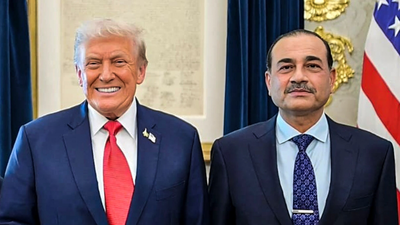
US president Donald Trump spoke with Pakistan army chief Asim Munir earlier this week as Islamabad is attempting to position itself as a key mediator in the ongoing US-Israel-Iran conflict. Meanwhile, Pakistani prime minister Muhammad Shehbaz Sharif held a separate call with Iranian president Masoud Pezeshkian on Monday, according to officials familiar with the discussions.The talks coincided with Trump’s announcement of a five-day suspension of his threat to strike Iran’s power plants, following what he described as “very good and productive” conversations with Tehran aimed at ending the war. The White House, however, cautioned that no formal negotiations are underway and nothing is concrete as of yet. “These are sensitive diplomatic discussions and the United States will not negotiate through the news media,” it said. While Trump’s posts on Truth Social temporarily pushed oil prices down, it remains unclear if Pakistan’s mediation efforts were directly linked to the market movement. Analysts note that the conflict and stalled diplomatic channels continue to keep the region on edge.
Pakistan offers Islamabad as potential venue
Two officials familiar with the talks told Financial Times Pakistan has offered its capital as a venue for discussions between senior US figures, including US vice president JD Vance, Trump’s envoys Steve Witkoff and Jared Kushner, and Iranian officials.“While sharing with the Iranian President the diplomatic outreach efforts of Pakistan’s leadership, the prime minister assured the Iranian leadership that Pakistan would continue to play a constructive role in facilitating peace,” Pakistan said in a readout of the call.
Regional powers engage behind the scenes
Other regional players are also working to de-escalate tensions. Turkey, which had been involved in mediation before the war, has held talks with Iranian officials and Trump’s envoy Steve Witkoff to secure a temporary ceasefire. Pakistan’s foreign minister Ishaq Dar spoke with Turkish counterpart Hakan Fidan on Monday, while Egypt’s foreign minister Badr Abdelatty held separate conversations with his Iranian and Pakistani counterparts over the weekend.Iran, however, denied direct negotiations with the US. “Over the past few days, messages were received via certain friendly states conveying the US request for negotiations to end the war,” Iranian foreign ministry spokesperson Esmaeil Baqaei told official news agency IRNA, according to FT.“Appropriate responses were given [to those initiatives] in accordance with the country’s fundamental positions.” He added that Iran’s stance on the Strait of Hormuz and its conditions for ending the conflict remain unchanged.
Experts remain skeptical
Analysts caution that early-stage backchannel messaging does not guarantee a breakthrough. Sanam Vakil from Chatham House told FT, “It’s positive to play out what a compromise and agreement might look like, but I don’t see a willingness on either side to compromise. I don’t think Trump can walk away from this crisis of his making. And I just don’t see Iran caving. They feel they have the upper hand and the leverage, this is again about their survival and the conditions that will assure their survival.”Past mediation efforts, often facilitated by Oman and Qatar, stalled after the US and Israel launched the war just two days following a round of talks between the Trump administration and Iranian officials in Geneva. Officials said senior Pakistani officials have been back-channeling communications between Tehran and US envoys, ensuring ongoing dialogue.
Pakistan’s dilemma
Pakistan’s position is strengthened by its geopolitical standing. It hosts no US military bases and has largely been spared Iranian missile and drone strikes, making it an intermediary for both sides. Islamabad also has the world’s second-largest Shia population after Iran and maintains close ties with Gulf states, including a defence pact with Saudi Arabia.The defence pact with Riyadh is another contention for Islamabad to deal with. According to the pact it supposedly considers attack on one as attack on all, similar to Nato’s article 5, but the specifics of the deal remain vague. Ever since the war in the Middle East began Islamabad has pursued cautious diplomacy, condemning the strikes on Iran, while simultaneously urging de-escalation. But analysts warn it cannot remain insulated from competing pressures.However, the country remains highly dependent on oil and gas imports from the Gulf, making stability in the region crucial. Iran’s supreme leader Ayatollah Mojtaba Khamenei even acknowledged Pakistan in a message for the Iranian New Year, saying he has a special feeling toward the people of Pakistan.While Trump has paused immediate military threats and Iran maintains a firm stance, Pakistan’s mediation efforts illustrate the limited channels available for conflict de-escalation.