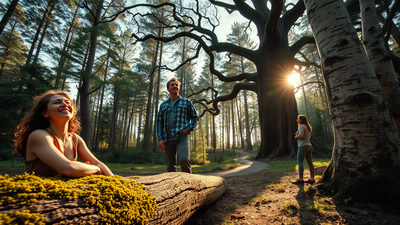
Forest bathing sounds like an ancient tradition, but it is actually younger than the personal computer. The practice known as shinrin-yoku was coined in Japan in 1982, not passed down through centuries. It began as a public health idea rather than a spiritual one, aimed at a country that was mostly forest but rapidly urbanising, with a workforce under visible strain. What followed was decades of scientific study into whether walking slowly through forests actually changes anything in the body. Some of that research holds up well, some of it is often stretched far beyond what it actually shows, and understanding the difference matters for anyone curious about what time spent among trees really does.
Origins of the forest bathing practice in Japan
The term shinrin-yoku was introduced by Tomohide Akiyama, who headed Japan’s Ministry of Agriculture, Forestry and Fisheries at the time. It roughly translates to taking in the atmosphere of the forest. Japan is covered by forest across roughly two-thirds of its land, and by the early 1980s, the country had urbanised quickly under an intense work culture. Akiyama’s idea connected two separate problems, an underused stock of national forest and a population showing clear signs of stress from city life. The concept was less about tradition and more about giving people a practical reason to use the forests already around them.
What the physiological studies on stress actually found
The most cited research on the physical effects of forest walks comes from a team led by Bum-Jin Park and Yoshifumi Miyazaki, who conducted field experiments across 24 forests in Japan. Participants walked through and viewed a forest on one day and an urban area on another. The team measured saliva cortisol levels, blood pressure, pulse rate and heart rate variability, a common marker of the balance between the body’s stress and rest systems, detailed in their published work in Environmental Health and Preventive Medicine. On average, cortisol and pulse readings were lower in the forest setting, and heart rate variability shifted toward a calmer state. The effect was real, though the sample leaned heavily toward young men and captured only a short walk rather than long-term health outcomes.
Why the immune system claims need more caution
Much of the popular claim that forest bathing boosts immunity traces back to work by Qing Li, an immunologist at Nippon Medical School in Tokyo. In an early study published in the International Journal of Immunopathology and Pharmacology, twelve healthy men were taken on a three-day forest trip and their natural killer cell activity, a type of white blood cell involved in fighting infection and tumours, was measured before and after. Activity increased. A follow-up study comparing a forest trip with a city trip, published in a paper, found that only the forest trip produced the rise, with effects reported to last more than seven days, and linked the change to airborne compounds released by trees called phytoncides. This is the origin of the widely repeated figure that natural killer cell activity rises by around fifty per cent after forest exposure. The number comes from very small groups of participants, without blinding, and without a control group in the earliest study, which makes it a starting point for further research rather than firm proof of disease protection.
What systematic reviews say about the overall evidence
Independent reviews of the field have been far more cautious than popular coverage. A 2019 systematic review published in Environmental Health and Preventive Medicine examined 28 studies and found the quality of evidence uneven, with randomised trials scoring notably higher than other designs.A more recent systematic review and meta-analysis published in Frontiers in Psychology in January 2026 applied the standard GRADE framework used to judge medical evidence and rated certainty across every outcome studied as very low, largely due to inconsistency and risk of bias across the available studies.
The modest but meaningful takeaway from the research
None of this means forest bathing does nothing. It suggests the research base is thinner than headlines often imply, with samples that skew young or male and study designs that are difficult to blind, since people who agree to spend a day in a forest may already differ from those who do not. What does hold up consistently is a smaller and more useful finding, that short periods in natural settings tend to leave people calmer, both by their own reporting and on some short term physical measures. Seen this way, Akiyama’s original policy looks practical rather than mystical, since it simply gave a stressed urban population a reason to use the forests they already had. For anyone managing an existing health condition, time in a forest can be a pleasant addition to daily life, though nothing in the current research suggests it should replace medical care.