Iyer also said the housing finance company expects net interest margins (NIMs) to remain stable at around 3.75% this year while maintaining a credit cost guidance of 10 basis points. Can Fin Homes plans to further diversify beyond southern India by expanding its branch network in the north and west over the next few years.
In the June quarter (Q1FY27), Can Fin Homes reported a 17.6% year-on-year increase in net interest income (NII) to ₹427 crore from ₹363 crore, while profit after tax (PAT) rose 20.2% to ₹268 crore from ₹223 crore.
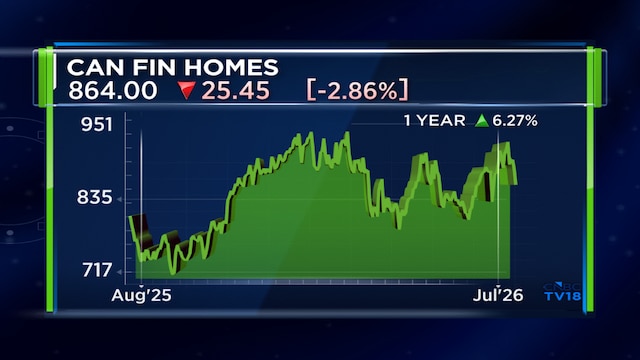
Shares of the Bengaluru-based housing finance company have gained nearly 7% over the past year, taking its market capitalisation to around ₹11,495 crore.
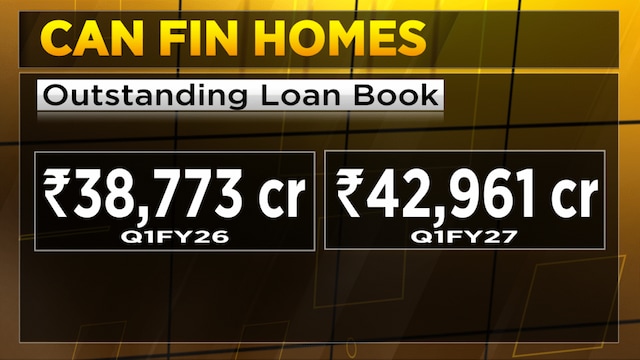
This is an edited transcript of the interview.Q: You are growing approvals quite fast and disbursements are up nearly 30%. Why isn’t that translating into faster AUM growth, which is at 11%? Could FY27 be much better?
A: In terms of our AUM projections, we have targeted 14% growth for the full year. Last year, we ended with around 10.4%, so on a quarter-on-quarter basis, you will see a slight improvement as we move forward. We expect to end the year with around 14% AUM growth.
One of the reasons why disbursement growth is not translating into AUM growth is that we also have loan run-downs. This quarter, the run-downs have been slightly higher.
Last quarter, we shifted a large portion of our portfolio from an annual reset to a quarterly reset. As a result, the interest rate benefit was passed on by keeping EMIs steady while shortening loan tenure. This increased amortisation during the quarter.
So, it is not because of balance transfers or prepayments. It is mainly the higher amortisation impact during this quarter.
Q: Your gross and net non-performing asset (NPA) ratios have improved year-on-year, but there has been a sequential uptick. What happened, and what is your guidance for the full year?
A: If you look at the cyclical trend, every year the first quarter sees a slight increase in NPAs.
However, if you look at Stage 2 and Stage 3 assets together— special mention account (SMA-1), SMA-2 and NPAs—there has actually been a reduction compared with March.
A larger portion of the SMA-2 book has moved into NPAs. To some extent, this was intentional so that we have the full year to work on Securitisation and Reconstruction of Financial Assets and Enforcement of Security Interest Act. (SARFAESI) accounts and recoveries.
Overall, SMA-1, SMA-2 and NPAs together have declined in absolute terms compared with March, which is an improvement.
For the full year, our credit cost guidance remains 10 basis points. Last year also, we guided for 10 basis points and ended at that level. We do not expect this year’s credit cost to be any different.
 Q: You have guided for 14% AUM growth and 10 basis points of credit cost. What is your outlook on yields and NIMs, given the interest rate trajectory?
A: As I mentioned, a large part of our loan book moved from annual reset to quarterly reset, and we passed on the interest rate benefit with effect from April 1.
During the January-March quarter of 2026 (Q4FY26), we had guided that the yield on the overall loan book would be around 9.81%, and we have maintained that for the full quarter. At the end of the first quarter, our yield remains 9.81%.
Our NIM guidance continues to be 3.75% for the year. We ended this quarter at 3.81%, and we continue to maintain our full-year guidance of 3.75%.
Q: Incremental loans continue to come largely from southern India. Are you looking to remain concentrated there or diversify geographically? Also, your loan mix is shifting towards higher-ticket loans. Are these conscious decisions?
A: Our southern concentration has actually been coming down over time. Over the last three years, our branch expansion strategy has focused on opening more branches in the north and west. Since we are traditionally a south-based player with a larger presence across the five southern states, our southern exposure was around 72% three years ago.
We have now brought it down to below 65%, and we intend to reduce it further to around 60% by 2027-28 (FY28). So, going forward, we expect the rest of India to contribute more to our business. This year, we plan to open 28 branches, with the majority located in the north and west.
As for ticket sizes, they have increased mainly because construction costs have gone up and inflation has pushed property prices higher.
In addition, Bengaluru and Hyderabad, where we typically have higher-ticket loans, were affected over the past one-and-a-half years by issues such as e-Khata and HYDRA -Hyderabad Disaster Response and Assets Monitoring and Protection. Those markets are now recovering.
This year, Karnataka grew 18%, which was actually the lowest growth among all our regions. Markets with higher-ticket loans have started performing better, which is why our average ticket size has increased.
Q: RBI’s new guidelines on stressed non-financial assets impose a seven-year holding limit. Will you have to dispose of any legacy assets because of these rules?
A: These guidelines mainly relate to NPA assets acquired under the SARFAESI Act. Normally, we do not hold such assets for very long.
Also, the guidelines apply only when assets are transferred into the lender’s own name, which we generally do not do. Under SARFAESI, we have the legal authority to sell the assets without transferring ownership to ourselves.
Watch the full conversation here

As soon as an account becomes an NPA, we initiate the sale process. Usually, after one or two auctions or advertisements, we are able to dispose of the property.
Typically, we hold such assets for only two to three years, so a seven-year window is quite long. I believe it is fair, and I do not expect these guidelines to have any meaningful impact on us.
Catch all the latest updates from the stock market here