
Oil prices hit their highest level since early June overnight, with global benchmark Brent crude briefly topping $90 a barrel before retreating again. But, after plenty of nervousness last week over fighting in the Middle East and the wobbly AI trade, futures suggest U.S. stocks will start the new week on a strong footing. Earnings from Tesla, Intel, American Express, Verizon and Google parent Alphabet will give investors plenty to think about over the coming days.
📈 Follow our live markets data and coverage.
It’s hard to be different
Mutual-fund managers can’t catch a break, and maybe they never will. At least now they have a better excuse.
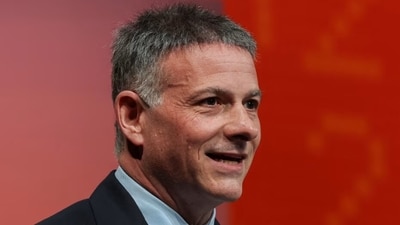
Hedge-fund manager David Einhorn caused a stir two years ago when he called markets “fundamentally broken.” Money regularly comes out of paychecks and pours into index funds tracking the S&P 500, buying stocks with no regard to value—only their weighting.
Index funds are much cheaper than active funds so they tend to outperform most of them after expenses. But, according to Einhorn and others, people who buy them don’t realize that it’s increasingly the weight of their cash, not research by a shrinking group of people like him, behind some companies’ rich valuations.
“They’re gonna assume everybody else’s done the work,” said Einhorn.
Index fund fans counter that claims of distortion are mostly sour grapes from fund managers struggling to outperform. For one thing, index funds do little trading of their own. Active managers’ jobs might even get easier as they scrap over a smaller slice of the market.
If anything, though, the opposite is happening. Last year, four in every five U.S. stock mutual funds couldn’t beat the S&P 500.
Now an award-winning paper by University of California Ph.D. student Hannah Unterberg helps explain why. She doesn’t argue that markets are broken, but her research shows that passive funds’ rise really does make active managers’ lives harder.
Active fund managers are supposed to find stocks that have been overlooked by the index. But when they face redemptions and they have to sell, then those stocks face “asymmetric price pressure,” according to Unterberg.
In plain English, when money goes from a fund that looks different to the index to one that exactly matches the index, the stocks that the manager favored suffer a little and the ones he or she shunned get a small lift. There’s a buyer for every seller of a stock, of course, but that still has a small effect on performance.
Since fund managers get punished for being different, it seems like the best move for continued employment is to just make their fund a lot like the S&P 500. But Unterberg points out the flaw in that strategy.
“You can decide to become more passive, but then how are you convincing your investors not to just buy an index fund?”
It’s a vicious cycle. As index funds keep winning, more money will flow to them.
Does it still pay to be a good stock picker? In theory it should in the long run. That’s good news for fund managers with understanding investors. Unfortunately, patience is in short supply in the investing world.
This is an edition of the Markets A.M. newsletter, preparing you for the trading day ahead with expert insight into the companies and industries set to move markets. If you’re not subscribed, sign up here.
Stocks I’m Watching
↗️ Alibaba: Shares in the Chinese internet giant rose after it previewed its new AI model, which it said is second only to Anthropic’s Fable 5.
↘️ Ryanair: Shares in the budget airline fell after it reported a drop in first-quarter profit, hit by lower fares and rising fuel costs because of the conflict in the Middle East.
🔎 AMC Entertainment: The movie theater chain is set to report second-quarter earnings ahead of the opening bell.
↘️ Segro: Shares in the U.K. real-estate investment trust slipped in London after Prologis said Segro rejected its takeover bid, the industrial real-estate company’s third attempt to buy it.
↗️ Micron Technology, Marvell Technology, Intel, Advanced Micro Devices: Shares in the chip makers recovered slightly in premarket trading after Friday’s tech selloff, which was triggered by the release of a new model from China’s Moonshot AI.
One Big Chart
America’s biggest food companies have tried everything to win shoppers back. They’ve cut prices, ramped up marketing and added protein to everything from Cheerios to Goldfish. It hasn’t worked, and investors are wisely moving on.
What I’m Reading
Once the Magnificent Seven’s most enthusiastic fans, ordinary investors are looking elsewhere for the next superstar tech stocks. (WSJ)Sky-high deficits threaten the U.S. bond market, writes the Journal’s chief economics commentator, Greg Ip. (WSJ)A corporate crime spree? The Trump administration has moved sharply away from charging companies over their employees’ wrongdoing, recently closing a string of criminal investigations with lenient resolutions or no charges at all. (WSJ)They call her “The Assassin” on Wall Street, and she has a new target. (WSJ)Federal officials accepted pricey gifts from Paramount as the company needed approval for deals. (Pro Publica)
Today in Markets History
📰 On this day in 1969, Neil Armstrong became the first man to walk on the moon. The world watched dumbstruck as the historic event was broadcast live, but Wall Street yawned. The Dow Jones Industrial Average dropped 1.4% the following trading day.
Beyond the Newsroom
WSJ | Buy Side: These are the top cold-brew coffee makers to keep you cool and caffeinated.
About Me
Business and finance have fascinated me for a long time. Before writing this newsletter, I edited The Wall Street Journal’s Heard on the Street team for a decade, wrote two investment books and managed a team of stock analysts at a global investment bank.
The Markets A.M. newsletter prepares you for the trading day ahead, with expert insight into the companies and industries set to move markets. Send your feedback to markets.am@wsj.com (if you’re reading this in your inbox, you can just hit reply). For a recap of the day when the markets close, sign up for Markets P.M.