
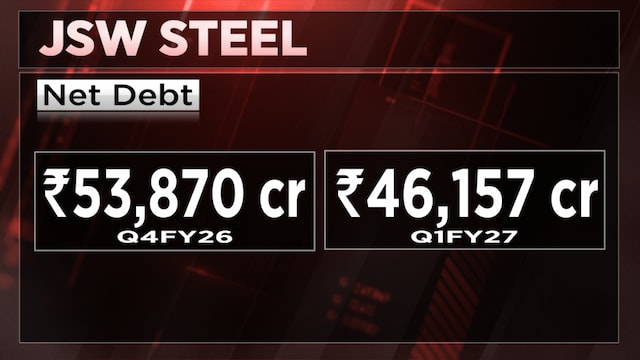
Acharya also said the company remains focused on expanding capacity through its existing brownfield projects and the Paradeep greenfield expansion rather than pursuing acquisitions. He ruled out any equity fundraising, saying JSW Steel is comfortable with its leverage and remains committed to maintaining financial discipline as it works towards its 62 million tonne capacity target by 2031-32 (FY32).
JSW Steel reported the NMDC (Q1FY27), with revenue rising 9.8% year-on-year to ₹47,364 crore from ₹43,147 crore. Earnings before interest, taxes, depreciation and amortisation (EBITDA) increased 24% to ₹9,383 crore, while the EBITDA margin improved to 19.81% from 17.56% a year earlier. Net profit more than doubled, surging 112.6% to ₹4,696 crore from ₹2,209 crore, while other income jumped 106.9% to ₹724 crore from ₹350 crore.
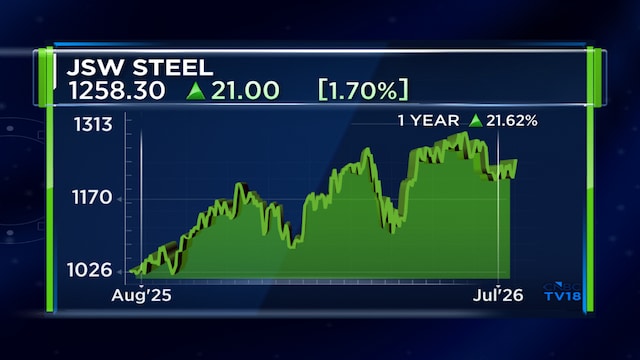
Mumbai-based JSW Steel’s shares have gained nearly 22% over the past year, taking its market capitalisation to around ₹3,08,408.43 crore.
This is an edited transcript of the interview.Q: Give us a couple of details first in terms of the steel price move. What was the increase we saw in April-June quarter of 2026 (Q1FY27)? And given that we are entering a seasonally weak quarter, what’s the trajectory in the July-September quarter of 2026 (Q2FY27)? How much softness are you factoring in?
A: We had a strong operational performance. Our capacity utilisation, excluding BF-3 (Blast Furnace No. 3) which was under shutdown, was 94%. Consolidated sales were helped by a better mix towards flat products and a higher share of value-added and special products, which supported net sales realisation (NSR).
If you recall, steel prices started recovering from January 2026 and continued through March, with that trend spilling over into Q1. As a result, we saw a quarter-on-quarter NSR improvement of roughly ₹6,500 per tonne, which was offset by higher costs and supported by a better product mix, leading to improved returns.
Q: Can you give us more clarity on the price outlook for Q2?
A: Prices for long products had already fallen during the last quarter. In a seasonally weaker monsoon quarter, demand for long products is affected because construction activity slows.
Flat steel prices are also likely to moderate, although not to the same extent as long products. It’s difficult to quantify the exact impact, but costs will increase in Q2 because coking coal prices are moving up. So, there will be both seasonal pressure from the monsoon and higher input costs.
 Q: You mentioned input costs have gone up. Tell us about coking coal prices. You had guided for an increase of around $15 per tonne in Q1. Has that happened? What’s your outlook for Q2?
A: In Q1, our coking coal cost increased by $17 per tonne, slightly higher than our guidance.
For Q2, we estimate another increase of around $12-15 per tonne. While coking coal prices have started easing over the last week or two, most of that benefit will likely be reflected only in the following quarter.
Q: Putting everything together, what’s the EBITDA outlook? Volumes could recover, but Q2 is seasonally weak and coking coal costs are higher.
A: In Q2, you will see higher volumes from JSW Steel as BF-3 at Vijayanagar ramps up and our Ohio operations in the US continue to improve. That should support our overall EBITDA in absolute terms.
On the cost side, coking coal will continue to have some impact. Steel prices are difficult to estimate, so I am not in a position to provide an EBITDA range.
Another positive is that iron ore prices have started declining, both in Odisha and through recent NMDC price cuts. That should provide some benefit during Q2, especially in the latter part of the quarter.
Q: Let’s talk about overseas operations. The US has improved and Italy has also seen better performance. Do you expect both operations to continue improving?
A: Our US operations have performed well. The caster upgrade and vacuum degassing projects are complete, volumes have increased and the unit is ramping up steadily.
The US business reported $16 million EBITDA, compared with virtually break-even in the January-March quarter of 2026 (Q4FY26). In Italy, we reported €7 million EBITDA in Q1 despite an annual shutdown at the rail mill.
Another positive development is that we have signed the Accordo di Programma (ADP) with Italy, which will help fast-track our rail modernisation project. We have also received a €33 million grant, and we expect stronger rail orders going forward.
Both the US and Italy operations should continue improving in Q2.
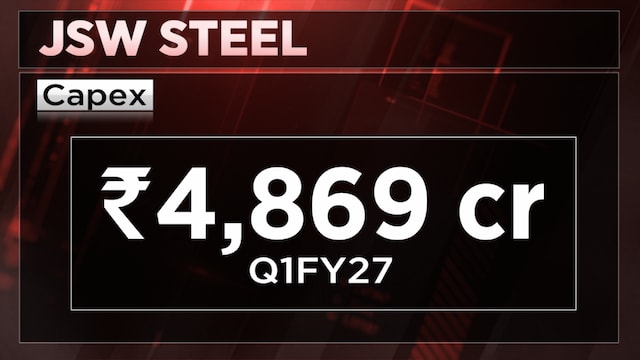 Q: Let’s focus on leverage. The JFE Steel deal has helped reduce debt. What’s the capex outlook? Is there any equity raise or QIP planned?
A: There are no plans for equity fundraising. You’re right that our net debt-to-EBITDA ratio has come down to 1.46 times.
We have said that while we expand capacity and move towards our 62 million tonne target by FY32, we are comfortable keeping net debt-to-EBITDA below 2.5 times. We have achieved that well ahead of schedule and will continue maintaining financial discipline.
Q: Can you share details on the proposed JSW One IPO? How much will JSW Steel sell?
A: JSW One is evaluating various opportunities, including an IPO. At this stage, it’s difficult for us to disclose more. We will wait until the prospectus is filed before sharing further details.
Watch the full conversation here

Q: You have outlined your capacity expansion plans. With Vedanta Steel & Iron now demerged, would JSW Steel consider acquiring those assets?
A: Our growth roadmap from 30 million tonne to 62 million tonne is primarily through brownfield expansion and the modular greenfield project at Paradeep.
We believe our investment cost is among the most competitive in the industry, allowing us to build world-class facilities efficiently.
Our focus remains on executing these expansion projects. We would only consider an acquisition if an asset is exceptionally attractive. As of now, our priority continues to be our planned brownfield expansion.
Catch all the latest updates from the stock market here